A Guide On How To get Your Vehicle Scrapped In 2026
Here is a step-by-step guide to get your old vehicle scrapped and make some quick cash
By Salil Kumar
Published February 6, 2026
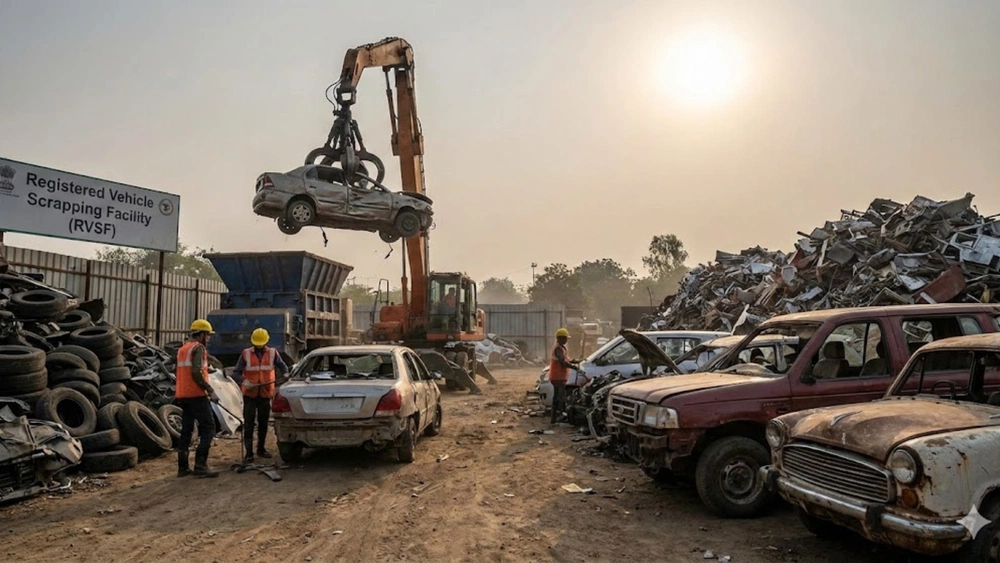
Table of Contents
- What is the Vehicle Scrappage Policy?
- Eligibility Criteria for Scrapping a Vehicle
- How Much Do I have To Pay For Vehicle Scrappage
- Forms and Paperwork for Scrappage
- Benefits of the Vehicle Scrappage Policy
- How to Scrap Your Vehicle: The Step-by-Step Guide
So, We recently to get a new Nexon for our team after selling my old one to CARS24. One of our teammates also had an old Santro which he decided to get scrapped to get the max benefit on our Nexon (review soon), Here is a detailed guide that could help you if you are about to do the same.
Lets start with the basics first !
What is the Vehicle Scrappage Policy?
India's Vehicle Scrappage Policy, officially launched in 2021 by the Ministry of Road Transport and Highways (MoRTH), is a government initiative aimed at phasing out old, polluting vehicles from the roads. The idea is simple: encourage owners to scrap their aging cars, bikes, or commercial vehicles in exchange for incentives like discounts on new ones, tax rebates, and a cleaner environment. I
Think of it as a retirement plan for your ride when it's too old and inefficient, you send it off with some perks instead of letting it rust away.
In essence, the policy targets vehicles over 15-20 years old (depending on the type) that fail fitness tests. It's voluntary for private vehicles but mandatory for commercial ones in certain cases. Since its rollout, it's evolved with amendments, like integrating it with the Central Motor Vehicles Rules, and by 2026, more states have ramped up implementation with registered scrapping facilities popping up nationwide.
Also Read- Govt Doubles Renewal Fees for 20+ Year Old Cars and Bikes
Eligibility Criteria for Scrapping a Vehicle
Not every vehicle qualifies for scrappage—it's designed for those that are past their prime. Generally, private vehicles like cars and bikes become eligible once they cross the 20-year mark, while commercial vehicles are scrutinized after 15 years. However, age isn't the only factor; the vehicle must fail an automated fitness test at a registered center.
If your car is an "old soul" but still runs like a dream and passes the test, you can technically keep it on the road for another few years, though the re-registration fees are significantly higher to discourage this.
To participate, you must be the registered owner with a valid Registration Certificate (RC) and insurance, ensuring there are no pending legal hurdles like unpaid fines or active bank loans. While the policy covers everything from two-wheelers to heavy-duty trucks, certain categories like electric vehicles or hybrids are currently excluded because they already meet modern emission standards.
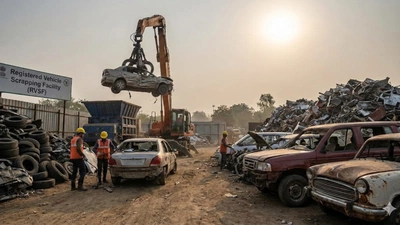
The entire eligibility check is handled at Registered Vehicle Scrapping Facilities (RVSFs), making the process official and transparent. Here are some key pointers
Diesel Vehicle Age: Must be older than 10 years (specifically for NCR).
Petrol/CNG Vehicle Age: Must be older than 15 years (specifically for NCR).
Fitness Status: Any vehicle that has failed the automated fitness test or has an expired registration that cannot be renewed.
Damage Condition: Vehicles deemed unrepairable due to accidents, fire, or natural disasters.
Ownership Title: You must be the registered owner or have a legal heir certificate.
Financial Clearance: Must have a No Objection Certificate (NOC) from the bank if there was a loan.
Challan Status: All pending traffic fines and court challans must be paid in full.
Tax Compliance: All road taxes must be cleared and up to date with the RTO.
Legal Status: The vehicle must not be involved in any active police cases, thefts, or litigation.
Documentation: You must possess the Original RC, a copy of your Aadhaar/PAN, and a cancelled cheque for payment.
How Much Do I have To Pay For Vehicle Scrappage
While the policy is designed to save you money, there are some upfront costs to keep in mind. Scrapping fees generally range from ₹1,000 for a small two-wheeler to over ₹10,000 for heavy commercial vehicles, depending on the facility and the size of the ride. In almost all the case syou have to pay zero fees ( I did not have to pay a thing while scrapping my Santro, tow was arranged by facility closeby), Still these charges below might apply
Processing Fee:₹1,000 – ₹2,500 charged by the scrapping center for dismantling and hazardous waste disposal.
Towing Charges:₹500 – ₹3,000 if the vehicle is non-functional (often free if the center is nearby).
RTO Deregistration Fee:₹200 – ₹500 for the official cancellation of your vehicle's records.
Certificate of Deposit Fee:₹300 – ₹500 for the issuance of the digital certificate required for new car discounts.
Hypothecation Removal:₹100 – ₹1,500 to clear the bank's name if the car was previously on a loan.
Duplicate RC Fee:₹500 – ₹1,500 only if you have lost your original registration papers.
Green Tax Arrears:₹1,500 – ₹3,000 for any unpaid environmental taxes due on older vehicles.
Pending Traffic Challans:Variable (must pay 100% of all outstanding fines before the RTO approves scrapping).
Road Tax Penalties: Variable (any unpaid state road tax must be cleared with late interest).
Forms and Paperwork for Scrappage
To legally scrap your vehicle in 2026, the paperwork is primarily managed through the government’s Scrap Parivahan portal, which has digitized the old manual RTO processes. You begin by submitting Form 2, the official application for scrapping, which requires you to upload your Aadhaar, PAN, and a cancelled cheque for the scrap value payout.
Once the Registered Vehicle Scrapping Facility (RVSF) accepts the request and you handover the Original Registration Certificate (RC), they are required to "deface" the RC (typically by punching holes in it) in your presence.
Note- There is no physical form or paperwork required every form and registration is done through the VAHAN portal.
Benefits of the Vehicle Scrappage Policy
The perks of this policy are multi-layered, benefiting your wallet, the industry, and the planet. For the owner, the biggest draw is the financial incentive: manufacturers often provide a 5% discount on new vehicles just for showing a CoD, and many states offer a road tax rebate of up to 25%. On a macro level, it forces a "fleet renewal," replacing old engines that emit 10 to 12 times more pollutants than modern BS-VI engines.
Beyond the individual, the policy acts as a massive recycling engine. By dismantling cars in a controlled environment, we recover high-quality steel, aluminum, and rubber, which reduces the need for expensive raw material imports. It’s also a safety win; older cars lack the structural integrity and safety features (like airbags and ABS) that are standard today, so removing them makes the roads safer for everyone.
Manufacturer Discount: Direct 5% discount on the ex-showroom price of your new vehicle (Maruti, Tata, Mahindra, and others have officially agreed to this).
Registration Fee Waiver: Complete exemption from paying registration fees on your new car (saving you approximately ₹5,000 to ₹20,000 depending on the model).
Road Tax Rebate: Up to 25% concession on the road tax for new private vehicles (and up to 15% for commercial vehicles).
Scrap Value Payout: Instant cash or cheque for 4% to 6% of the ex-showroom value of the car being scrapped (calculated based on its curb weight). Usually rate is between ₹15 to ₹40 per kg depending on how much steel or aluminum is used in the car
Scrappage Benefits by carmaker
Maruti Suzuki offers a tiered scrappage bonus ranging from ₹20,000 to ₹30,000. Specifically, models like the Alto K10 and WagonR attract a ₹20,000 benefit, while premium Nexa models like the Invicto or Grand Vitara offer up to ₹30,000. Note: This is usually an alternative to the standard exchange bonus, not an addition.
Tata Motors provides a discount of 1.5% of the ex-showroom price or a fixed bonus. For popular SUVs like the Nexon, Harrier, and Safari, the official benefit is capped at ₹35,000. For commercial vehicles, Tata offers a significantly higher incentive of 3% of the ex-showroom price.
Hyundai India offers a flat scrappage bonus of ₹20,000 for most models (Venue, Creta, i20). For their flagship electric or premium models like the Ioniq 5 or Tucson, the incentive can be pushed up to ₹50,000 as a "Green Bonus" linked to the scrappage certificate.
Mahindra & Mahindra adheres to the official industry standard of 1.5% of the ex-showroom price or ₹20,000 (whichever is lower) for the XUV and Scorpio range. For heavy commercial vehicles (over 3.5 tonnes), they offer a 3% discount on the new purchase.
Kia India provides a dedicated scrappage incentive of ₹20,000 across the Seltos, Carens, and Sonet lineup. This is strictly a "scrappage-only" benefit that cannot be clubbed with their internal exchange loyalty programs.
Toyota Kirloskar Motor offers benefits of up to ₹40,000 on hybrid models like the Hyryder and Innova Hycross. For the Glanza, the benefit is capped at ₹20,000. Toyota’s policy heavily favors customers moving from old ICE vehicles to new Strong Hybrids.
Honda, Renault & Nissan offer a flat scrappage incentive of ₹20,000. Renault specifically promotes this through its "RELIVE" program, which helps handle the paperwork and vehicle pickup on behalf of the customer.
Mercedes-Benz India is the only luxury carmaker to offer a flat cash incentive. They provide a ₹25,000 discount over and above any ongoing monthly offers if you produce a valid scrappage certificate.
BMW, Audi & JLR (Jaguar Land Rover) provide a discount of 1.5% of the ex-showroom price. On a vehicle like the Land Rover Defender or BMW X5 (costing ₹1 Cr+), this results in a mandatory discount of at least ₹1.5 Lakh.
Skoda & Volkswagen offer a scrappage bonus of ₹20,000 for the Kushaq, Slavia, Taigun, and Virtus. This is typically marketed as a "Sustainability Bonus" to encourage the retirement of 15-year-old vehicles.
So by now, you should have a clear understanding of what the vehicle scrappage policy is, including the eligibility criteria, costs, and benefits. Now comes the second part for those who have decided to go ahead with the scrappage route.
Also Read- All You Need To Know About Vehicle Fitness Fees Increase
How to Scrap Your Vehicle: The Step-by-Step Guide
Step 1: Visit the Parivahan Sewa website at parivahan.gov.in.
Step 2: Under the 'Online Services' tab, select 'Vehicle Scrapping'.
Step 3: Select your State from the list to see specific local tax rebates.
Step 4: Log in using your mobile number and enter the Vehicle Registration Number and the last 5 digits of your Chassis Number.
Step 5: From the dashboard, select an authorized Registered Vehicle Scrapping Facility (RVSF) near you.
Step 6: Submit Form 1 digitally and upload your documents (RC, ID, etc.).
Step 7: Schedule a pickup or drop-off for physical verification at the facility.
Step 8: Once the RVSF marks the vehicle as "Accepted," download your Certificate of Deposit (CoD) instantly from your account.
Step 9: Take the COD to a dealership to claim your 5% discount, or use the 'Transfer Certificate' section to sell it to another person.
Note- The step 9 is where I had a bit of an issue, As the Tata dealer I was negotiating with was not giving any more discounts on my new booking with COD (they can do that legally), So I decided to trade or transfer it to another person
Why the Certificates are the Most Important Part
One of the most misunderstood parts of the policy is the paperwork. There isn't just one "scrap paper"—there are two distinct documents that serve very different purposes.
Certificate of Deposit (CoD)-This is what you get the moment you hand over your keys; it represents the value of the vehicle you’ve surrendered. The Certificate of Deposit is essentially a "tradable asset." When you surrender your vehicle at an RVSF, they issue this digital certificate via the VAHAN portal.
Its primary purpose is to act as a voucher for incentives. However, the brilliance of the CoD is that it is linked to the certificate, not necessarily the person. If you scrap an old car but don't intend to buy a new one immediately, you don't have to let those benefits go to waste. You can actually sell or transfer your CoD to someone else who is looking to buy a new vehicle.
You log into the VAHAN portal, navigate to the "Certificate of Deposit" section, and enter the details of the buyer. The system transfers the ownership of the certificate digitally. Do note these certificates are valid for only 3 years from the date of issuance
Certificate of Scrapping- This on the other hand, is the final legal proof that the vehicle has been physically dismantled and no longer exists in the eyes of the law. Just keep it in some safe place
Can I Take My Car To Registered Scrapping Facilities?
You can’t just go to any local junkyard to get these benefits; you must use an authorized RVSF. Large players like Tata Motors (Re.Wi.Re), Maruti Suzuki (CERO), and Mahindra MSTC have set up state-of-the-art hubs across major cities like Delhi-NCR, Mumbai, Pune, and Chennai.
These facilities are audited by the government to ensure they don't leak hazardous fluids like battery acid or engine oil into the ground, a common problem with unauthorized "local" scrappers. You can find the full, updated list of these facilities on the MoRTH or Parivahan websites.
The 2025-2026 Update: What’s Changed?
As of early 2026, the policy has moved from "voluntary" to "enforced through economics." While you aren't forced to scrap a car that passes its fitness test, the government has introduced the Environment Protection (End-of-Life Vehicles) Rules, 2025. This makes manufacturers (OEMs) responsible for the recycling of the cars they build.
Additionally, a new proposal from MoRTH has bumped the potential tax rebate up to 50% for extremely old vehicles (pre-2002 or BS-II compliant), as these are the primary targets for removal. The network has also exploded: there are now 129+ Registered Scrapping Facilities (RVSFs) across 21 states.
Also Read- How to Get Your Vehicle's RC Extended
Commonly Asked Questions
I can’t find my chassis and vehicle number?
You can find your vehicle registration number on your number plate or your Registration Certificate (RC). The chassis number is usually engraved on the vehicle's body (near the engine or the driver-side door frame). If the physical plate is unreadable, you can find the full chassis number on your RC or your motor insurance policy document.
My RC has expired?
You can still scrap a vehicle with an expired RC. In fact, the policy is specifically designed to handle vehicles that are past their registration validity. As long as you are the registered owner and can provide the original expired RC (or an indemnity bond/FIR if lost), the Registered Vehicle Scrapping Facility (RVSF) can process the application on the VAHAN portal.
Do I have to visit the RTO?
No, you do not need to visit the RTO. The process is now fully digital and integrated with the VAHAN database. Once the RVSF completes the scrapping process and issues the Scrapping Certificate, the vehicle is automatically marked as "Scrapped" in the RTO records. Your digital records are updated without you having to stand in a single queue.
I don’t want to scrap my car, can I get my RC extended?
Technically, yes, but it is expensive. You must pass a rigorous automated fitness test at an Automated Testing Station (ATS). If the vehicle passes, you can renew the RC for 5 years, but the government has significantly increased the re-registration fees and added a "Green Tax" to discourage keeping old vehicles on the road. If the car fails the fitness test twice, it must be scrapped by law.
What to do with the CoD?
The Certificate of Deposit (CoD) is your financial asset. You have two options:
Redeem it: Show it to a car dealer when buying a new vehicle to get a 5% manufacturer discount and a road tax waiver (up to 25%).
Sell it: If you aren’t buying a new car, you can transfer/sell the CoD to someone else via the VAHAN portal for a cash profit.
What to do with the Scrappage Certificate?
Keep the Scrappage Certificate (CVS) as legal proof that your car no longer exists. It is your ultimate safeguard against any future legal liabilities, misused number plates, or traffic fines involving that vehicle. Unlike the CoD, this certificate is not tradable and is for your records only.
How long does the scrappage process take?
The digital application takes about 15–20 minutes. Once you hand over the vehicle to the RVSF, the Certificate of Deposit (CoD) is usually generated within 24 hours. The final Scrappage Certificate and the physical dismantling of the car typically take 7 to 15 days, depending on the facility's workload.
Can I cancel my scrappage application?
You can cancel the application on the Parivahan portal as long as you have not physically surrendered the vehicle to the RVSF. Once the vehicle is handed over and the "Acceptance" is marked by the scrapper on the portal, the process is irreversible because the digital record is instantly updated.
How is the scrappage price of my car decided?
The price is primarily based on the weight and current market rate of the scrap metal (mostly steel). RVSFs calculate the "Scrap Value" as approximately 6% of the current ex-showroom price of a similar new vehicle. You can negotiate this price slightly between different authorized scrappers based on the condition of high-value parts like the engine, battery, and tires.
What if the original owner of the vehicle has passed away?
If the registered owner is deceased, you cannot scrap the vehicle immediately. You must first legally transfer the ownership to a legal heir. This requires filing Form 31 with the RTO along with a copy of the death certificate, a succession or legal heir certificate, and an NOC from all other potential heirs. Once the RC is transferred to your name, you can then proceed with the digital scrapping application on the VAHAN portal as the new registered owner.
Can I scrap a car that has pending traffic challans?
No, the system will block the de-registration process if there are active encumbrances. In the 2026 digital workflow, the RTO will not issue a final Scrappage Certificate until all outstanding fines are settled. You must visit the E-Challan Parivahan portal to pay off any pending dues. Once the "Pending" status is cleared from the national database (usually within 24–48 hours), you can proceed with the scrapping request.
What do I do if my car is not in running condition?
You do not need to worry about driving a non-functional car to the facility. Most authorized Registered Vehicle Scrapping Facilities (RVSFs) like CERO or Tata Re.Wi.Re offer free or subsidized towing services for "End-of-Life Vehicles" (ELVs). When you book your appointment on the portal, simply select the pickup option; the facility will send a tow truck to your location to collect the vehicle and verify the chassis number on the spot before hauling it away
Helpful Links
Vahan Portal
Official How to PDF By Ministry of Transport
Maruti Suzuki/Toyota Official Scrapper
Image Source- Gemini Nano Banana, MOT
Write a comment
Comments
No comments yet. Be the first to comment!