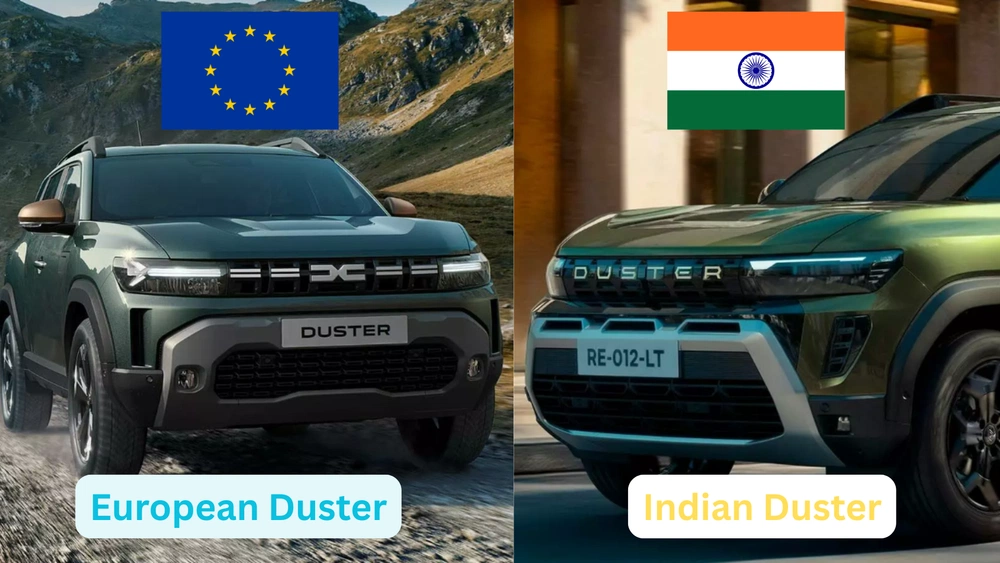
I like the interior design of UK spec Duster more with its sharper AC vents and rugged appeal, but the India version gets more soft touch materials. Also, the exterior design of global Duster is pretty spot on and didn't require any fiddling. It glbal spec model's DRL signature looks way sharper than what we get here but the India one does the rear lights better!
Apart from that here is everything that India Duster misses out on.
| Missing Feature | Global Duster | Indian Duster |
|---|---|---|
| AWD / 4x4 System | Available with terrain control | Not available (FWD only) |
| Off-Road Drive Modes | Snow, Mud/Sand, Offroad modes | Not available |
| Hill Descent Control | Available on AWD trims | Not available |
| Ground Clearance (AWD spec) | Up to 217 mm | ~212 mm |
| Approach Angle | Up to 31° | ~26.9° |
| Standard Boot Space | 594 litres | 518 litres |
| Diesel Engine Option | Available in select markets | Not offered |
Exterior Design
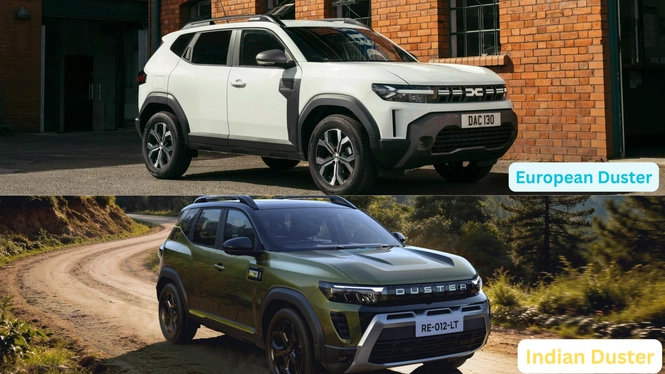
The Indian-spec Renault Duster takes the global Dacia Duster as its foundation but adapts it significantly for local preferences, resulting in a bolder, more premium appearance that stands out in the Indian compact SUV segment.
It features a prominent "Duster" lettering integrated into the grille (replacing the traditional Renault diamond in some views), sharper and more aggressive LED headlights without the exact Y-shaped DRL pattern seen globally, a full-width connected LED light bar at the rear, C-shaped taillamps with clear lenses, oversized skid plates for a rugged touch, Renault-badged door accents, and options for two-tone color schemes with vibrant accents. This gives it a more commanding road presence suited to Indian highways and urban chaos, often with colorful highlights that appeal to buyers looking for something flashy yet tough.
In contrast, the global Dacia Duster maintains a cleaner, more minimalist European design philosophy, think sharp Y-shaped DRLs, squared-off wheel arches, and a focus on functional ruggedness without extra flair.
The Indian version is reportedly slightly taller (by about 4 cm in some accounts) to accommodate features like a larger glass roof, which enhances cabin airiness but slightly alters proportions compared to the global model's more compact, off-road-optimized stance. While the core silhouette remains similar, the Indian Duster misses the global's understated, no-nonsense aesthetic, trading it for a more market-specific boldness that prioritizes visual impact over pure minimalism.
Interior Layout and Quality
Inside, the Indian Duster 2026 feels like a major step up in perceived quality and modernity, clearly designed with Indian family buyers in mind. It boasts a twin-screen setup, a large 10.1-inch portrait-style touchscreen infotainment display paired with a 10.25-inch digital instrument cluster, positioned in a higher, more driver-centric console layout.
Soft-touch materials cover much of the dashboard and doors, ambient lighting adds a premium glow, leatherette upholstery feels upscale, and redesigned air vents contribute to a cleaner, more sophisticated cabin atmosphere. The addition of a panoramic sunroof (often standard or widely available) floods the interior with light, making it feel more spacious and airy.
The global Dacia Duster, on the other hand, sticks to a more straightforward, utilitarian layout with less emphasis on luxury touches, simpler materials, a less elaborate screen configuration in base trims, and no widespread panoramic roof or extensive soft-touch coverage.
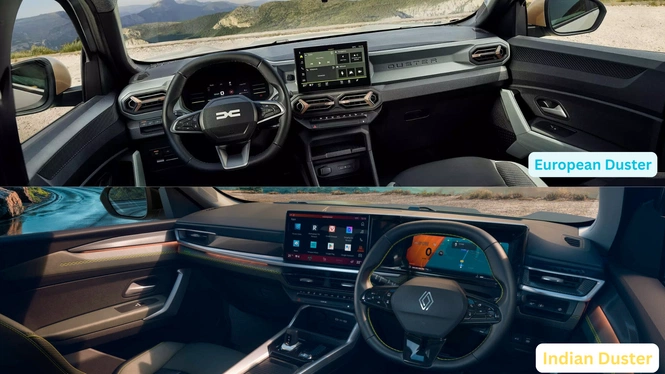
While both share the same basic architecture, the Indian version elevates the experience noticeably, with better seat comfort, ventilated front seats in higher variants, and thoughtful storage solutions tailored for Indian use. This means the Indian Duster doesn't really miss out here; instead, it gains a more refined and feature-rich cabin that punches above its segment in perceived quality.
Renault has loaded the Indian Duster with a generous suite of modern tech to compete head-on with rivals like the Hyundai Creta and Kia Seltos.
Highlights include 6 airbags, Google-built-in infotainment with Gemini AI voice assistance, native navigation, wireless Android Auto and Apple CarPlay, Arkamys-tuned audio, dual-zone climate control, wireless charging, a 360-degree camera, and a comprehensive Level-2 ADAS package covering adaptive cruise control, lane-keep assist, blind-spot monitoring, automatic emergency braking, and driver attention alerts.
Globally, the Dacia Duster offers solid basics like connectivity and some ADAS in higher trims, but it rarely matches the Indian model's depth of integration, such as the full Google ecosystem, panoramic sunroof as a common fitment, ventilated seats, or the extensive safety net.
The Indian version actually surpasses many global specs in premium conveniences, meaning it misses very little (if anything) in this area and often gains an edge for tech-savvy buyers who want a loaded package without jumping to higher price brackets.
Drivetrain, Off-Road Capability, and Practicality
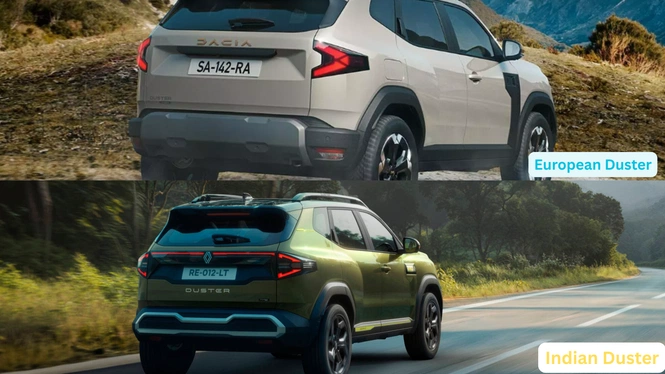
The biggest compromise in the Indian Duster is its strict front-wheel-drive configuration, no all-wheel-drive or 4x4 option is available at launch, unlike global Dacia versions where mild-hybrid trims can include 4x4 with dedicated modes for snow, mud, sand, and off-road use, providing superior traction on slippery or uneven surfaces.
Ground clearance hovers around 210 to 212 mm with approach and departure angles in the mid-to-high 20s to low 30s, solid for urban potholes and light bad roads but less capable than global AWD models' higher clearance and better angles with reinforced protection.
Boot space is practical at around 518 liters (to the parcel shelf) or up to 700 liters to the roof, though slightly reduced compared to the global non-hybrid's 594 liters or more, likely due to packaging for hybrid components or the electric tailgate.
Image source- Renault UK,Renault India, Wikimedia commons for flags
Table of Contents
- Exterior Design
- Interior Layout and Quality
- Drivetrain, Off-Road Capability, and Practicality
Join the Conversation
Trending
Skoda Navratri and Diwali Season Offers in October 2026
Skoda is offering benefits of up to Rs. 90,000 on the Kylaq, Rs. 80,000 on the Kushaq and Rs. 30,000 on the Slavia in October 2026. The offers include dealer discounts, exchange bonuses, and corporate or loyalty benefits.
Anmol Kumar
October 17, 2026
Renault Duster E-Tech 160 Hybrid Explained
The Renault Duster E-Tech 160 strong hybrid combines a 1.8-litre petrol engine with two electric motors, delivering 160 PS and a claimed 29 kmpl. Here is how it compares with the Maruti Suzuki Grand Vitara strong hybrid.
Salil Kumar
October 17, 2026
Renault Duster Strong Hybrid Launched At Rs. 16.99 Lakh With 160 PS, 29 km/l Mileage
The Renault Duster Strong Hybrid E-Tech 160 is priced from Rs. 16.99 lakh and gets a 1.8-litre petrol engine, two electric motors and a 1.4 kWh battery. It claims 29 kmpl mileage, with deliveries starting November 6, 2026.
Anmol Kumar
October 17, 2026

Featured
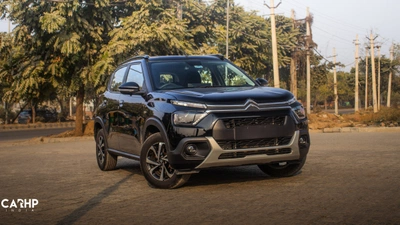
Citroen C3 Review: Who Should Consider This Car?
A few days ago, I took the Citroen C3X out for a spin in the city and on the highways. I travelled long distances and checked its fuel efficiency, features, comfort, and other factors. Today, I’ll briefly share my overall experience with the C3X and will tell you whether you should consider it or not and which is the most value-for-money variant of the lot.
Vatsal Agrawal
May 19, 2026
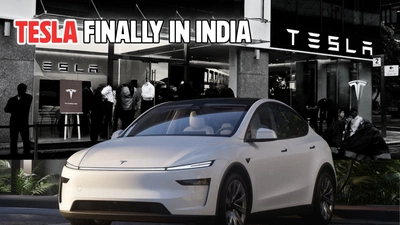
Tesla Finally In India Officially. Why Now And What Does It Mean For EVs?
The much-anticipated 2025 Tesla Model Y has officially arrived in India, marking a pivotal moment for the nation's burgeoning electric vehicle market. Launched on July 15, 2025, the Model Y Juniper facelift offers cutting-edge technology, impressive range, and signature Tesla performance. Positioned as a premium electric SUV, its entry will intensify competition and reshape consumer expectations for EVs across the subcontinent.
Author
July 17, 2025
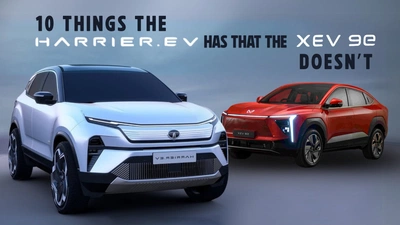
Here Are 10 Things The Harrier.EV Offers That The Mahindra XEV 9E Doesn't
The Harrier.EV is an incredible new offer from Tata. Its most popular competitor would be the Mahindra XEV 9E, priced similarly. With these two incredible offerings from home grown brands available, here is a list of everything the Harrier.EV offers that the XEV 9E doesn't.
Author
June 13, 2025
Write a comment
Comments
No comments yet. Be the first to comment!