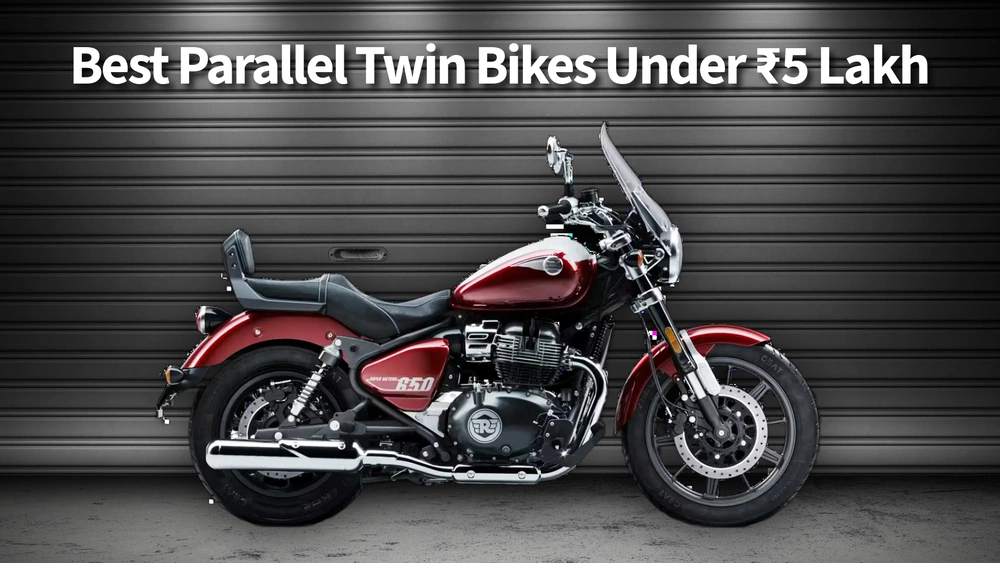
Two years ago, this list would have had three entries. Today, it has ten. The number of affordable parallel-twin offerings has been on the rise, and more are set to follow soon. Many bike makers have realized that not everyone wants the same old stale single-cylinder with just an increase in displacement.
While more exotic inline-four and three-cylinder bikes are still out of reach for many, a parallel-twin with make in India manufacturing, solves every one of those problems.
Here are the most affordable twin-cylinder bikes you can get under 5 lakhs:
| Bike | Price | Engine | Features | Weight |
|---|---|---|---|---|
| Kawasaki Ninja 300 | Rs 3.17L | 296 cc, 39 PS @ 11,000, 26.1 Nm, Liquid | Telescopic 37mm, Analogue + LCD | 179 kg |
| Yamaha MT-03 | Rs 3.30L | 321 cc, 42 PS @ 10,750, 29.5 Nm, Liquid | USD 37mm, LCD | 167 kg |
| Royal Enfield Interceptor 650 | Rs 3.35L | 648 cc, 47 PS @ 7,250, 52.3 Nm, Air/Oil | Telescopic 41mm, Analogue + Digital | 218 kg |
| Yamaha R3 | Rs 3.39L | 321 cc, 42 PS @ 10,750, 29.5 Nm, Liquid | USD, LCD | 169 kg |
| Royal Enfield Continental GT 650 | Rs 3.48L | 648 cc, 47 PS @ 7,250, 52 Nm, Air/Oil | Telescopic 41mm, Analogue + Digital | 214 kg |
| Kawasaki Versys-X 300 | Rs 3.49L | 296 cc, 39 PS @ 11,500, 26 Nm, Liquid | Telescopic,, Digital | 172 kg |
| RE 650 Range (Classic / Bear / Shotgun / Super Meteor) | Rs 3.64 – 4.02L | 648 cc, 47 PS @ 7,250, 52–56.5 Nm, Air/Oil | Varies, Analogue+Digital / TFT | 218–243 kg |
| Aprilia Tuono 457 | Rs 3.97L | 457 cc, 47.6 PS @ 9,400, 43.5 Nm, Liquid | USD 41mm, 5" TFT + BT, 3 modes, TC (3-level, switchable) | 175 kg |
| Aprilia RS 457 | Rs 4.22L | 457 cc, 47.6 PS @ 9,400, 43.5 Nm, Liquid | USD 41mm, 5" TFT + BT, 3 modes, TC (3-level, switchable) | 175 kg |
| BMW F 450 GS (Base) | Rs 4.70L | 420 cc, 48 PS @ 8,750, 43 Nm, Liquid | KYB USD 43mm, 6.5" TFT + BT, 3 modes, TC (cornering) | 178 kg |
Kawasaki Ninja 300
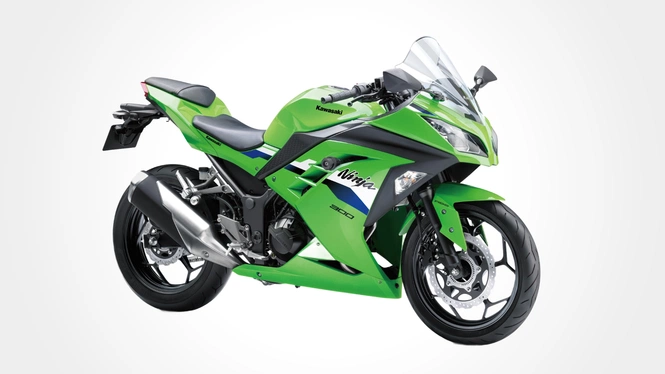
The cheapest parallel twin in India and the oldest design on this list is the Ninja 300 by Kawasaki, which has been around since 2013. Kawasaki has left it largely unchanged because it does not need to change to sell.
The 296cc liquid-cooled engine makes 38.5 hp, but the number that matters more is where it makes it - 11,000 rpm. Meanwhile, the assist and slipper clutch, 290 mm petal disc up front, and dual-channel ABS are all standard.
What the Ninja 300 does not have is anything remotely modern in terms of electronics or display. The instrument cluster is an analogue tachometer (not a con, IMHO, reminiscent of GOAT Version 2 R15) with an LCD panel.
Additionally, there are no riding modes, no traction control, no Bluetooth, no TFT. It is a mechanically honest bike that asks you to ride it rather than manage it, and for a certain kind of buyer that is exactly right.
Consider if -
- You want the cheapest entry into a faired parallel twin and a budget ceiling that nothing else on this list matches.
- You want to build a strong riding discipline only possible form a old school dinosaur like, 300 before moving up to liter class.
Skip if -
- Daily city commuting is the primary use. The engine only rewards you above 7,000 rpm, which traffic makes impossible.
- Modern electronics matter to you. No TFT, no riding modes, no traction control at any price on this bike.
- Your physio is out of town, a very aggressive rider triangle!
Also Read – Upcoming Confirmed Bikes And Scooter In 2026
Yamaha MT-03
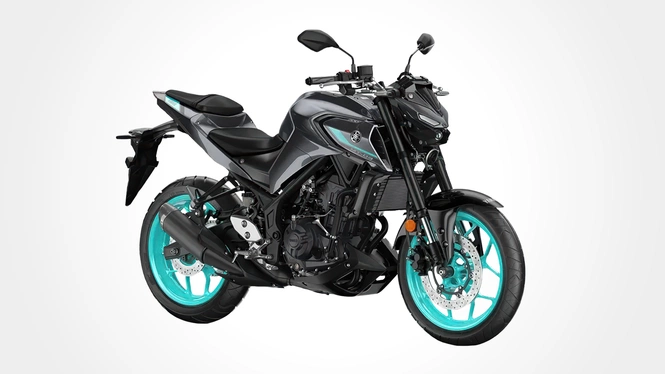
The MT-03 and R3 by Yamaha run the same - 321cc engine, USD front forks, dual-channel ABS, and the same assist and slipper clutch. The MT-03 removes the fairing, raises the handlebar into a naked street position, and costs approx Rs 9,000 less.
The 321cc engine with forged pistons is this bike's best argument against everything else under Rs 3.50 lakh. It is more tractable in city traffic and equally exciting at the top end.
What India gets is the CBU from Indonesia, which is the same unit as the global model - USD forks, slipper clutch, LCD display with gear position indicator.
There is no TFT, no Bluetooth, no riding modes. The LCD is basic but functional.
Against the Aprilia Tuono 457 at Rs 3.97 lakh the nearest naked twin above it, the MT-03 is Rs 67,000 cheaper, 136cc smaller, and missing traction control, riding modes, and the TFT.
Consider if -
- You want the lightest parallel twin on this list at 167 kg it is 51 kg lighter than the Interceptor 650 and genuinely easy to manoeuvre in city conditions.
- The naked upright ergonomics suit daily commuting and the USD forks and slipper clutch give it proper hardware without the faired sportsbike compromise.
Skip if -
- You want riding modes or traction control the MT-03 has ABS and a slipper clutch and nothing else electronically regardless of price.
- You are outside a major metro where Yamaha BigWink service coverage is limited.
Yamaha R3
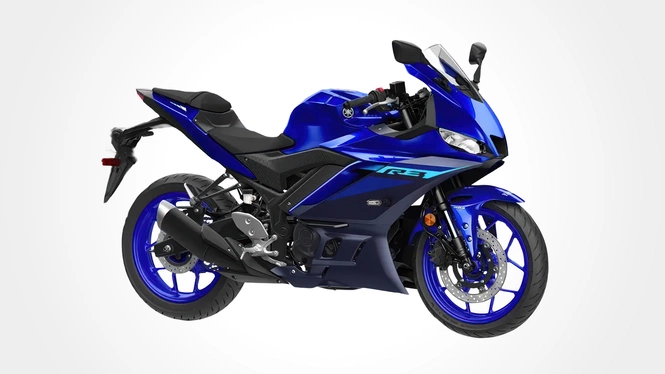
Same engine, same forks, same slipper clutch, same ABS as the MT-03. The R3 adds a full fairing, clip-on handlebars below the top yoke, and a more committed sportsbike riding posture for Rs 9,000 more. The LCD display is the same. The electronics are the same.
The about Rs 22,000 price gap between the ₹3.39L Yamaha R3 and Rs 3.17L Ninja 300 buys you a more modern machine. The R3 offers a larger 321cc engine (+3 PS, +3.4 Nm), premium USD forks, a full LCD console, and is 10kg lighter.
Consider if -
- You want a full-faired sportsbike and the R3's USD forks and more tractable low-rev power band justify the Rs 22,000 premium over the Ninja 300.
- You are in a major metro where Yamaha BigWink service infrastructure makes CBU ownership practical and parts accessible.
Skip if -
- You will primarily use it in city traffic. Clip-on bars and a committed crouch become genuinely uncomfortable in stop-and-go conditions over time.
- You are outside a major metro where CBU servicing and parts sourcing is harder and more expensive than locally assembled bikes.
Also Read – What to Expect from the Yamaha R2
Royal Enfield Interceptor 650
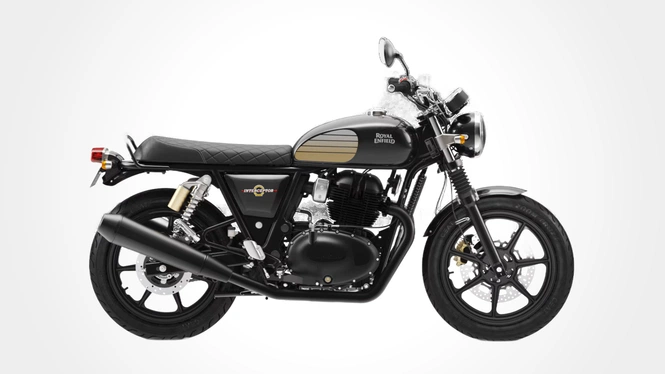
The Interceptor by Royal Enfield launched in 2018 and changed what an affordable parallel twin could be in India. Seven years later, it is still the default recommendation for a first-time parallel twin buyer, and the reason is the engine.
The 648cc engine with a 270-degree crankshaft produces an uneven firing interval that mimics a V-twin's rhythmic pulse. At Rs 3.35 lakh you are getting more displacement, more torque, and more character than anything else on this list except the Bear 650.
The slipper clutch is standard. The instrument cluster is a classic twin-pod analogue-digital unit with no TFT, no riding modes, and no traction control.
The honest trade-off relative to the Yamaha and Kawasaki twins is weight and electronics. The Interceptor weighs 218 kg, significantly more than the 167 kg MT-03 or 169 kg R3 and it has none of the rider aids that the Aprilia twins and BMW offer.
It is a motorcycle that rewards a rider who values engine character, low-speed torque, and relaxed ergonomics over modern technology.
Consider if -
- You want the best engine character. The thumping 648cc is a genuinely special unit that no liquid-cooled 300cc twin can replicate.
- You ride primarily on highways or weekend roads. Royal Enfield's service network density across India, including tier-2 and tier-3 cities matters for long-distance ownership.
- Aftermarket support and community are important to you. The Interceptor has one of the largest owner ecosystems of any motorcycle in India.
Skip if -
- You want riding modes or traction control. The MT-03 has ABS and a slipper clutch and nothing else electronically regardless of price.
- You are outside a major metro where Yamaha BigWink service coverage is limited.
Royal Enfield Continental GT 650
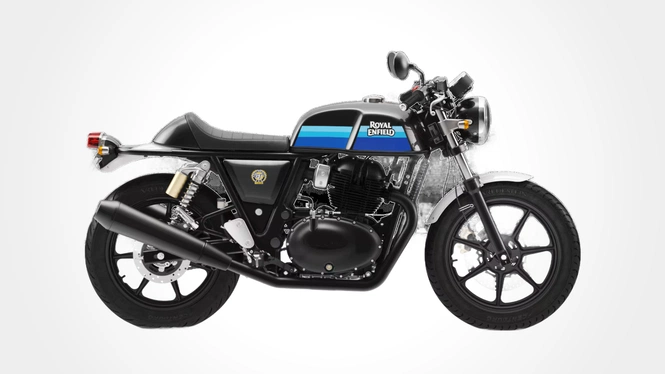
Mechanically identical to the Interceptor - same 648 cc 270-degree parallel twin, same slipper clutch, same 41mm telescopic forks, same brakes, same analogue-digital instrument cluster, same absence of riding modes and traction control.
The Rs 13,000 premium over the Interceptor buys cafe racer ergonomics clip-on handlebars, rear-set footpegs and a visual package that references 1960s British café racing.
The GT 650 is 4 kg lighter than the Interceptor at 214 kg and has bit more lean forward riding posture for those who prefer a go-fast kind of driving.
Consider if -
- The café racer aesthetic is specifically what brought you to this list. The GT 650 is one of the best-looking motorcycles at this price point and the riding posture suits committed weekend riding.
- You ride primarily solo on open roads where the forward ergonomics feel purposeful and connected rather than tiring.
- The Rs 13,000 premium over the Interceptor is trivial enough that visual preference is the deciding factor.
Skip if -
- You carry a pillion regularly. Rear-set footpegs and the single-seat default make two-up riding significantly less comfortable than the Interceptor.
- Daily city commuting is the primary use. The committed posture causes wrist and lower back fatigue in stop-and-go conditions that the Interceptor does not.
- You have not ridden a café racer before. Test ride the GT for at least 30 minutes in traffic before committing, because the ergonomics are a genuine daily-use trade-off.
Also Read – Everything You Should know About Upcoming Royal Enfield 750CC Range
Kawasaki Versys-X 300
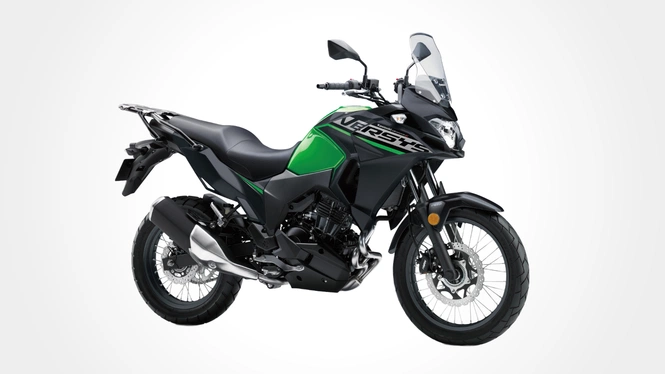
The same 296cc engine as the Ninja 300, retuned to produce peak power 500 rpm higher at 11,500 rpm to suit its more touring-oriented character.
The format changes everything else - upright handlebar, 19-inch front wheel, longer suspension travel, higher ground clearance, and an adventure-tourer stance. The assist and slipper clutch is standard, as is dual-channel ABS. The display is a digital unit.
Within Kawasaki's lineup this sits below the Versys 650, which starts at Rs 8.63 lakh and is entirely outside this list. The X 300 is the most affordable adventure-format parallel twin in India by a significant margin.
Consider if -
- You want the most affordable adventure-format parallel twin available, with upright ergonomics, a 19-inch front wheel, and suspension travel that actually absorbs broken Indian urban roads.
- Your adventure riding is light mixed-use, NCR driving (Big-LOL)broken city roads, the occasional gravel track, weekend highway runs rather than serious off-road work.
- The Rs 1.21 lakh gap to the BMW F 450 GS is a stretch and the Versys-X 300 covers your actual use case adequately.
Skip if -
- Serious adventure riding is the actual brief. The 296cc engine will be working hard with luggage and a pillion on sustained climbs.
- You are buying for highway touring as the primary use. The 296cc engine is limited at highway speeds with any meaningful load.
The New Royal Enfield 650 Range
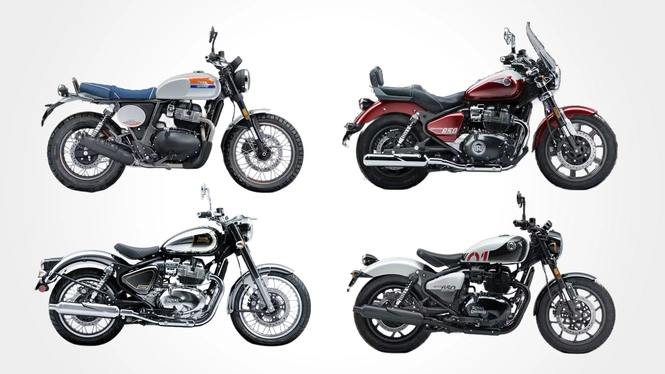
Four more Royal Enfield models sit between the Continental GT and the BMW F 450 GS on this list, all sharing the same 648 cc 270-degree parallel twin. All have slipper clutches. None have riding modes or traction control.
The Bear 650 is the most technically differentiated for money - Showa USD forks from the Shotgun adapted for longer travel, TFT with Tripper navigation, switchable rear ABS for off-road use, and 56.5 Nm of torque from the two-into-one exhaust system 4.2 Nm more than any other RE 650 variant. At Rs 3.75 lakh it is the most hardware-loaded Royal Enfield on this entire list.
The Super Meteor at Rs 4.02 lakh has the lowest seat height in the family at 740 mm and is the most comfortable machine for long-distance highway cruising, with TFT navigation standard.
The Classic 650 at Rs 3.64 lakh is the heaviest at 243 kg. That kerb weight is noticeable at low speeds and when manoeuvring. It suits buyers for whom the heritage visual language is the primary reason for the purchase.
The Shotgun at Rs 3.94 lakh is built around aesthetics first. It is the best-looking motorcycle in this price bracket if the bobber format appeals, but the single-seat default and 16-inch rear tyre limit both practicality and tyre choice.
Also Read – How Much Will It Cost To Service Your Royal Enfield Bike?
Aprilia Tuono 457
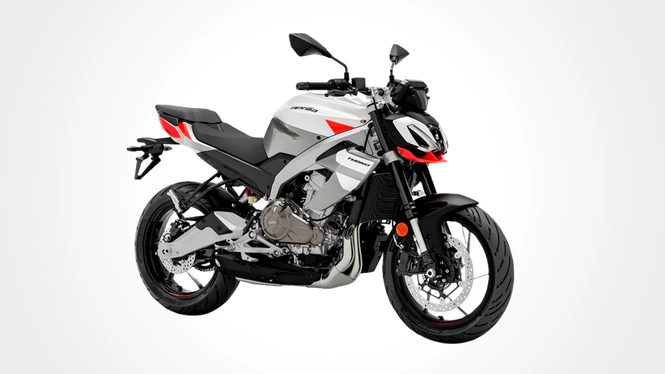
The Aprilia Tuono 457 is where this list changes character. Everything below it Kawasaki, Yamaha, Royal Enfield has ABS and a slipper clutch and little else electronically.
The features a 5-inch TFT display with Bluetooth smartphone connectivity, ride-by-wire throttle, three riding modes (Eco, Rain, Sport), three levels of switchable traction control, switchable ABS, and 41mm USD forks with 120mm travel. The quickshifter is an optional accessory.
The engine is a 457 cc liquid-cooled parallel twin with a 270-degree crankshaft, the same firing interval as the Royal Enfield 650 twins. At Rs 3.97 lakh this is significant because the 270-degree crank gives the Tuono a V-twin-like exhaust character that makes it sound and feel more expensive than its displacement.
Manufactured at Piaggio's Baramati facility in Maharashtra, it is a genuinely made-in-India Italian motorcycle.
Consider if -
- You want traction control and riding modes under Rs 4 lakh. The Tuono 457 is the only naked motorcycle on this list that offers both, and normally these features cost significantly more.
- The 270-degree crank engine character combined with a TFT display, Bluetooth, and switchable ABS makes this the most technically complete naked parallel twin under Rs 5 lakh.
Skip if -
- Your nearest Aprilia authorised service centre is not conveniently close. Aprilia's network is strong in major metros and limited in smaller cities, and this matters for daily ownership.
- The RE Interceptor 650 at Rs 3.35 lakh covers your needs. If engine character and serviceability matter more than electronics, the Interceptor is Rs 62,000 less for more displacement and torque.
Also Read – Checkout the Aprilia bike lineup
Aprilia RS 457
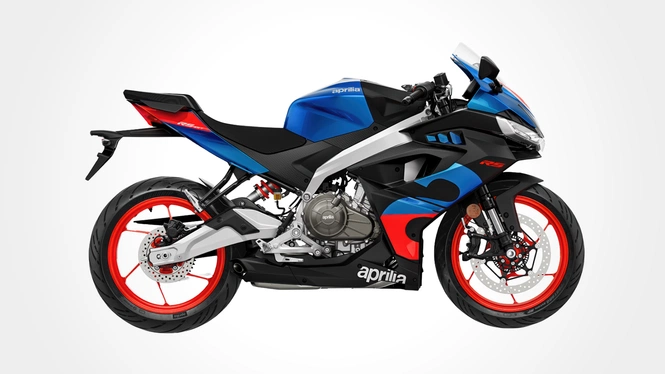
The RS 457 and Tuono 457 are mechanically identical. Same 457cc 270-degree parallel twin, same 5-inch TFT with Bluetooth, same three riding modes, same three-level switchable traction control, same switchable ABS, same 41 mm USD forks.
The RS 457 adds a full fairing, clip-on handlebars set semi-high above the top yoke, and a sportsbike aesthetic for Rs 25,000 more.
Our teammate Gauren has driven this and pointed out that engine in this bike is used as a stressed member, meaning, its directly bolted on to the frame, masking its one of the hardest cornering bikes on our list.
Consider if -
- You want a full-faired sportsbike with a complete electronics suite. Traction control, riding modes, TFT, switchable ABS and the RS 457 is the only bike on this list that delivers all of that in a faired format.
- You plan to track the bike occasionally. The RS 457's aluminium perimeter frame, stressed, radially mounted Brembo-derived calipers, and electronics package are genuinely track-capable at this price.
Skip if -
- Daily commuting is the main use. The sportsbike ergonomics will become genuinely uncomfortable over time in city stop-and-go conditions.
- People have complained about the RS 457’s brakes in the past as being extremely weak above 150 kmph, which it can easily attain. You might have to shell out ₹15k more for an aftermarket brake upgrade.
- The Tuono 457 at Rs 25,000 less suits your needs. The same engine and electronics in a naked format that is far more practical for everyday riding.
Also Read – Cheapest Bikes With Fully Digital Display In 2026 Under 1 Lakh
BMW F 450 GS (Base)
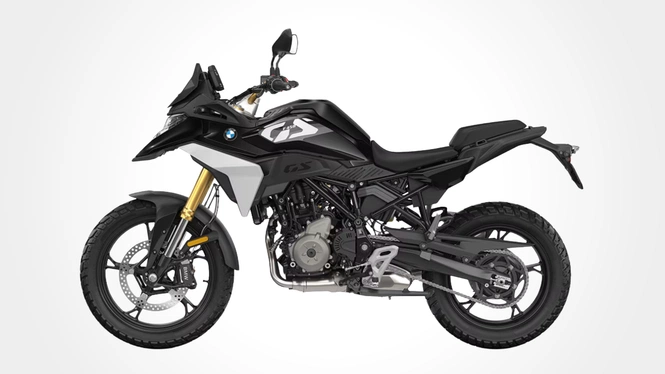
The BMW F 450 GS arrived in April 2026 and is the most electronically sophisticated motorcycle on this list by a meaningful margin. Built by TVS at the Hosur facility in Tamil Nadu, the 420cc parallel twin uses a 135-degree crankshaft offset, different from both the RE 270-degree and the Yamaha 180-degree which creates a firing character that sits between a conventional parallel twin's buzz and a V-twin's thump.
At 48 PS and 43 Nm from its 420cc parallel twin, it is the most powerful engine on this list.
The Base variant at Rs 4.70 lakh comes standard with - 6.5-inch TFT with Bluetooth and navigation, three riding modes (Rain, Road, Enduro), cornering-sensitive ABS Pro, dynamic traction control, engine drag torque control, KYB USD forks with 180mm travel, heated grips, and adjustable levers.
The quickshifter is optional on the Base but comes standard on the Exclusive and GS Trophy about 20-50 k more expensive.
The Easy Ride Clutch, which acts as a centrifugal clutch allowing stop-and-go riding without the clutch lever, is exclusive to the GS Trophy and is the second major bike to get this stretch after Honda CB range in India.
No other bike under Rs 5 lakh in India has cornering ABS. No other bike under Rs 5 lakh has heated grips standard.
The electronics package here exceeds what you find on motorcycles costing Rs 8 to 9 lakh in other segments. The reason this is possible is local manufacturing, the same BMW-TVS partnership that built the G 310 GS, but applied to a fundamentally more capable platform.
People have been asking questions about its weight. I think for an adventure motorcycle with a 19-inch front wheel and long-travel suspension, 178 kg is genuinely light.
Consider if -
- Cornering ABS, heated grips, riding modes, and a 6.5-inch TFT with navigation matter to you. No other bike under Rs 5 lakh in India offers this electronics package, period.
- You ride on varied terrain broken roads, occasional off-road tracks, highway touring, where the 19-inch front wheel, long-travel KYB suspension, and Enduro mode are actually used.
Skip if -
- Your riding is entirely on tarmac and the adventure architecture is aspiration rather than actual use the Interceptor 650 at Rs 1.35 lakh less gives more engine character for pure road riding.
- You want a street naked. The Aprilia Tuono 457 at Rs 73,000 less gives you traction control, riding modes, and a TFT in a lighter, more city-friendly package.
- The quickshifter matters to you at this price. It is optional on the base variant and only comes standard from the Exclusive at Rs 4.90 lakh.
Also Read – Top 5 Highlights You Need to Know About the BMW F 450 GS
FAQ
Which is better: a big single cylinder or a parallel twin?
A well-tuned big single and a parallel twin optimise for different things, and neither is categorically better. A single like the Royal Enfield Himalayan 450 or KTM 390 Duke is lighter, simpler, cheaper to maintain, and delivers a tactile, visceral riding experience; the single-cylinder thump at low revs is not something a parallel twin replicates. For city-heavy riding with occasional weekend use, a sorted single is entirely adequate.
A parallel twin's biggest USP can be summed up in one word “REFINEMENT”, it spreads combustion across two cylinders, which reduces vibration at sustained highway speeds and under load.
The practical difference is most felt on extended rides above 80 kmph: a 648 cc parallel twin at 100 kmph cruising feels settled and unstressed in a way a single cylinder cannot replicate.
What should I consider when buying a parallel twin?
Service network first. A Royal Enfield Interceptor and an Aprilia RS 457 are both parallel twins at similar prices, but their ownership experience is completely different outside a major metro. Check the nearest authorised service centre before you decide.
Be honest about ergonomics before you commit. Clip-on handlebars feel exciting in a showroom for fifteen minutes.
Test ride every candidate for at least 20 to 30 km on roads that resemble your actual commute before deciding. The difference between the Interceptor's upright stance and the Continental GT's forward crouch is felt immediately on a long city rides.
What is the difference between a boxer twin, parallel twin, V-twin, and L-twin?
These describe how two cylinders are positioned and fired relative to each other and the direction of travel.
A parallel twin places both cylinders upright and side by side inline with the bike. The engine is narrow and compact.
A boxer twin (horizontally-opposed twin) points the two cylinders outward horizontally from either side of the engine, like the BMW R-series. This drops the centre of gravity as low as it can go and puts both cylinders fully in the airstream for cooling. The penalty is width the cylinders protrude from each side and can catch obstacles or the ground in a tip-over.
A V-twin arranges both cylinders in a V shape, with the angle between them ranging from 45 degrees (classic Harley-Davidson) to 90 degrees (many Ducatis, older SV650). The 45-degree V-twin creates the famous uneven firing interval and the distinctive potato exhaust note that defines Harley's identity. A 90-degree V-twin achieves near-perfect primary balance and is mechanically one of the smoothest twin configurations possible.
An L-twin is a specific 90-degree V-twin with one cylinder pointing straight up and one pointing horizontally forward, forming an L shape when viewed from the side. This is Ducati's ex-signature layout( they have embraced the V4 and V2s lately). The horizontal cylinder acts as a structural frame element, and the 90-degree angle gives it the same natural balance as any 90-degree V-twin.
If you have any doubts, please leave a comment below. We will reach back to you as soon as possible.
Image Source: Respective brand websites
Table of Contents
- Kawasaki Ninja 300
- Yamaha MT-03
- Yamaha R3
- Royal Enfield Interceptor 650
- Royal Enfield Continental GT 650
- Kawasaki Versys-X 300
Join the Conversation
Trending
Honda CB500 Launched At Rs 2.75 Lakh, Full Price List Revealed
Honda has launched the CB500 in India from Rs 2.75 lakh ex-showroom. The 501cc single-cylinder roadster comes in three variants with bookings now open through Honda BigWing dealerships.
Anmol Kumar
September 22, 2026
Honda CB350C Launched in India at Rs 2 Lakh, Gets New Colours and Graphics
The 2026 Honda CB350C has been launched in India from Rs 2 lakh, with new colours and graphics across its three variants. It continues with the 348.36cc engine, five-speed gearbox and dual-channel ABS.
Salil Kumar
September 22, 2026
2026 Honda CB350 Launched At Rs 1.95 Lakh, Gets New Variants and Colours
Honda has launched the CB350 in India at Rs 1.95 lakh. It gets new STD, DLX and Chrome variants with fresh colours, while the 348.6cc engine, five-speed gearbox and features remain unchanged.
Anmol Kumar
September 22, 2026
Honda QC3 Launched At Rs 1.35 Lakh With 145km Range, 5-inch TFT
Honda has launched the QC3 electric scooter in India at Rs 1.35 lakh ex-showroom Delhi. It gets a 3kWh battery, 145km IDC range and a 5-inch TFT console with smartphone connectivity.
Arjun Nair
September 22, 2026
Royal Enfield Classic 350 Signature White Launched At Rs 2.24 Lakh, Gets Touring Seat As Standard
Royal Enfield has added a Signature White colour to the Classic 350 lineup at Rs 2,24,275 ex-showroom Chennai. It costs the same as the Emerald shade and gets a brown touring seat as standard.
Anmol Kumar
September 22, 2026
Featured
Citroen C3 Review: Who Should Consider This Car?
A few days ago, I took the Citroen C3X out for a spin in the city and on the highways. I travelled long distances and checked its fuel efficiency, features, comfort, and other factors. Today, I’ll briefly share my overall experience with the C3X and will tell you whether you should consider it or not and which is the most value-for-money variant of the lot.
Vatsal Agrawal
May 19, 2026
Tesla Finally In India Officially. Why Now And What Does It Mean For EVs?
The much-anticipated 2025 Tesla Model Y has officially arrived in India, marking a pivotal moment for the nation's burgeoning electric vehicle market. Launched on July 15, 2025, the Model Y Juniper facelift offers cutting-edge technology, impressive range, and signature Tesla performance. Positioned as a premium electric SUV, its entry will intensify competition and reshape consumer expectations for EVs across the subcontinent.
Charan Narain
July 17, 2025
Here Are 10 Things The Harrier.EV Offers That The Mahindra XEV 9E Doesn't
The Harrier.EV is an incredible new offer from Tata. Its most popular competitor would be the Mahindra XEV 9E, priced similarly. With these two incredible offerings from home grown brands available, here is a list of everything the Harrier.EV offers that the XEV 9E doesn't.
Charan Narain
June 13, 2025
Write a comment
Comments
No comments yet. Be the first to comment!