August 2026 Car Sales As Per VAHAN
By Anmol Kumar
Updated September 2, 2026
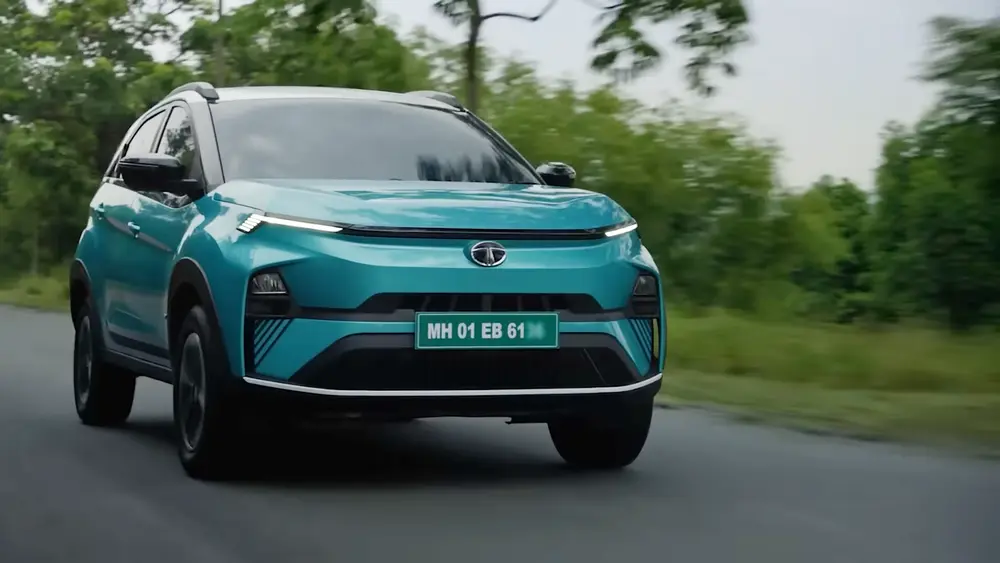
India saw just over 32 lakh passenger cars sold in the first eight months of 2026, spanning everything from sub-10 lakh hatchbacks to multi-crore supercars. The market remains heavily skewed towards mass-market buyers, but electric vehicles are growing fast and the luxury segment continues to find new customers.
Here is a full breakdown of how every segment performed.
Mass Market
| Company | Jan | Feb | Mar | Apr | May | Jun | Jul | Aug | MoM (Jul vs Aug) | Total |
|---|---|---|---|---|---|---|---|---|---|---|
| Maruti Suzuki | 2,04,293 | 1,38,044 | 1,56,067 | 1,41,983 | 1,47,941 | 1,48,764 | 1,42,223 | 1,41,570 | -0.5% | 12,20,885 |
| Mahindra & Mahindra | 63,026 | 53,525 | 60,736 | 52,473 | 46,084 | 47,749 | 49,077 | 41,810 | -14.8% | 4,14,480 |
| Tata Motors | 58,938 | 52,602 | 59,733 | 49,788 | 44,600 | 43,984 | 43,655 | 42,930 | -1.7% | 3,96,230 |
| Hyundai | 66,171 | 44,478 | 47,958 | 46,113 | 44,138 | 41,412 | 44,201 | 42,659 | -3.5% | 3,77,130 |
| Toyota | 36,398 | 26,599 | 27,984 | 26,913 | 25,425 | 27,643 | 28,013 | 22,023 | -21.4% | 2,20,998 |
| Kia | 32,137 | 26,669 | 30,021 | 26,601 | 25,397 | 23,707 | 25,942 | 22,768 | -12.2% | 2,13,242 |
| Skoda Auto VW | 10,811 | 8,366 | 9,732 | 9,591 | 8,789 | 8,465 | 8,432 | 7,340 | -12.9% | 71,526 |
| MG Motor | 6,798 | 5,188 | 7,170 | 6,661 | 6,198 | 7,253 | 7,137 | 5,644 | -20.9% | 52,049 |
| Honda Cars | 6,175 | 4,897 | 5,795 | 5,443 | 4,472 | 4,851 | 5,733 | 4,752 | -17.1% | 42,118 |
| Renault | 4,809 | 3,263 | 3,629 | 4,128 | 4,235 | 3,836 | 3,486 | 3,197 | -8.3% | 30,583 |
| Nissan | 2,458 | 1,763 | 2,737 | 3,219 | 3,026 | 2,791 | 2,743 | 2,725 | -0.7% | 21,462 |
| Stellantis | 1,278 | 843 | 793 | 743 | 625 | 733 | 908 | 776 | -14.5% | 6,699 |
| VinFast | 478 | 453 | 778 | 921 | 999 | 1,153 | 945 | 750 | -20.6% | 6,477 |
| Mass Market Total | 4,93,770 | 3,66,690 | 4,13,133 | 3,74,577 | 3,61,929 | 3,62,341 | 3,62,495 | 3,38,944 | -6.5% | 30,73,879 |
India sold just over 30.7 lakh mass-market passenger cars between January and August 2026, with Maruti Suzuki alone accounting for nearly 12.2 lakh. That means roughly four in every ten cars sold in India carried a Maruti badge. The Wagon R, Swift, Brezza and Ertiga remain some of the biggest volume drivers in the market. Maruti's sales peaked at 2.04 lakh units in January before easing to 1.41 lakh in August, reflecting the broader seasonal slowdown rather than a major loss of momentum.
The fight behind Maruti is much closer. Mahindra sold 4.14 lakh units during the period, followed by Tata at 3.96 lakh and Hyundai at 3.77 lakh. Mahindra's growth has been driven largely by the Scorpio N and XUV700, which have helped the company build a much stronger position in the Rs 15 lakh to Rs 25 lakh SUV market. These products have also changed the way buyers view Mahindra, particularly when it comes to design, features and value.
Also Read – Mid-Size SUVs Overtake Compact SUVs in India for the First Time
Hyundai continues to rely on strong performers such as the Creta, Venue and Verna. The brand has maintained a steady presence without having to depend heavily on discounts. Tata's numbers need a little more context. Its ICE sales have softened, but when Tata's electric vehicle sales are added separately, the company's overall position looks much stronger.
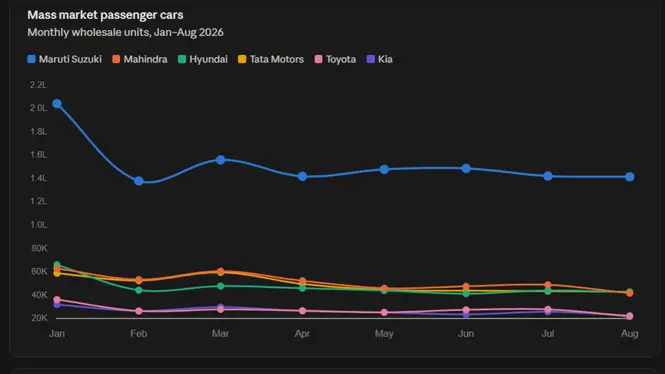
Kia and Toyota are both sitting around the 2.1 lakh to 2.2 lakh mark. Kia's Sonet and Seltos continue to perform well, although sales have gradually eased from 23,707 units in June to 22,768 in August. A product refresh could give the brand another push. Toyota, meanwhile, continues to benefit from models such as the Innova HyCross and Urban Cruiser Hyryder, which fit well with the growing demand for practical family SUVs.
Skoda Auto Volkswagen is also showing a healthier presence in India, with the group recording 71,526 units during the period across its brands. MG and Honda Cars remain much smaller, with annual volumes in the 40,000 to 52,000 range. Both have a loyal customer base but need stronger products and fresh launches to generate meaningful growth.
VinFast is the new name to watch. Its volumes are still tiny, but sales have climbed from 478 units in January to more than 1,100 by June. It is far too early to call it a major player, but the early numbers suggest the Vietnamese EV maker is gradually finding its place in the Indian market.
Also Read – Tata Motors Cars and SUVs to Get Costlier by Up to Rs 25,000 from 1 September 2026
Electric Cars
| Company | Jan | Feb | Mar | Apr | May | Jun | Jul | Aug | MoM (Jul vs Aug) | Total |
|---|---|---|---|---|---|---|---|---|---|---|
| Tata Electric | 8,951 | 6,174 | 8,740 | 9,213 | 10,753 | 12,495 | 13,956 | 12,602 | -9.7% | 82,884 |
| Mahindra Electric | 3,613 | 3,196 | 5,996 | 5,847 | 6,245 | 7,656 | 7,437 | 6,162 | -17.1% | 46,152 |
| BYD India | 235 | 341 | 493 | 543 | 743 | 909 | 795 | 537 | -32.5% | 4,596 |
| Tesla India | 38 | 29 | 53 | 43 | 36 | 38 | 116 | 111 | -4.3% | 464 |
| EV Total | 12,837 | 9,740 | 15,282 | 15,646 | 17,777 | 21,098 | 22,304 | 19,412 | -13.0% | 1,34,096 |
India sold around 1.34 lakh electric cars between January and August 2026, with the monthly trend showing a clear increase in demand. Sales rose from 12,837 units in January to 22,304 in July, almost doubling in just seven months.
Tata Electric remains the clear leader with 82,884 units. Its sales increased from 8,951 units in January to 13,956 in July, helped by products such as the Nexon EV and Punch EV. Together, they give Tata a strong presence across the more affordable end of the EV market.
Mahindra Electric has seen one of the more noticeable increases in the segment. Sales rose from 3,613 units in January to more than 5,000 in March and reached 7,656 in June before easing slightly. The BE 6e and XEV 9e have played an important role in attracting buyers looking for more premium electric SUVs.
Also Read – Hyundai Confirms Next-Gen Creta, New i10, and a Sub-4m Electric SUV for India, More Models Planned
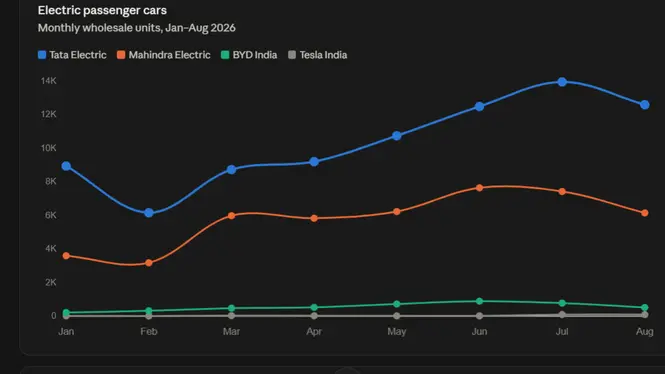
BYD is still small at 4,596 units, but its sales have been moving in the right direction. Monthly volumes increased from just 235 units in January to 909 in June. The Atto 3 has helped the brand establish a presence among urban buyers who are willing to consider an international EV brand.
Tesla's 464 units are insignificant in terms of overall market volume, but its arrival is important for the premium EV segment. The brand brings a global benchmark for technology and EV ownership and could push established manufacturers to raise their game.
Electric cars currently account for around 4% of total passenger car sales based on the eight-month numbers. That share is still relatively small, but the growth rate suggests EVs are becoming an increasingly important part of India's passenger vehicle market.
Premium and Luxury
| Company | Jan | Feb | Mar | Apr | May | Jun | Jul | Aug | MoM (Jul vs Aug) | Total |
|---|---|---|---|---|---|---|---|---|---|---|
| BMW India | 2,157 | 1,380 | 1,781 | 1,597 | 1,440 | 1,786 | 1,765 | 1,378 | -21.9% | 13,284 |
| Mercedes-Benz | 1,917 | 1,420 | 1,459 | 1,269 | 1,159 | 1,397 | 1,362 | 1,160 | -14.8% | 11,143 |
| Jaguar Land Rover | 494 | 533 | 514 | 526 | 396 | 642 | 635 | 551 | -13.2% | 4,292 |
| Audi | 50 | 21 | 30 | 14 | 5 | 13 | 14 | 11 | -21.4% | 158 |
| Maserati | 3 | 2 | 4 | 1 | 6 | 6 | 1 | 4 | +300% | 27 |
| Lamborghini | 10 | 5 | 6 | 2 | 6 | 9 | 6 | 4 | -33.3% | 48 |
| Bentley | 0 | 2 | 0 | 1 | 2 | 1 | 0 | 0 | — | 6 |
| Premium Total | 4,631 | 3,363 | 3,794 | 3,410 | 3,014 | 3,854 | 3,783 | 3,108 | -17.8% | 28,957 |
India's premium and luxury car segment sold around 28,957 units between January and August 2026. The numbers are small compared with the mass market, but the segment continues to benefit from a growing pool of high-income buyers.
BMW India leads with 13,284 units, with monthly sales generally ranging between 1,300 and 2,100 units. January was particularly strong at 2,157 units, while sales later settled at lower levels. Mercedes-Benz remained close behind with 11,143 units. The competition between the two German brands remains tight, with both targeting India's growing pool of affluent professionals and entrepreneurs.
SUVs remain central to both brands' strategies. Locally produced models, strong financing options and a growing appetite for premium SUVs have helped luxury manufacturers expand beyond their traditional sedan customer base.
Also Read – Best Luxury Cars Under ₹1 Crore On-Road
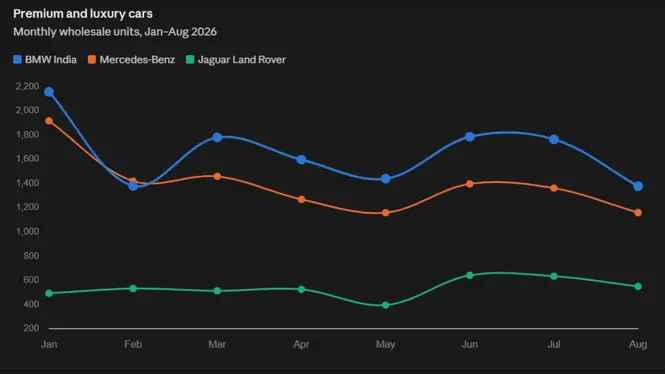
Jaguar Land Rover India sold 4,292 units during the period. Its volumes are much smaller than BMW and Mercedes, but products such as the Defender continue to give the brand a strong position among premium SUV buyers.
Audi's 158 units stand out as an unusual figure compared with its German rivals. The gap highlights the challenges the brand has faced with its product cycle and network in India, despite having strong brand recognition.
At the very top of the market, Lamborghini, Maserati and Bentley continue to operate in a completely different space. Their volumes are tiny, but their presence reflects India's growing base of ultra-high-net-worth buyers.
Carhp Original Insights
Given the whole ethanol fiasco, we expect CNG cars to gain further momentum. Skoda is already evaluating a CNG option for the Kylaq and possibly the Kushaq as well.
Diesel car sales should remain steady, especially for Mahindra cars and for large SUVs offered by Hyundai and Tata.
Entry-level and midsize EV SUV demand, along with new launches in these segments, should also grow in the near future, provided the infrastructure issue is addressed alongside it. The BaaS schemes available on most EV cars on sale today should further bolster their demand in lower middle and middle class families.
Also Read – Supreme Court Extends Third-Party Insurance for New Cars to 4 Years, Two-Wheelers to 6 Years
Source: VAHAN
Table of Contents
- Mass Market
- Electric Cars
- Premium and Luxury
- Carhp Original Insights
Join the Conversation
Trending

What Is CBG? Know About Its Production, Engine Performance, Prices and Future in India
Compressed biogas (CBG) is gaining attention in India as a renewable alternative to CNG. Here's how it is produced, its impact on engine performance and mileage, current pricing factors, and its future in India's automotive sector.
Salil Kumar
October 21, 2026
How 2027 Traffic Rule Changes Will Affect Drivers in India
India’s traffic rules are tightening, with repeat offenders facing possible driving licence disqualification and stricter deadlines for paying or disputing e-challans. New vehicle safety requirements will also affect specified commercial vehicles from 2027. Check the latest 2027 Indian traffic rules here.
Anmol Kumar
October 21, 2026

Hyundai Bayon Safety Features Revealed Ahead of October 26 Launch
Hyundai has revealed the safety package of the upcoming Bayon ahead of its October 26 launch in India. The compact SUV gets Level 2 Pro ADAS with 23 functions, six airbags as standard and a body structure made using 69% advanced multi-grade high-strength steel.
Anmol Kumar
October 21, 2026
Featured
Citroen C3 Review: Who Should Consider This Car?
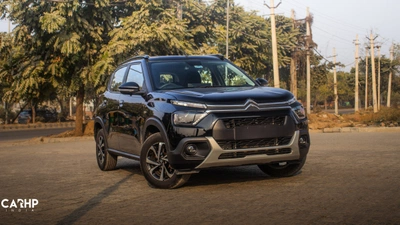
A few days ago, I took the Citroen C3X out for a spin in the city and on the highways. I travelled long distances and checked its fuel efficiency, features, comfort, and other factors. Today, I’ll briefly share my overall experience with the C3X and will tell you whether you should consider it or not and which is the most value-for-money variant of the lot.
Vatsal Agrawal
May 19, 2026
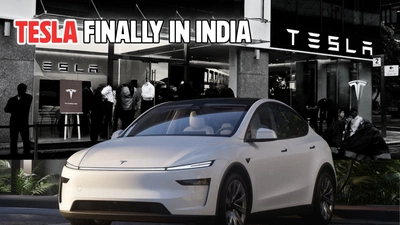
Tesla Finally In India Officially. Why Now And What Does It Mean For EVs?
The much-anticipated 2025 Tesla Model Y has officially arrived in India, marking a pivotal moment for the nation's burgeoning electric vehicle market. Launched on July 15, 2025, the Model Y Juniper facelift offers cutting-edge technology, impressive range, and signature Tesla performance. Positioned as a premium electric SUV, its entry will intensify competition and reshape consumer expectations for EVs across the subcontinent.
Author
July 17, 2025
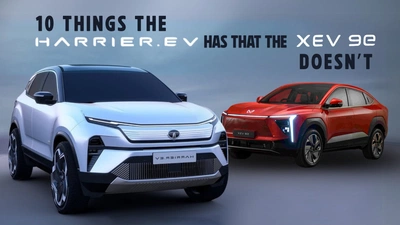
Here Are 10 Things The Harrier.EV Offers That The Mahindra XEV 9E Doesn't
The Harrier.EV is an incredible new offer from Tata. Its most popular competitor would be the Mahindra XEV 9E, priced similarly. With these two incredible offerings from home grown brands available, here is a list of everything the Harrier.EV offers that the XEV 9E doesn't.
Author
June 13, 2025
Write a comment
Comments
No comments yet. Be the first to comment!