


Mahindra Bolero Neo
Overall Rating

Mahindra Bolero Neo
Overall Rating
EMI Loading
Mahindra Bolero Neo Key Specifications
Mahindra Bolero Neo Highlights
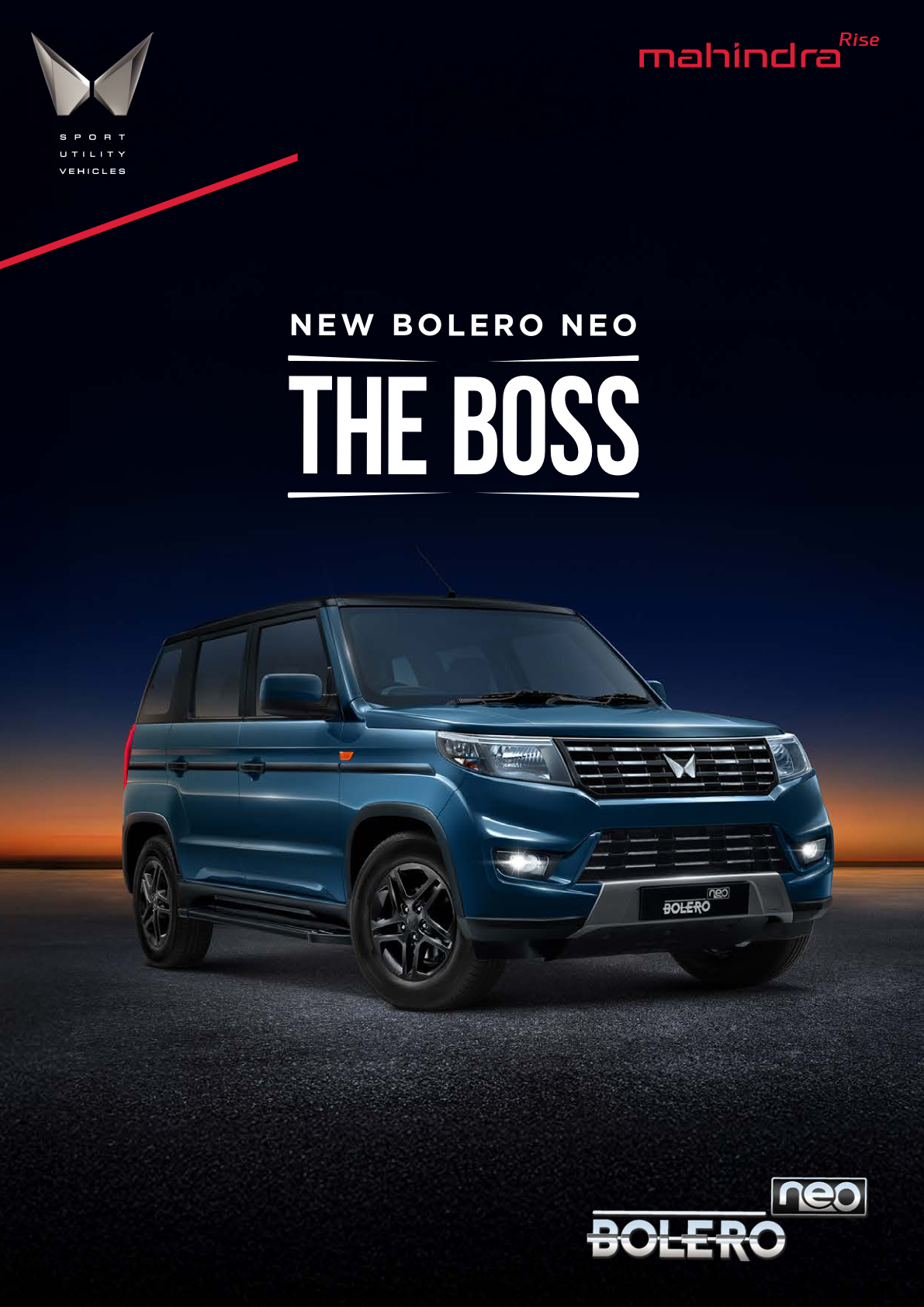

Locking rear differential.

Rear-wheel drive.

7-inch touchscreen.
Mahindra Bolero Neo Overview

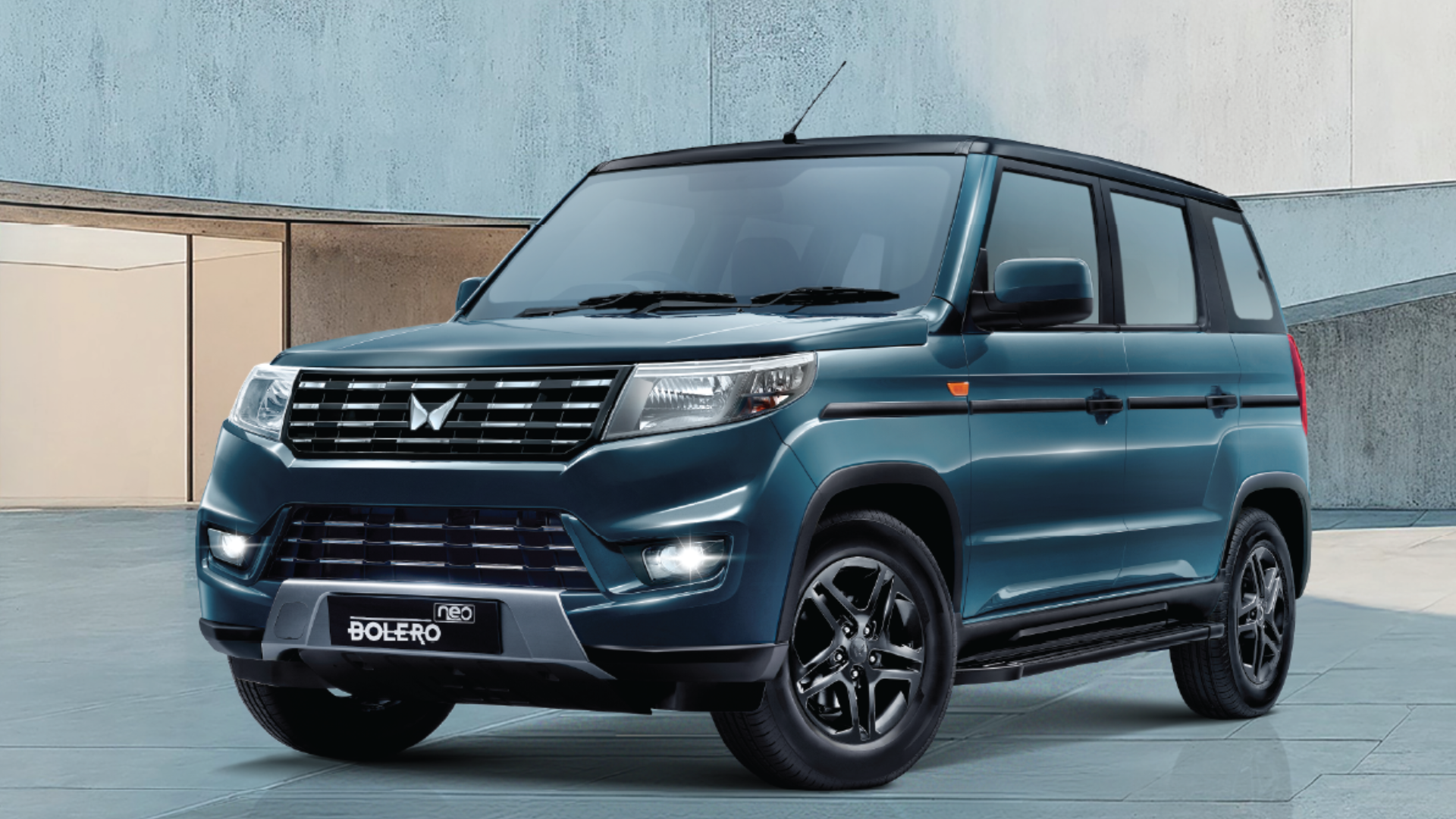
The Mahindra Bolero Neo is what you get when a nameplate maintains its core brief across a decade of updates.
With a body-on-frame construction, rear-wheel-drive, diesel-only SUV with seven seats and a 50-litre fuel tank, positioned for buyers who need rugged durability, a three-row layout, and low running costs at an accessible price, the Bolero Neo is not a premium lifestyle SUV or a comfort-focused family car. It is a workhorse vehicle that happens to offer modern features like a touchscreen and cruise control alongside its ladder frame, diesel, and jump-seat formula.
The vehicle's origin as the TUV300 is evident in its proportions and approach. At 3995 mm in length with a 2680 mm wheelbase, it is compact but tall, with a high seating position, a boxy body, and a ground clearance of 180 mm. The 2025 facelift refreshed the exterior with a new grille and updated styling, improved ride and handling technology in all variants, and introduced the N11 as a new top-of-range option. The fundamentals remain unchanged.
The Bolero Neo's commercial case rests on several pillars. The diesel engine's 17.29 km/l ARAI efficiency combined with the 50-litre tank gives it a theoretical range of over 850 km on a full tank, which is exceptional for a seven-seat vehicle at this price. The 2680 mm wheelbase delivers a stable, settled highway ride, and the rear-wheel-drive body-on-frame construction gives it a clear advantage on rough terrains and poor road conditions that monocoque crossovers cannot match.
Safety is the major compromise this SUV asks buyers to make. Dual airbags and ABS with EBD are the most that any Bolero Neo variant offers, and the 1-star Global NCAP safety rating is the most consequential limitation for any buyer using this as a primary family vehicle.
Moreover, there is no automatic gearbox option, no petrol engine option, the interior quality is not premium but built to last, it lacks most of the features sub-4 metre compact SUVs offer, and the side-facing jump seats in the third row are not comfortable over longer distances and are less suitable for young children than a conventional front-facing bench.
Engine and Performance
Engine and Performance
The Bolero Neo comes with a single, 1.5-litre mHawk100 three-cylinder turbocharged diesel producing 99 bhp and 260 Nm.
On paper, these figures are modest. However, in the context of a vehicle that weighs under 1,700 kg in most configurations, the torque arrives early in the rev range and is accessible from around 1,500 rpm, which suits both city driving and highway cruising without demanding frequent gear changes.
The engine is not particularly refined by modern standards, with the diesel clatter audible at idle and under light loads, and the three-cylinder configuration produces cabin vibrations that four-cylinder diesels do not. At highway speeds and moderate engine loads the noise level settles and the Bolero Neo becomes a more relaxed cruiser.
The 5-speed manual gearbox is paired well enough with the engine's character. Gear throws are long rather than slick, and the clutch is appropriately weighted for a body-on-frame diesel vehicle. The gearbox does not encourage sporty driving, which is appropriate given the vehicle's brief.
Ride and Handling
RIDEFLOW, Mahindra's name for the suspension, steering, and braking package that was standardised across all Bolero Neo variants with the 2025 facelift, aims to improve ride comfort and handling balance over the previous model's setup.
The result is a ride that absorbs the large-amplitude bumps of rural and semi-urban roads reasonably well while maintaining enough damping to avoid excessive body movement at highway speeds. The leaf spring rear setup, which is conventional for the body-on-frame formula at this price, produces a noticeably different ride character from coil-spring or multi-link setups, particularly when the vehicle is lightly loaded, and the rear can feel floatier over undulations.
The rear-wheel-drive layout, unusual in the modern hatchback and crossover world but standard for the Bolero Neo's ladder-frame format, gives the vehicle a specific handling character that is more planted and predictable in low-traction conditions than a typical front-wheel-drive crossover, particularly when the vehicle is loaded.
A hydraulic power steering means that the Neo is not the easiest car to drive around or park in busy cities and park in tight spaces (though the sub 4-metre length does help).
The N10(O)'s Multi-Terrain Technology (or MLD) adds a brake-based differential lock that improves traction on slippery or loose surfaces by selectively applying the brake to the wheel with less grip, transferring torque to the wheel with more. It is not a mechanical 4WD system and does not provide the same capability as a transfer case with low-range gearing, but it is a practically useful addition for buyers in areas with poor road surfaces or seasonal mud and gravel.
fuel economy
fuel economy
The 17.29 km/l ARAI figure is strong for a seven-seat body-on-frame diesel SUV and reflects the mHawk100 engine's calibration for efficiency over outright power. Real-world returns of 13 to 17 km/l are consistent with the vehicle's weight and typical use patterns, with lighter loads on open roads at the higher end and full seven-seat city use at the lower end.
The 50-litre fuel tank is one of the Bolero Neo's most practically appreciated specifications. At real-world efficiency figures, a full tank provides a range of 650 to 850 km between fuel stops, which is valuable for buyers in semi-urban and rural markets where fuel station density may be lower and longer stretches between fills are common.
Running costs for diesel vehicles in India are typically lower per kilometre than petrol at current fuel prices, and the mHawk100's established reliability track record keeps maintenance expenses predictable.
interior
interior
The Bolero Neo's cabin is honest and functional.
The base N4 uses vinyl seat covers, an analogue instrument cluster with a basic LCD MID, and has no infotainment touchscreen. From the N8 upward, a 9-inch touchscreen with Android Auto and Apple CarPlay becomes the cabin's focal point. The interface is adequate rather than impressive, but wireless smartphone connectivity through Android Auto and Apple CarPlay handles navigation and media effectively.
The N11's Lunar Grey leatherette upholstery and the N10(O)'s Mocha Brown leatherette give the upper trims a more considered appearance than the lower variants' plain fabric and vinyl.
The three-row seating layout is the Bolero Neo's defining practical feature. The first and second rows accommodate five adults in reasonable comfort, with adequate legroom in the second row for average-height occupants. The third row uses side-facing jump seats that fold out from the boot area.
These are functional for occasional use and for shorter occupants, but are not suitable for long journeys and are less safely positioned than a conventional rear-facing bench seat. Buyers who regularly carry seven adults over longer distances should consider this carefully.
Boot space with the third row in use is minimal. Folding the third row flat opens up a usable 384 litres of area. The rear door provides good access to the boot and the third row, and the overall loading height is manageable.
The cabin's material quality throughout is functional rather than premium. Hard plastics on the dashboard and door panels, plain fabric trim in most variants, and a straightforward layout without any ambient lighting or decorative elements give the Bolero Neo an interior that prioritises utility.
exterior
exterior
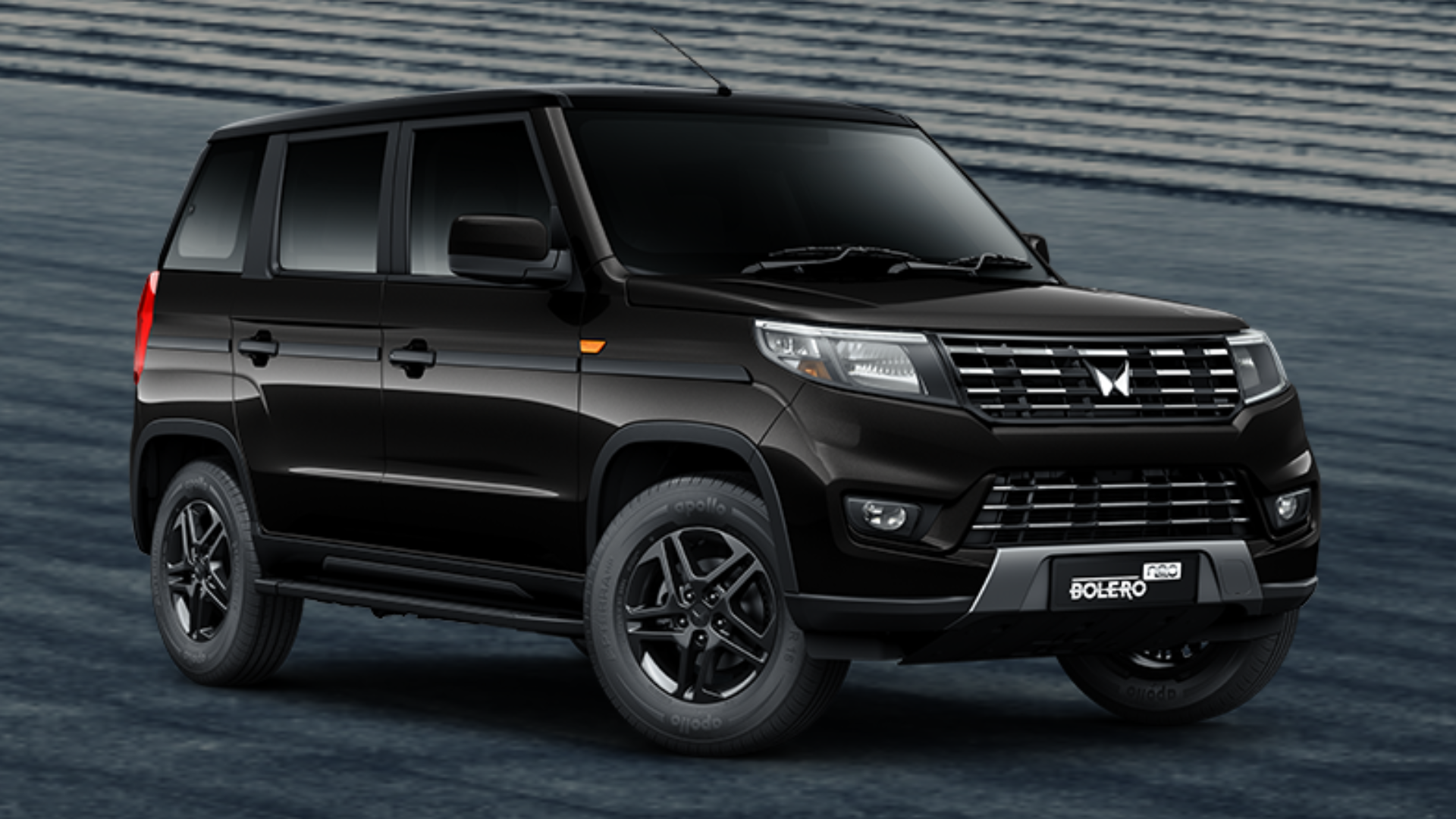
The Bolero Neo's exterior takes the boxy, upright silhouette of the TUV300 and applies successive rounds of styling updates to make it look more contemporary.
At 3995 mm in length, the Bolero Neo sits at the sub-4-metre boundary, which keeps it compact enough for urban use while the tall 1817 mm height and full body width of 1795 mm ensure that the three-row interior is properly usable. The 180 mm ground clearance handles typical urban and semi-urban road conditions well, though it is below the figures of even some front wheel drive crossovers.
The 2025 facelift's revised front grille replaces the previous honeycomb mesh pattern with horizontal slats, and the air dam below has been similarly updated. LED DRLs are added from the N10(R) variant, giving the upper trims a more premium front appearance than the N4 and N8's halogen setup.
Its side profile is simple and boxy, with a black strip running across horizontally at the level of the door handles, which has been a design trait of the original Bolero. The wheel arches are square, and the 16-inch dark metallic grey alloy wheels in the N11 trim are the most visually distinctive element in the range and give this top trim a noticeably different on-road presence compared to the 15-inch alloys of the N10(R).
The N11 is also the only variant available with a dual-tone exterior colour treatment.
The highlight at the rear is the tailgate mounted spare wheel, which is a functional arrangement consistent with the vehicle's body-on-frame SUV character. The roof spoiler at the rear is standard from the N8 upward.
safety
safety
The Bolero Neo was tested by Global NCAP in 2024, scoring 1 star for both adult and child occupant protection, scoring 20.26 out of 34, and 12.71 out of 49 respectively. The test flagged the bodyshell as unstable under frontal loading, driver's chest protection as weak, and both driver and passenger knees as marginal due to unstable footwell area.
Adding to these concerns, the side seating benches posed a significant risk for all occupants, due to which Mahindra fell disappointingly short of Global NCAP’s safety expectations with the continued use of this type of seating. On the active safety front, ESC (Electronic Stability Control) is not fitted as standard, and the seatbelt reminder system did not meet Global NCAP's requirements. Side curtain airbags are absent.
That said, standard safety equipment across all variants includes dual front airbags, ABS with EBD, corner braking control, engine immobilizer, and a speed alert warning, with ISOFIX child seat mounts available on higher variants.
competition
competition
The Bolero Neo has no true like-for-like rivals, as it remains the only body-on-frame, rear-wheel-drive, 7-seat SUV in the sub-4-metre category in India. However, buyers shortlisting it typically also consider the following alternatives.
The Maruti Suzuki Ertiga is the most pragmatic comparison for buyers who want a proper 7-seater at an accessible price. The Ertiga is a monocoque MPV that offers a smoother ride, a petrol mild-hybrid option, factory CNG across multiple variants, a proper torque converter automatic gearbox, six airbags with ESP as standard, and Maruti's wide and trusted service network.
It does not offer the Bolero Neo's road presence, body-on-frame construction or rear-wheel drive with rough terrain capabilities.
For buyers who want seven seats primarily for family use on regular roads, the Ertiga's overall package, including its safety equipment breadth and brand support, makes it the more complete recommendation for most buyers in the price overlap.
The Mahindra Bolero is the Neo's closest relative. The standard Bolero also seats seven in a similar layout, but is even more raw and utilitarian in every aspect, and its pricing overlaps with the Bolero Neo's lower range. Its engine puts out lesser power, the cabin is not as refined or feature equipped, and the safety features are nearly identical.
For buyers who need a bare bones, no frills durable workhorse, the Bolero is practical choice, while the Bolero Neo is the more feature-equipped, more urban-friendly choice between the two.
In the sub-4-metre compact SUV segment, the Bolero Neo goes up against rivals like the Maruti Suzuki Brezza, Tata Nexon, Hyundai Venue, Skoda Kylaq, and Mahindra's own XUV 3XO. All these are front wheel drive monocoque crossovers offer multiple powertrain options, better refinement, are much better suited to urban driving conditions, feature rich, and also much safer.
The Bolero Neo holds the rear wheel drive and ladder frame construction that none of these crossovers have, making it an ‘SUV’ in the real sense, with the ability to take on terrains that only SUVs with four wheel drive would usually attempt.
final verdict
final verdict
The Mahindra Bolero Neo occupies a specific and increasingly narrow position in the Indian market.
Its formula, a body-on-frame, rear-wheel-drive, seven-seat diesel SUV with a 50-litre tank and genuine road-surface tolerance, continues to address a genuine need for buyers in rural and semi-urban India where fuel economy, durability, and passenger capacity matter more than cabin finesse or active safety systems.
Within that context, its 2025 facelift made the Bolero Neo more modern and better equipped without changing its core character. The 9-inch touchscreen from the N8, the rear camera across all variants, RIDEFLOW suspension technology throughout, and the N11's leatherette interior collectively lift the car's everyday usability.
The one aspect of the Bolero Neo that cannot be contextualised or rationalised for all buyers is the 1-star Global NCAP safety rating, with just two airbags and ABS with EBD, the absence of ESP, and an unstable body shell and structure.
For buyers in markets and use cases where these limitations are understood and accepted, the Bolero Neo's value proposition is genuinely strong. For buyers who carry families regularly on mixed or highway roads and for whom safety is high on the priority list, the Bolero Neo is difficult to recommend.
The N10(R) variant at its price point represents the best balance in the range, with a 9-inch touchscreen with Android Auto and Apple CarPlay, cruise control, LED DRLs, 15-inch alloy wheels, ISOFIX, Type-C charging, and height-adjustable driver seat, without the N10(O)'s premium for the Multi-Terrain Technology or the N11's cosmetic additions.
Mahindra Bolero Neo News
Maruti XL6, Mahindra Bolero Neo Prices Revised in October 2026
Maruti Suzuki has increased prices of select XL6 variants by Rs. 10,000, while Mahindra has revised prices across the Bolero Neo range. The Bolero Neo gets hikes of up to Rs. 9,000 and a price cut of Rs. 9,102 on select variants.
Anmol Kumar
October 19, 2026




Mahindra Bolero Neo FAQs
How many seats does the Bolero Neo have, and how are they arranged?
−The Bolero Neo seats seven in a 5+2 configuration, five seats across the first and second rows, and two side-facing jump seats in the third row. Both the second and third rows fold to free up cargo space.
Is the Bolero Neo available with a petrol engine?
+No. The Bolero Neo is diesel-only, powered by a single 1493cc mHAWK100 engine across all variants.
What is the Mahindra Bolero Neo's Global NCAP safety rating?
+The Bolero Neo was tested by Global NCAP in 2024 and received 1 star for adult occupant protection and 1 star for child occupant protection. The test flagged the bodyshell as unstable under frontal loading and noted the absence of ESC as standard.
Does the Bolero Neo have cruise control?
+Yes, cruise control is available from the N10(R) variant of the Bolero Neo.
Does the Bolero Neo have 4x4?
+No. The Bolero Neo is rear-wheel drive across all variants. However, the N10(O) variant gets Mahindra's Multi-Terrain Technology (MTT), which intelligently distributes torque to help maintain traction on uneven surfaces.
What are the key safety features in the Bolero Neo ?
+The Bolero Neo gets dual front airbag, ABS with EBD, Corner Braking Control, engine immobilizer, and a speed alert warning. ISOFIX child seat mounts are available on higher variants.
What is the boot space of the Mahindra Bolero Neo?
+The Bolero Neo offers 384 Litres of boot space without the third row in use.
How many variants does the Bolero Neo come in?
+The Mahindra Bolero Neo is available in 5 variants: N4, N8, N10(R), N10 Opt, and N11.
Which variants of the Mahindra Bolero Neo have a sunroof?
+The Mahindra Bolero Neo does not get a sunroof on any variant.
Is the Mahindra Bolero Neo available in petrol, CNG, electric or diesel engines?
+The Bolero Neo is currently available with Diesel engines.
What are the key safety features in the Bolero Neo ?
+The Bolero Neo comes equipped with several safety features including Anti-lock Braking System (ABS), Central Locking and Electronic Brakeforce Distribution (EBD).
What are the boot space and dimensions of the Mahindra Bolero Neo?
+The Bolero Neo offers 384 Litres of boot space. Its dimensions are 3995 mm in length, 1795 mm in width, and it has a wheelbase of 2680 mm.
What colours does the Mahindra Bolero Neo come in?
+The Mahindra Bolero Neo is available in the following colours: Pearl White, Diamond White, Rocky Beige, Highway Red, Napoli Black and Dsat Silver.