


Mahindra Bolero
Overall Rating

Mahindra Bolero
Overall Rating
EMI Loading
Mahindra Bolero Key Specifications
Mahindra Bolero Highlights

Power windows.

Digital cluster.

7 seats
Mahindra Bolero Overview

The Mahindra Bolero has been in production since 2000 and has sold over 1.5 million units in India, making it one of the longest-running and most commercially successful utility vehicles the country has seen. It has survived multiple platform cycles, the arrival and departure of its own successors, changing consumer tastes, and the rise of the compact SUV. Yet, remains on sale because it continues to fill a role that more modern vehicles simply do not.
The Bolero is a body-on-frame, rear-wheel-drive, diesel-only utility vehicle with seven seats, a 60-litre fuel tank, 183 mm of ground clearance, and a mechanical simplicity that translates into durability, easy serviceability, and low maintenance costs in markets where Mahindra's dealership density is highest and the roads are least forgiving. It is not a lifestyle product, and it does not aspire to be one.
The B8 variant's leatherette upholstery and alloy wheels are the most significant concession the Bolero makes in the direction of urban premium, and they sit alongside the same engine, the same gearbox, and the same ladder-frame architecture that has defined the vehicle since the beginning.
The Bolero's 2025 facelift updated its exterior and interior in ways that are meaningful without being transformative. The revised grille, the new B8 trim level, and the 7-inch infotainment from the B6(O) are additions that improve its competitive positioning without altering what it fundamentally is. The engine, the platform, and the fundamental brief remain unchanged, and for the buyers who choose the Bolero, that is precisely the point.
If you're considering the Bolero, don't miss our variant-wise breakdown that explains the differences between each option.
Engine and Performance
Engine and Performance
Powering the Bolero is a 1.5-litre three-cylinder turbocharged diesel engine that has powered this SUV since a decade, in progressively updated states. In its latest form, it is called the mHawk75, and produces 75 bhp and 210 Nm.
| Specification | Details |
|---|---|
| Engine | 1.5L mHawk75 three-cylinder turbo diesel |
| Displacement | 1493 cc |
| Power | 75 bhp at 3600 rpm |
| Torque | 210 Nm at 1600-2200 rpm |
| Transmission | 5-speed manual |
| Drivetrain | Rear-wheel drive |
| Suspension (F) | Independent double wishbone |
| Suspension (R) | Leaf spring |
| Brakes (F) | Disc |
| Brakes (R) | Drum |
| Ground Clearance | 183 mm |
The outputs are modest by contemporary standards, but the Bolero's kerb weight and intended use pattern are designed around them. The torque arrives from 1,600 rpm and is available through a broad 600 rpm band, which suits rural and semi-urban use effectively. The engine pulls steadily at low revs without demanding frequent gear changes on gradual inclines, and the 5-speed manual's ratios are suited to the kind of mixed road speeds the Bolero typically encounters.
The engine is not refined in the way modern diesel cars aim to be. Diesel clatter at idle and under light loads is clearly audible, the three-cylinder character produces vibrations through the steering wheel and floor, and at highway speeds the engine note rises noticeably. These are inherent to the mHawk75's character and have been consistent across the vehicle's production life. For buyers who have owned or regularly used Boleros, none of these are dealbreakers. It is simply what the vehicle sounds and feels like.
Ride and Handling
The rear-wheel-drive layout, combined with the leaf-spring rear suspension, gives the Bolero a characteristic load-carrying stability that front-wheel-drive crossovers cannot replicate. The leaf springs flatten under load, improving the vehicle's composure when carrying heavy cargo or a full complement of seven adults, and the rear-wheel drive provides better traction under load in rural conditions than front-wheel drive can consistently deliver. Unladen, the rear is noticeably more active over road irregularities than a coil-spring or multi-link arrangement would be.
The independent double wishbone front suspension provides a more controlled ride at the front than a beam axle alternative would, and the combination gives the Bolero a front-to-rear ride balance that is firm but composed on typical surfaces.
On paved urban roads at normal speeds, the ride is adequate. On broken rural surfaces, the combination of ground clearance and the suspension's willingness to absorb large inputs makes the Bolero more capable than the ride quality on smooth tarmac suggests.
The 183 mm ground clearance is the most practically meaningful chassis figure for the Bolero's typical use environment, providing comfortable clearance over the rutted, broken, and flooded roads that characterise rural and semi-urban India.
fuel economy
fuel economy
The 16.5 km/l ARAI figure is appropriate for a body-on-frame diesel utility vehicle of the Bolero's weight and specification. Real-world returns of 12 to 15 km/l are typical across mixed urban and rural driving, with fully loaded conditions and rough terrain at the lower end and disciplined highway cruising at the higher end.
The 60-litre fuel tank is the Bolero's most practically significant fuel economy attribute. At typical real-world returns, a full tank provides a range of 700 to 900 km, which is exceptional, and one of the primary reasons the Bolero remains the preferred choice for buyers in areas with lower fuel station density.
The range buffer also reduces the frequency and inconvenience of refuelling in areas where good fuel stations are not always immediately accessible.
interior
interior
The Bolero's interior is its most openly honest aspect.
The B4 base variant has no infotainment or music system. Hard plastics throughout the dashboard and door panels, analogue instruments, and a layout that has changed only incrementally over the vehicle's production life give the cabin a utilitarian character that is not softened by any design flourish or premium aspiration.
The 2025 facelift's most notable interior addition is the 7-inch touchscreen infotainment system on the B8 variant. The unit supports Bluetooth audio and phone connectivity and represents a meaningful feature addition for buyers who previously had no in-car connectivity option. Android Auto and Apple CarPlay are not available on this system. The B8's leatherette upholstery is the other meaningful interior addition, giving the top variant a more considered finish than the fabric-trimmed variants below it.
No USB charging ports are offered on any variant, a gap that is consistent with the Bolero's target buyer but increasingly noticeable in 2026. No rear AC vents are provided, which limits the cabin's comfort for third-row and second-row passengers in hot conditions.
The 7-seat layout has the same trade-offs as the Bolero Neo's, with the first and second rows provide adequate space for five adults, but the third row's side-facing jump seats are functional for shorter occupants and shorter journeys but are not suitable for adult use over longer distances.
With the third row folded, 384 litres of boot space is available, which is practical enough for cargo use.
exterior
exterior
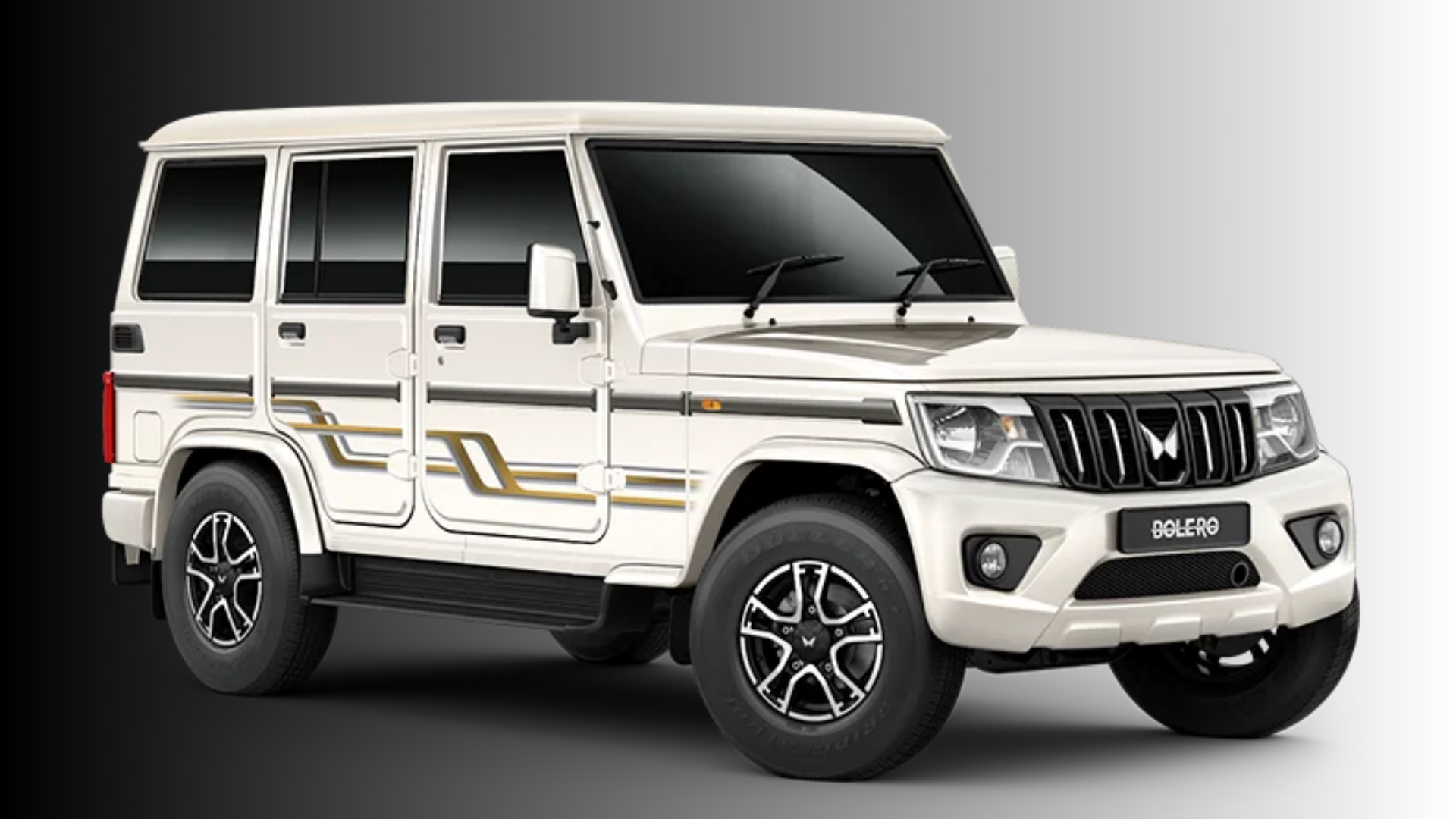
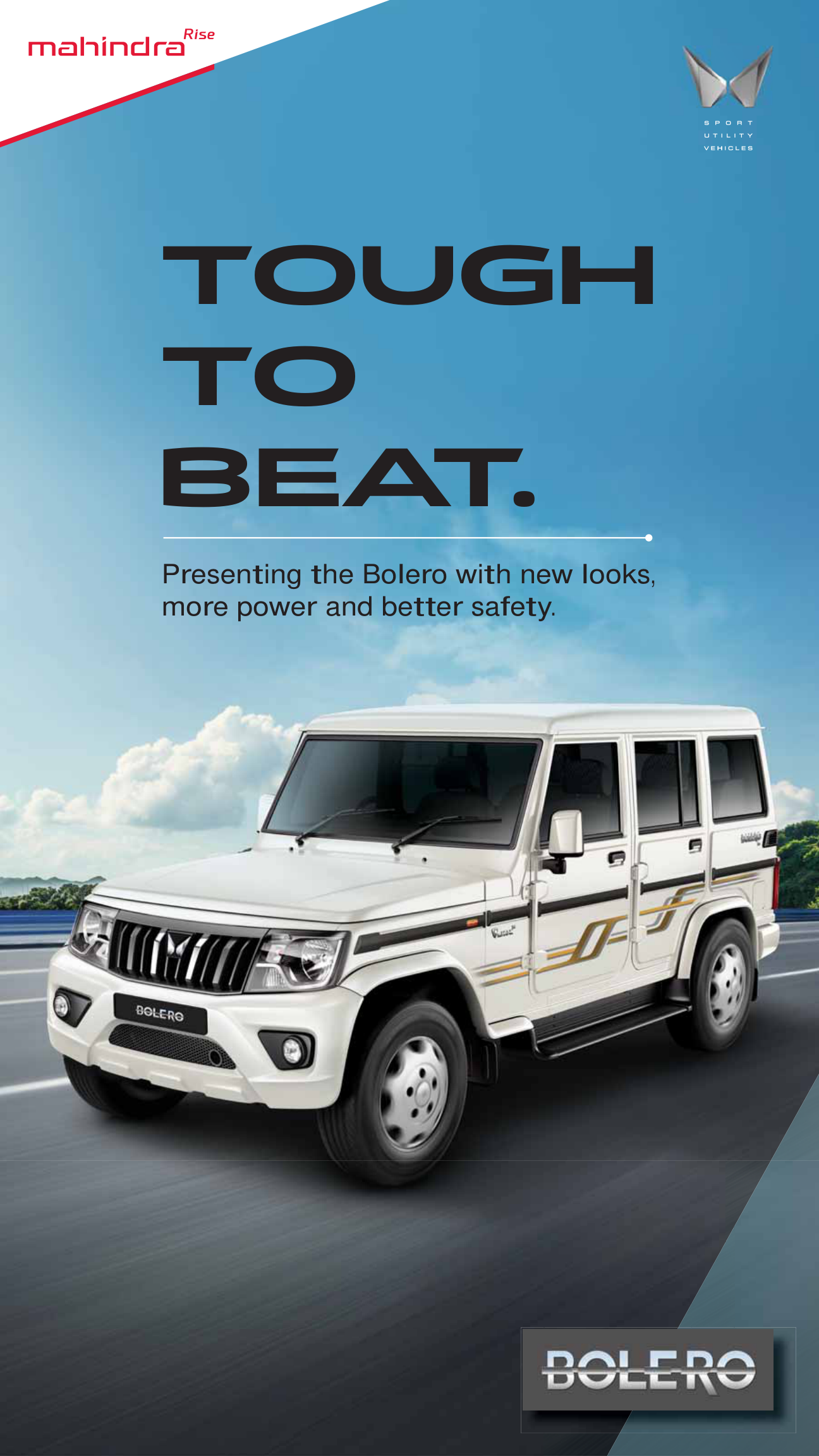
The Bolero's exterior design has always prioritised visual substance over stylistic sophistication, and the 2025 facelift retained that character.
The revised front grille adopts a wider, more prominent horizontal slat arrangement in place of the previous version's smaller-scale treatment. New fog lamp housings and revised bumper detailing refresh the face without changing the overall profile, which remains the same upright, boxy utility vehicle silhouette the Bolero has carried throughout its production life.
The body-on-frame construction and the tall 1880 mm height give the Bolero a commanding road presence that is especially useful in the mixed-traffic environments where the vehicle spends most of its time. The high shoulder line and upright proportions maximise interior volume for the body length, and the spare wheel mounted on the tailgate is standard across all variants.
The B8's 15-inch dual-tone alloy wheels are the most distinctive visual element in the current range, improving the top variant's exterior appearance noticeably over the steel wheel configurations of the lower trims.
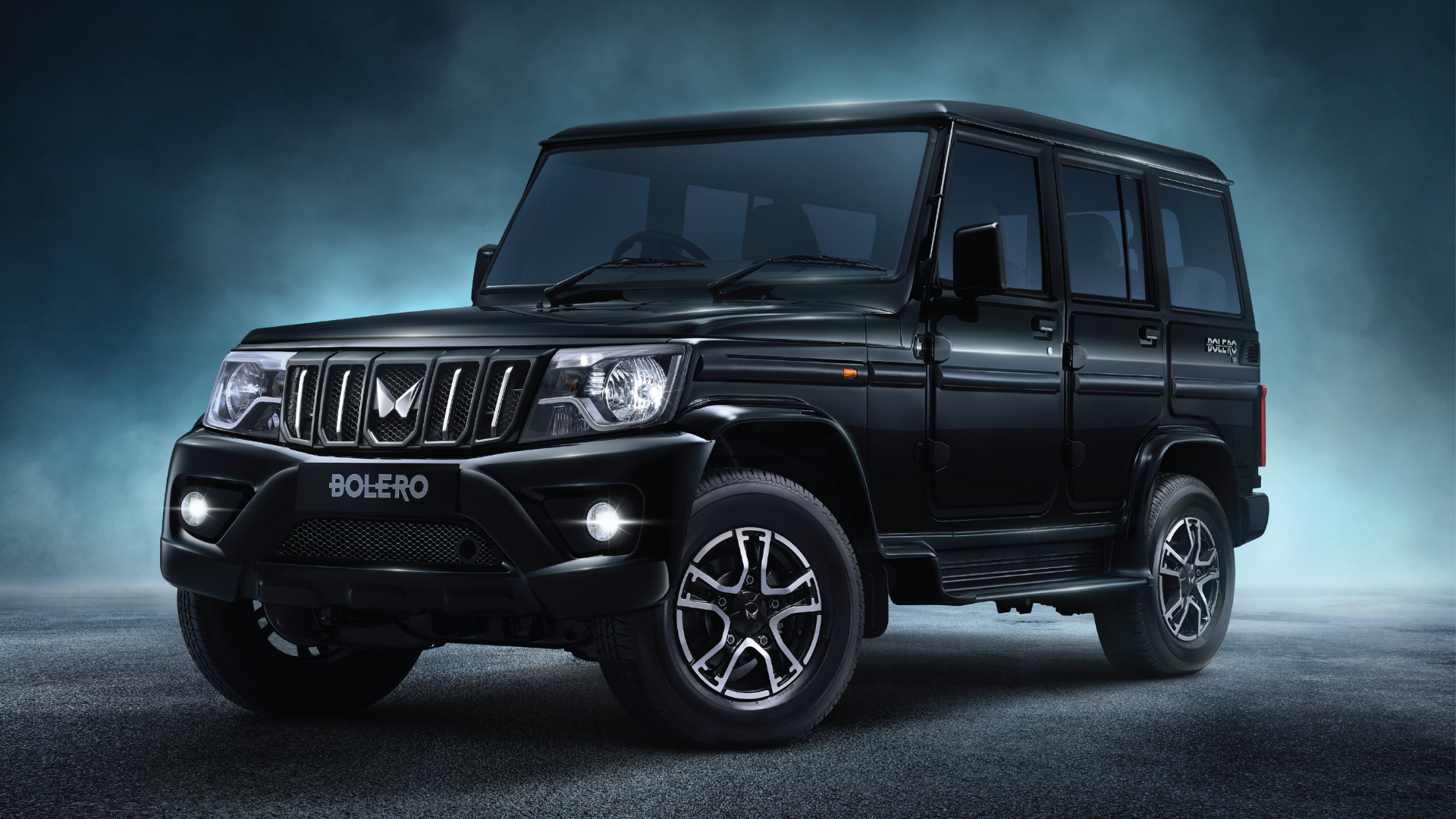
The Stealth Black exterior option on the B8 applies gloss black to every exterior panel including bumpers, mirrors, and wheels, creating a visually cohesive and striking overall effect that differentiates the top variant clearly from the rest of the range.
safety
safety
The Bolero's safety package is intentionally basic.
Dual front airbags, ABS with EBD, and rear parking sensors are the active and passive safety equipment available across all four variants, including the top B8. There is no ESP, no hill hold, no ISOFIX child seat mounts, no TPMS, no rear camera, and no driver assistance of any kind.
For the Bolero's primary buyers, this safety package has historically been considered acceptable, but for buyers who are evaluating the Bolero as a primary family vehicle for regular highway travel, the absence of ESP and additional airbags is a meaningful concern relative to alternatives in and around this price range.
The Bolero has not been independently tested by Global NCAP or Bharat NCAP under any current testing protocol, and no formal crash rating exists for any version of the current car.
competition
competition
The Bolero’s closest direct competitors are the Mahindra Bolero Neo and the Renault Triber.
The Bolero Neo offers a more compact overall length and slightly refined cabin materials, yet the standard Bolero counters with its longer 2680 mm wheelbase that translates into better rear-seat space and stability when carrying seven passengers or cargo.
The Triber provides modular seating arrangements and a wider range of modern convenience features, while the Bolero leads with its 210 Nm diesel torque, body-on-frame construction and higher load-carrying ability on rough roads.
Neither rival matches the Bolero’s long-term parts availability and proven fleet-duty record in rural and commercial applications.
final verdict
final verdict
The Mahindra Bolero is not trying to compete with modern compact crossovers, and evaluating it as if it were is the wrong frame of reference.
It is a body-on-frame, rear-wheel-drive diesel utility vehicle with a 60-litre fuel tank and seven seats, built for buyers who need exactly those attributes in markets where exactly those attributes matter most. By that measure, the 2025 facelift made it more complete without changing what it is.
As for the limitations, the engine is adequate rather than punchy, the cabin looks and feels basic no USB charging, no ISOFIX, and no independent crash rating. For a family buying the Bolero as their primary vehicle for regular highway travel with children, these gaps are consequential and alternatives should be seriously considered.
For a fleet operator, a rural buyer, or a commercial user who understands the Bolero's specific value and has factored these limitations into the decision, the vehicle's combination of durability, range, diesel efficiency, and accessible pricing remains difficult to replicate.
The B6(O) with its 7-inch touchscreen and front power windows represents the best everyday balance in the range. The B8 adds alloy wheels and leatherette seats for buyers who want the Bolero's character in its most visually polished form. The B4 remains the most affordable entry and serves buyers for whom the feature additions above it are genuinely unnecessary.
Mahindra Bolero News




Mahindra Bolero FAQs
What engine does the Bolero use?
−The Bolero runs a 1.5L mHawk75 diesel engine producing 76 hp at 3600 rpm and 210 Nm of torque between 1600–2200 rpm.
What is the fuel tank capacity?
+The Bolero has a 60-litre diesel tank.
How many people can the Bolero seat?
+It seats 7 passengers in a 5+2 configuration, with the rear two seats typically jump-style.
Does the Bolero have airbags and ABS?
+Yes, dual – driver and co-driver airbags, alongside Anti-lock Braking System (ABS) are standard across all variants.
Which variant gets a touchscreen infotainment system?
+The 17.8 cm touchscreen infotainment system is available on all variants except the base.
What is the mileage of the Bolero?
+16.5 km/l (ARAI claimed).
Does the Bolero have a touchscreen or Android Auto?
+A 7-inch touchscreen with Bluetooth is available from the B6(O) variant. Android Auto and Apple CarPlay are not supported on any Bolero variant.
What is the ground clearance of the Bolero?
+183 mm.
Is the Mahindra Bolero available in petrol, CNG, electric or diesel engines?
+The Bolero is currently available with Diesel engines.
What are the key safety features in the Bolero ?
+The Bolero comes equipped with several safety features including Anti-lock Braking System (ABS), Central Locking and Electronic Brakeforce Distribution (EBD).
What colours does the Mahindra Bolero come in?
+The Mahindra Bolero is available in the following colours: Diamond White and Dsat Silver.