

Mahindra Vision SXT
Mahindra Vision SXT Key Specifications
Mahindra Vision SXT Variants & Prices
Filter By Fuel type & Transmission type| Variant Details | Expected Price | |
|---|---|---|
Vision SXT Base Base Model | ₹ Price To Be Announced* |
Vision SXT Base
Mahindra Vision SXT Overview

The Mahindra Vision SXT represents a significant step in Mahindra’s dedicated electric vehicle roadmap, moving away from ICE-derived platforms to the purpose-built NU_IQ architecture. Unveiled as part of the broader Vision series in August 2025, the SXT is designed to sit between the existing XUV400 and the upcoming premium BE (Born Electric) range. This vehicle is part of a multi-car strategy including the Vision S, X, and T, all of which share a common design language focused on efficiency and futuristic styling. For the Indian buyer, the Vision SXT is expected to serve as a practical family SUV that prioritizes cabin space and long-distance travel capability. With production scheduled to commence in late 2027, the vehicle will likely undergo extensive testing across diverse Indian terrains to ensure battery reliability and thermal management. The positioning of the SXT suggests that Mahindra is targeting urban professionals and families who want to transition to electric mobility without compromising on the rugged SUV proportions the brand is known for. By utilizing the new platform, Mahindra can optimize the floor plan to provide a completely flat rear floor and better weight distribution, which should improve both handling and passenger comfort compared to older EV models.
Battery and Motor
The Mahindra Vision SXT is expected to offer two battery pack options to cater to different buyer needs and price points. The entry-level variants may feature a battery capacity of around 35kWh to 40kWh, while the long-range versions could get a larger 55kWh to 60kWh pack. Based on these capacities, the estimated MIDC (Modified Indian Drive Cycle) range is likely to fall between 400 km and 500 km on a single charge. The vehicle will utilize a Permanent Magnet Synchronous Motor (PMSM) mounted on the front axle for the standard models, delivering a power output of approximately 130 bhp to 170 bhp and torque figures in the range of 250 Nm to 310 Nm. This setup should allow the SUV to accelerate from 0 to 100 km/h in under 9 seconds. For charging, the Vision SXT will support CCS2 fast charging, allowing the battery to go from 10% to 80% in roughly 45 to 60 minutes using a 50kW DC fast charger. A standard 7.2kW AC wall box charger provided with the car may take 8 to 10 hours for a full charge at home. The battery chemistry is expected to be Lithium Iron Phosphate (LFP), which is known for its durability and better safety profile in high-temperature environments like India.
interior
Inside the cabin, the Mahindra Vision SXT will likely move towards a minimalist and tech-heavy layout facilitated by the flat floor of the NU_IQ platform. The center stage of the dashboard is expected to be occupied by a dual-screen setup, featuring a 10.25-inch or larger touchscreen infotainment system and a matching digital instrument cluster for the driver. Mahindra is expected to integrate its latest Adrenox connected car suite, offering over 60 connected features including remote climate control, geo-fencing, and vehicle health tracking. The use of sustainable and high-quality materials is expected, with soft-touch plastics on the dashboard and premium fabric or leatherette upholstery for the seats. Rear seat passengers will benefit from the dedicated EV platform, which provides more legroom and knee room than traditional SUVs of this size. Practical features such as a panoramic sunroof, dual-zone automatic climate control, and ventilated front seats are likely to be included in the top-end variants to stay competitive. Cargo space is expected to be generous, with a boot capacity ranging between 380 to 420 liters, along with a small "frunk" or front trunk for storing charging cables and smaller items.
exterior
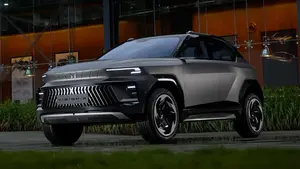
The exterior design of the Mahindra Vision SXT follows a modern "Born Electric" philosophy that emphasizes aerodynamics to maximize battery range. Teaser images and concept showcases indicate a front end dominated by a closed-off grille panel, which reduces air resistance. The lighting setup is expected to feature vertically stacked LED Daytime Running Lamps (DRLs) that create a distinct visual signature, likely connected by a thin LED light bar across the bonnet line. Reports suggest the SUV will have a length of approximately 4,300mm to 4,400mm, placing it firmly in the mid-size SUV category. To further enhance efficiency, the Vision SXT may offer flush-fitting door handles and aerodynamically optimized alloy wheels, likely in 17-inch or 18-inch sizes depending on the variant. The side profile will likely feature sharp character lines and a slightly sloping roofline to give it a sporty stance. At the rear, the vehicle is expected to carry a full-width LED tail lamp assembly and a prominent roof spoiler. The ground clearance is expected to be around 190mm to 200mm, which is a standard requirement for navigating Indian road conditions and water-logging. High-spec trims may also include a dual-tone paint scheme with a blacked-out roof and pillars to provide a floating effect.
competition
Upon its launch in 2028, the Mahindra Vision SXT will enter a highly competitive electric SUV space in India. Its primary rival will be the Tata Curvv.ev, which currently leads the segment with its unique coupe-SUV body style and multiple battery options. Other significant competitors include the MG ZS EV, which offers a premium cabin and a proven global platform. The Hyundai Creta EV and the Maruti Suzuki eVX (production version) will also be direct challengers, as both are expected to be available in the market by then with similar range and pricing brackets. While the Tata models focus on market dominance and widespread charging networks, Mahindra is likely to differentiate the Vision SXT through its rugged build quality, larger cabin space, and the specific technological advantages of the NU_IQ platform. The pricing overlap with upcoming electric models from Kia and Toyota will also mean that the Vision SXT must offer a superior feature-to-price ratio to attract buyers looking for a long-term electric vehicle investment.
Mahindra Vision SXT Car FAQs
Upcoming Cars
Mahindra Scorpio N facelift
₹13.80 Lakh Estimated
Aug 2026 Expected Launch

Mahindra Thar E
₹25 Lakh Estimated
Aug 2026 Expected Launch
Mahindra BE 07
₹29 Lakh Estimated
Mar 2027 Expected Launch

Mahindra Vision S
₹Price To Be Announced Estimated
Aug 2027 Expected Launch

Mahindra Vision T
₹Price To Be Announced Estimated
Dec 2027 Expected Launch