Tata's New Hyperion 1.5 TGDI Engine Explained
By Salil Kumar
Updated December 22, 2025

Tata Motors has engineered a major breakthrough with its in-house developed 1.5-litre TGDi petrol engine — a powertrain that places the brand firmly among global manufacturers capable of designing high-efficiency, performance-oriented petrol units.
First revealed at the 2023 Auto Expo, this engine combines cutting-edge combustion and emissions technologies with the robustness required for Indian roads and fuel conditions.
The Hyperion engine powered Tata Sierra just set NATRAX records for both Top Speed and fuel efficiency. Tata managed a staggering 222kmph and 29.9 kmpl. The mileage was achieved after 12 hours for continuous driving and 70 kmph average speed. You can watch the video here
Also Read- Tata Sierra-Top10 Features Explained
Developed at Tata’s Engineering Research Centre in Pune and its Coimbatore R&D facility, the 1.5-litre TGDi (Turbocharged Gasoline Direct Injection) engine produces around 170 PS at 5,000 rpm and 280 Nm of torque between 2,000 and 3,500 rpm.
With a displacement of 1,498 cc and a full-aluminium construction, it offers a power-to-weight ratio that rivals international turbo-petrol engines in its class. A smaller displacement version of the similar engine is being used in the current Curvv ICE range with 120PS output
Note-In the 2025 Tata Sierra this 1.5 TGDi is making 160 hp. The full 170hp is reserved for Harrier and Safari with this engine. This engine in Sierra is available form Adventure plus range onwards for an asking price of ₹17.99 lakhs
Advanced Turbocharging and Airflow Management
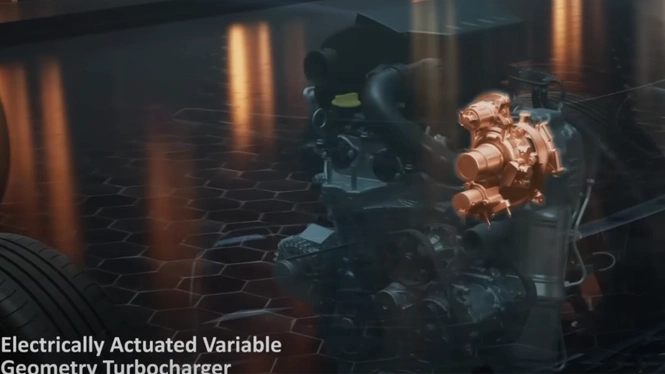
At the heart of the TGDi’s performance lies an electronically controlled variable-geometry turbocharger (eVGT). Unlike conventional fixed-geometry units, the eVGT uses an actuator to alter turbine vane angles in real time.
This allows the turbo to deliver strong boost at low rpm for instant response while maintaining high efficiency at top speeds.
The system effectively eliminates lag and provides a broad torque band, making the engine suitable for both city and highway driving.
Also Read- Tata Sierra VS Hyundai Creta Detailed Comparison
Complementing the turbo system is a centre-mounted dual variable valve timing system (VVT) that independently adjusts timing on both intake and exhaust camshafts.
This optimises airflow and combustion at every rpm, improving throttle response, fuel efficiency, and emissions control.
The central mounting reduces mechanical losses and ensures uniform timing control across all cylinders, leading to smoother performance.
Combustion Efficiency and Durability
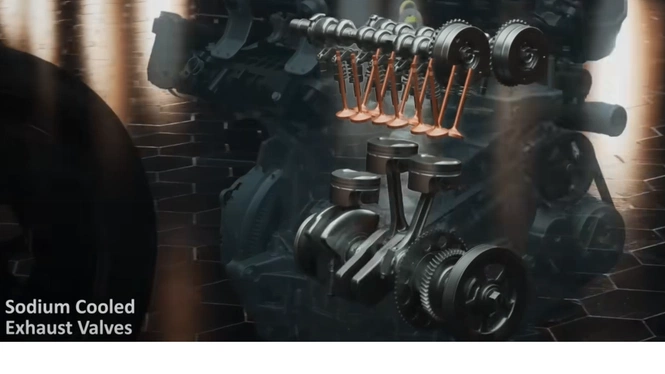
The engine’s combustion chamber has been precision-designed to handle high pressures and temperatures generated by turbocharging. It uses sodium-cooled exhaust valves, a feature usually found in high-performance engines.
These valves contain hollow stems partially filled with sodium that liquefies when heated. During operation, the liquid sodium circulates heat away from the valve head to the stem, reducing thermal stress and preventing valve seat wear.
This allows the engine to sustain high exhaust gas temperatures safely, improving reliability under continuous load.
To further enhance durability and efficiency, Tata employs friction-optimised steel piston rings.
These rings have a low-tension design and a specialised surface coating that reduces mechanical drag between the piston and cylinder wall. Lower internal friction directly translates to better fuel economy, reduced oil consumption, and longer engine life without compromising sealing performance.
Emissions Control and Thermal Management
The TGDi engine features an integrated exhaust manifold that channels gases through a three-way catalytic converter positioned close to the engine block.
This configuration ensures rapid light-off (quick heating of the catalyst) after startup, allowing early reduction of hydrocarbons, carbon monoxide, and nitrogen oxides.
The three-way catalyst simultaneously supports oxidation and reduction reactions, enabling the engine to meet Bharat Stage 6 Phase 2 standards and compatibility with E20 ethanol-blend fuels.
Tata’s engineers have focused heavily on thermal management.
Alongside the sodium-cooled valves, the engine uses a high-capacity intercooler and a variable-flow oil pump to regulate temperature under different loads. The combined system maintains consistent performance without detonation, even in extreme ambient conditions.
Modular and Future-Ready Design
The TGDi’s all-aluminium block, eVGT turbo, and adaptable ECU architecture make it a modular platform ready for hybrid integration or future emission upgrades. Its compact dimensions and balanced NVH characteristics allow it to power multiple upcoming Tata models, including the and Sierra and later safari and Harrier
With this engine, Tata Motors has demonstrated complete technical ownership from design and calibration to testing and emissions validation. The 1.5-litre TGDi is not just a new engine; it is the foundation for Tata’s next generation of performance-focused and cleaner internal combustion vehicles
| Specification | Details |
|---|---|
| Engine Type | 1.5-litre Turbocharged Gasoline Direct Injection (TGDi) |
| Displacement | 1,498 cc |
| Cylinders | Inline-4, all-aluminium |
| Max Power | 158 hp (Sierra), 160 hp (Harrier) |
| Peak Torque | 255 NM (Sierra), 280nm (Harrier) |
| Turbocharger | Electronically controlled Variable Geometry (eVGT) |
| Valve System | Centre-mounted Dual Variable Valve Timing (VVT) |
| Exhaust Valves | Sodium-cooled, high-temperature design |
| Piston Rings | Friction-optimised steel, low-tension |
| Emission Control | Three-way catalytic converter, BS6 Phase 2 compliant |
| Fuel Compatibility | Petrol, E20 ethanol blend |
| Models | Tata Sierra, Safari, harrier |
Table of Contents
- Advanced Turbocharging and Airflow Management
- Combustion Efficiency and Durability
- Emissions Control and Thermal Management
- Modular and Future-Ready Design
Join the Conversation
Trending

Five Chinese Cars That Could Shake Up the Indian Market
Chinese carmakers BYD, Denza and Jetour could bring five new SUVs, a luxury MPV and a high-performance electric grand tourer to India, with expected prices ranging from Rs 18 lakh to Rs 1.35 crore.
Anmol Kumar
October 23, 2026

Denza India Debut Set for November 13, Z9 GT and D9 Expected as First Models
Denza has confirmed its India entry, with the Z9 GT and D9 MPV expected as its first models. Prices could range from around Rs 90 lakh to Rs 1.5 crore, with no launch date announced yet.
Anmol Kumar
October 23, 2026
Top 10 Petrol Cars With Best Mileage You Can Buy
A list of the 10 most fuel-efficient petrol cars in India, including their claimed mileage, prices, engines and key features.
Arjun Nair
October 23, 2026

Featured
Citroen C3 Review: Who Should Consider This Car?
A few days ago, I took the Citroen C3X out for a spin in the city and on the highways. I travelled long distances and checked its fuel efficiency, features, comfort, and other factors. Today, I’ll briefly share my overall experience with the C3X and will tell you whether you should consider it or not and which is the most value-for-money variant of the lot.
Vatsal Agrawal
May 19, 2026

Tesla Finally In India Officially. Why Now And What Does It Mean For EVs?
The much-anticipated 2025 Tesla Model Y has officially arrived in India, marking a pivotal moment for the nation's burgeoning electric vehicle market. Launched on July 15, 2025, the Model Y Juniper facelift offers cutting-edge technology, impressive range, and signature Tesla performance. Positioned as a premium electric SUV, its entry will intensify competition and reshape consumer expectations for EVs across the subcontinent.
Author
July 17, 2025

Here Are 10 Things The Harrier.EV Offers That The Mahindra XEV 9E Doesn't
The Harrier.EV is an incredible new offer from Tata. Its most popular competitor would be the Mahindra XEV 9E, priced similarly. With these two incredible offerings from home grown brands available, here is a list of everything the Harrier.EV offers that the XEV 9E doesn't.
Author
June 13, 2025

Write a comment
Comments
No comments yet. Be the first to comment!