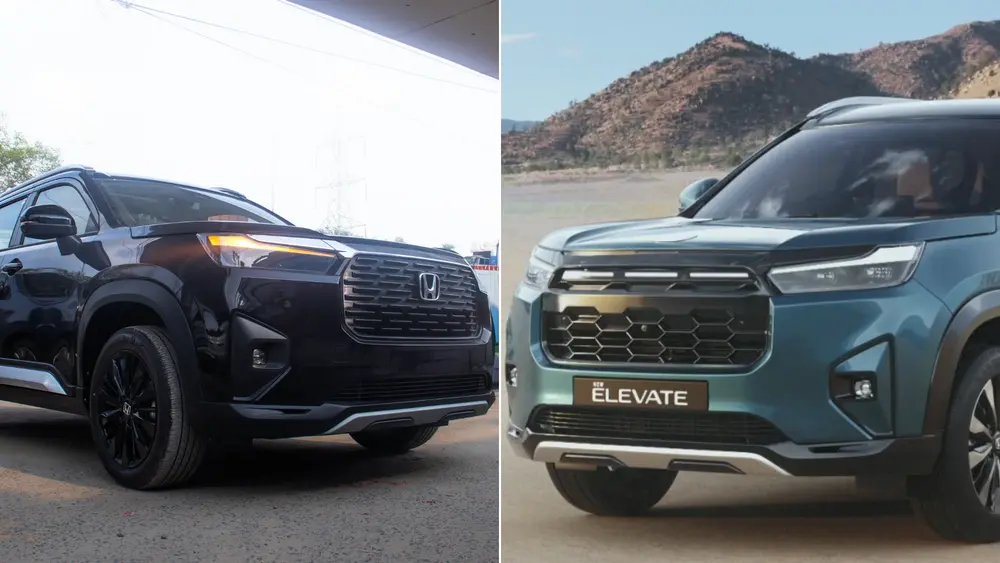
Quick Read - The 2026 Honda Elevate facelift gets sharper styling, more features, ventilated rear seats, a 360-degree camera and improved ADAS. The 1.5-litre petrol engine and basic dimensions remain unchanged, while new ZX+ and ZX+ Black variants expand the range.
The Honda Elevate has received its first major update since its India debut in 2023. However, the 2026 model is still a facelift rather than a new-generation SUV. Honda has retained the basic platform, dimensions and 1.5-litre naturally aspirated petrol engine, but has significantly expanded the equipment list and given the SUV a more premium look and feel.
The biggest changes are therefore concentrated around the exterior styling, cabin features, parking technology, braking hardware and ADAS functionality. Here is a detailed old-versus-new comparison.
Also Read - 2026 Honda Elevate Facelift Every Variant Explained
Exterior Design
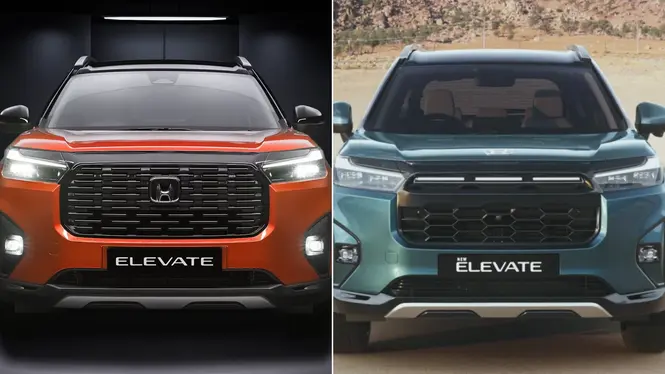
The original Elevate had a straightforward and upright SUV design. Its front end featured a large grille with chrome detailing, slim LED headlamps and L-shaped LED daytime running lights, while the overall body had a squared-off stance with a long bonnet and relatively clean side profile.
The 2026 facelift retains these fundamental proportions, so it still looks unmistakably like an Elevate, but Honda has made the front and rear considerably more contemporary. The biggest change is the new gloss-black honeycomb grille, while the LED lighting signature has been revised with segmented light elements extending towards the centre of the grille.
The Honda logo has also been repositioned closer to the bonnet edge.
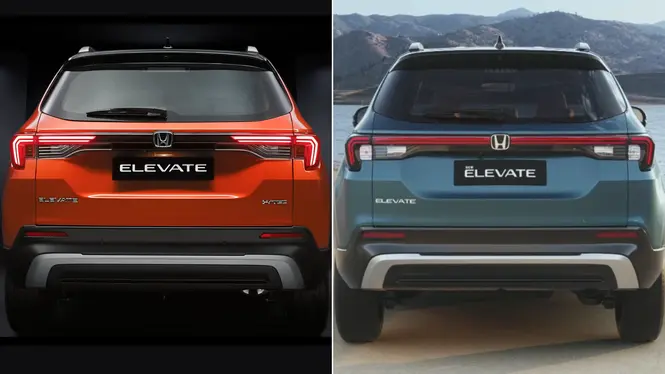
At the rear, the previously separate tail-lamps are now visually linked by a horizontal LED light bar, giving the SUV a wider appearance.
The lower bumper and exterior black cladding have also been revised, while the new model gets a fresh Nordic Forest Pearl colour and updated 17-inch alloy wheels. The important point is that Honda has not changed the Elevate's basic proportions, ground clearance or overall silhouette, so the facelift is evolutionary rather than radical.
| Exterior element | Old Elevate | New Elevate |
|---|---|---|
| Design theme | Simple, upright SUV | Sharper, more premium SUV |
| Front grille | Chrome-heavy design | Gloss-black honeycomb grille |
| Front lighting | L-shaped LED signature | Revised segmented LED lighting |
| Honda logo | Grille-mounted | Moved towards bonnet edge |
| Rear lighting | Separate tail-lamps | Connected LED light bar |
| Alloy wheels | 17-inch design | Revised 17-inch dark-finish design |
| New colour | Existing colour palette | Nordic Forest Pearl added |
The result is a more modern-looking Elevate without sacrificing the original SUV character. The old model had a more conservative appearance, while the new one uses black exterior elements and connected lighting to bring it closer visually to newer rivals.
It is worth noting that this is not a dimensional redesign. Buyers are essentially getting the same familiar Elevate body underneath the revised styling, which means the new model retains the old car's 220mm ground clearance and 458-litre boot.
Also Read - Top 10 Big SUVs Under ₹15 Lakh
Interior Design and Features
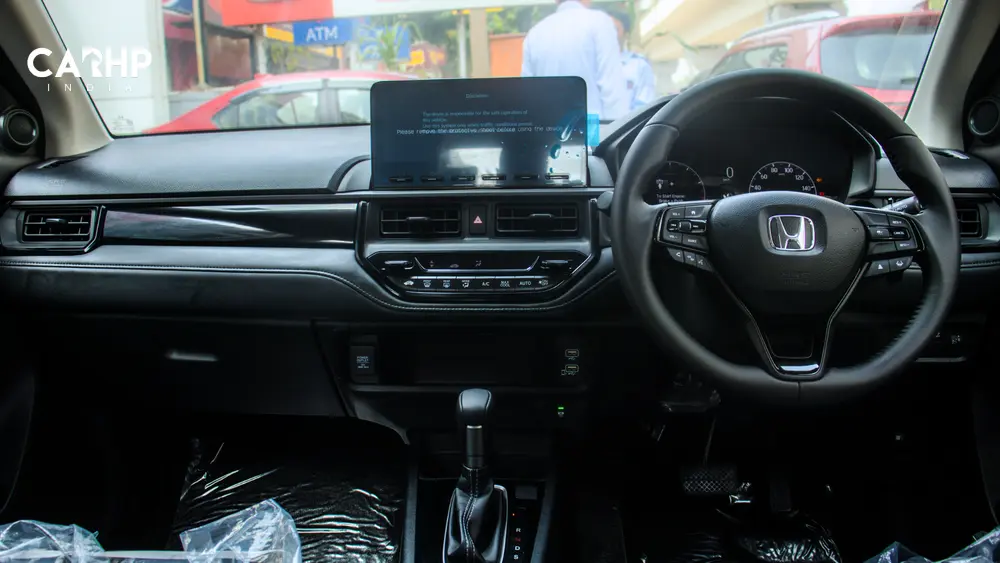
The interior is where the facelift makes a much more noticeable difference than the exterior. The old Elevate had a functional and ergonomically sensible dashboard, but it was criticised for looking relatively plain compared with feature-heavy rivals.
It already offered useful equipment such as a touchscreen infotainment system, wireless Apple CarPlay and Android Auto, wireless charging, automatic climate control, rear AC vents, a single-pane electric sunroof and a part-digital instrument cluster.
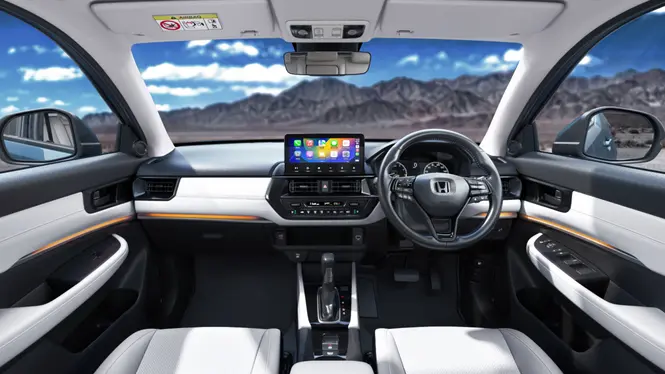
The new Elevate retains the familiar dashboard architecture but gives it a more premium treatment with additional leatherette surfaces, revised upholstery and a lighter cabin theme on regular variants.
More importantly, Honda has added several features that were missing from the outgoing car. These include ventilated front seats, powered front seats on the top variants, factory-fitted ambient lighting, USB Type-C ports, an air purifier with PM2.5 filtration and a 360-degree camera.
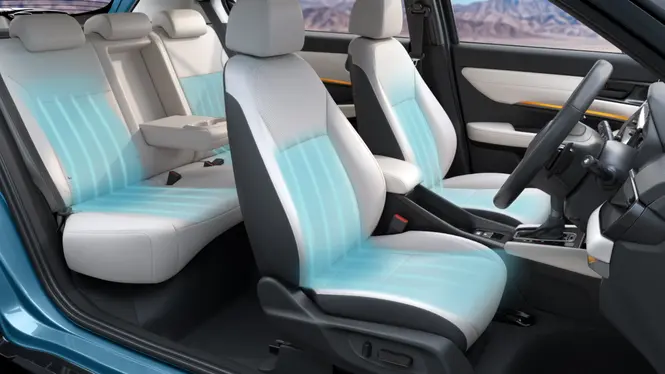
The biggest comfort upgrade is the availability of ventilated rear seats, which Honda positions as a segment-first feature.
| Interior feature | Old Elevate | New Elevate |
|---|---|---|
| Front ventilated seats | No | Yes |
| Rear ventilated seats | No | Yes |
| Powered front seats | No | Yes, top variants |
| 360-degree camera | Not factory-fitted | Yes, top variant |
| Ambient lighting | Accessory | Factory-fitted |
| Air purifier | No | Yes |
| PM2.5 filtration | No | Yes |
| USB Type-C | Limited/older setup | Added |
| 10.25-inch touchscreen | Higher variants | Retained |
| Sunroof | Single-pane | Single-pane |
Honda has also worked on one of the old Elevate's weaker areas, cabin refinement. Additional sound-deadening material has been used around the dashboard and wheel wells to reduce engine, tyre and road noise.
Also Read - Cheapest Cars With Ventilated Seats
Prices and Variants
The pricing strategy is interesting because Honda has kept the entry price unchanged while expanding the upper end of the range. The old Elevate was offered in SV, V, VX and ZX trims, with the ZX acting as the flagship. The facelift introduces the new ZX+ variant above the ZX, along with a ZX+ Black version.
The entry-level SV manual continues to start at Rs 11.80 lakh ex-showroom, meaning there is no increase at the bottom of the range.
However, prices rise progressively for comparable V, VX and ZX variants, with the biggest like-for-like increase being around Rs 53,000 for the ZX CVT. The new ZX+ takes the range substantially higher, with the ZX+ CVT priced at Rs 18.30 lakh and the ZX+ Black CVT reaching Rs 18.40 lakh.
This gives Honda considerably more room to offer premium equipment at the top of the range than it had with the outgoing SUV.
| Variant | Old Elevate | New Elevate |
|---|---|---|
| SV MT | Rs 11.80 lakh | Rs 11.80 lakh |
| V MT | Rs 12.27 lakh | Rs 12.29 lakh |
| V CVT | Rs 13.43 lakh | Rs 13.79 lakh |
| VX MT | Rs 13.92 lakh | Rs 13.93 lakh |
| VX CVT | Rs 15.08 lakh | Rs 15.39 lakh |
| ZX MT | Rs 15.18 lakh | Rs 15.39 lakh |
| ZX CVT | Rs 16.36 lakh | Rs 16.89 lakh |
| ZX+ MT | Not available | Rs 16.80 lakh |
| ZX+ CVT | Not available | Rs 18.30 lakh |
| ZX+ Black CVT | Not available | Rs 18.40 lakh |
The variant expansion is important because the new ZX+ is not simply a cosmetic flagship. It is designed to justify its higher price with equipment such as powered front seats, ventilated front and rear seats, a 360-degree camera, additional parking assistance and other premium features.
Engine and Powertrains
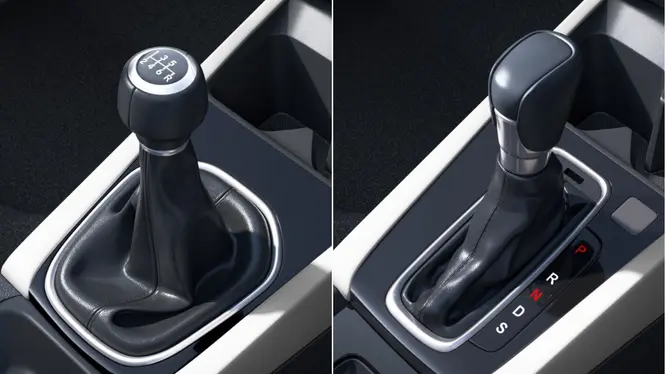
There is virtually no mechanical transformation between the two generations of Elevate. The new model continues with the same 1.5-litre naturally aspirated four-cylinder petrol engine that powered the original SUV. It produces 121 PS and 145 Nm and can be paired with either a 6-speed manual gearbox or a CVT automatic.
There is still no turbo-petrol engine, diesel engine, CNG version or strong-hybrid powertrain.
| Powertrain | Old/New Elevate |
|---|---|
| Engine | 1.5L naturally aspirated petrol |
| Power | 121 PS |
| Torque | 145 Nm |
| Manual | 6-speed MT |
| Automatic | CVT |
| Hybrid | No |
| Diesel | No |
| Turbo petrol | No |
| Claimed MT efficiency | 15.31 kmpl (old) |
| Claimed CVT efficiency | 16.92 kmpl (old) |
In other words, the 2026 Elevate is mechanically familiar rather than genuinely new.
Also Read - Honda's Upcoming Compact SUV Could Get Horse Powertrain's 1.2-Litre Engine
Safety
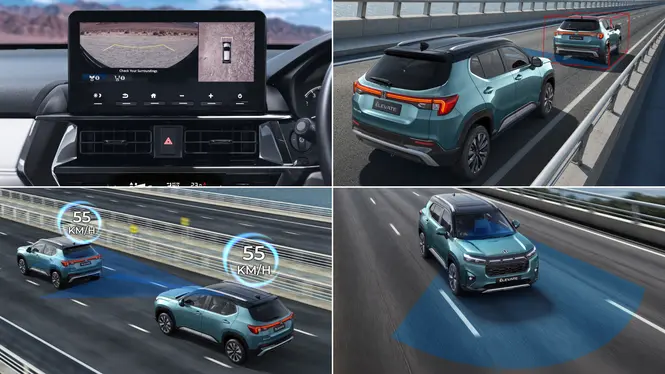
The original Elevate was already well equipped with core safety technology, particularly after Honda made six airbags standard across the range. It also had electronic stability control, traction control, hill-start assist, ABS with EBD, rear parking sensors, ISOFIX child-seat mounts and three-point seatbelts for all occupants.
Higher variants were equipped with Honda Sensing, bringing functions such as collision mitigation braking, adaptive cruise control, lane keeping assistance, road departure mitigation and auto high-beam assistance.
The facelift builds on this foundation rather than replacing it. The most significant additions are the 360-degree camera, front parking sensors, rear disc brakes on CVT versions and an electronic parking brake with Auto Hold.
The ADAS package has also been improved, with adaptive cruise control gaining a low-speed follow function on applicable versions.
| Safety feature | Old Elevate | New Elevate |
|---|---|---|
| Six airbags | Yes | Yes |
| ABS with EBD | Yes | Yes |
| Electronic stability control | Yes | Yes |
| Traction control | Yes | Yes |
| Hill-start assist | Yes | Yes |
| Honda Sensing ADAS | Higher variants | Higher variants |
| 360-degree camera | No factory system | Yes |
| Front parking sensors | No | Yes, top variant |
| Rear parking sensors | Yes | Yes |
| Electronic parking brake | No | Yes on CVT variants |
| Auto Hold | No | Yes on CVT variants |
| Rear disc brakes | No | Yes on CVT variants |
| Low-speed adaptive cruise | No | Yes |
The 360-degree camera gives the driver a much clearer view around the vehicle, front parking sensors make the SUV easier to position in tight spaces, and the electronic parking brake with Auto Hold makes stop-and-go driving more convenient. The updated ADAS functionality also makes the system more useful in congested traffic.
Also Read - Cheapest Cars With ADAS You Can Buy Right Now
Should you consider the New Elevate?
The answer is no, especially if you were already planning to buy an entry-level or lower-mid variant of the Elevate as they have received no new features.
With the new model now launched, the outgoing Elevate can be had with even bigger discounts, and the usual Diwali and festive-season offers could make the older SUV an even more attractive proposition.
For buyers who were already willing to spend Rs 15-18 lakh or more on top variants of the new Honda SUV, the new model makes more sense, particularly because of top trim additions such as the 360-degree camera and improved ADAS functionality, ventilated seats etc.
However, the cosmetic changes alone are not enough to justify paying a significant premium. The old Elevate still looks quite impressive and has aged well, so choosing the new model purely for its exterior design would be difficult to justify.
The same applies to the interior. While the facelift brings more features and a slightly more premium feel, the fundamental dashboard design remains familiar, meaning the outgoing model does not suddenly feel outdated. For most buyers shopping in the lower and mid-range variants, the heavily discounted old Elevate could therefore offer better value, while the new model makes more sense for buyers specifically looking for its additional technology and premium features.
Image Source: Honda India
Table of Contents
- Exterior Design
- Interior Design and Features
- Prices and Variants
- Engine and Powertrains
- Safety
- Should you consider the New Elevate?
Join the Conversation
Trending
MG Hector Blackstorm and Snowstorm Launched at Rs 20 Lakh
MG has launched the limited-edition Hector Blackstorm and Snowstorm at Rs 19.99 lakh each. Both come only as a 5-seater turbo petrol CVT, and a red-accented accessory pack gets fitted free at the dealership.
Anmol Kumar
October 7, 2026
Every Car With a Sunroof Under ₹15 Lakh
This list includes a variety of models, from premium hatchbacks to compact SUVs.
Arjun Nair
October 7, 2026
Top 10 SUVs with the Highest Ground Clearance
Ranging from compact SUVs to large, 7-seater SUVs, these models offer enough ground clearance to tackle most Indian roads.
Arjun Nair
October 7, 2026
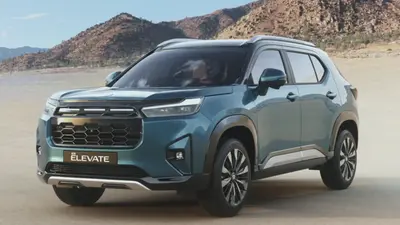
Featured
Citroen C3 Review: Who Should Consider This Car?
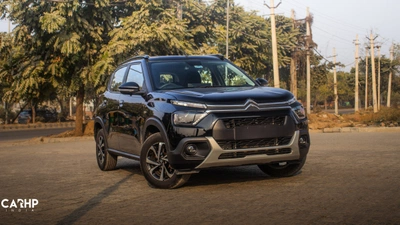
A few days ago, I took the Citroen C3X out for a spin in the city and on the highways. I travelled long distances and checked its fuel efficiency, features, comfort, and other factors. Today, I’ll briefly share my overall experience with the C3X and will tell you whether you should consider it or not and which is the most value-for-money variant of the lot.
Vatsal Agrawal
May 19, 2026
Tesla Finally In India Officially. Why Now And What Does It Mean For EVs?
The much-anticipated 2025 Tesla Model Y has officially arrived in India, marking a pivotal moment for the nation's burgeoning electric vehicle market. Launched on July 15, 2025, the Model Y Juniper facelift offers cutting-edge technology, impressive range, and signature Tesla performance. Positioned as a premium electric SUV, its entry will intensify competition and reshape consumer expectations for EVs across the subcontinent.
Author
July 17, 2025
Here Are 10 Things The Harrier.EV Offers That The Mahindra XEV 9E Doesn't
The Harrier.EV is an incredible new offer from Tata. Its most popular competitor would be the Mahindra XEV 9E, priced similarly. With these two incredible offerings from home grown brands available, here is a list of everything the Harrier.EV offers that the XEV 9E doesn't.
Author
June 13, 2025
Write a comment
Comments
No comments yet. Be the first to comment!