Universo Ferrari 2026 New Delhi: First India Exhibition Featuring Ferrari Luce EV, F80, F50, 12Cilindri, and More
By Arjun Nair
Updated October 27, 2026
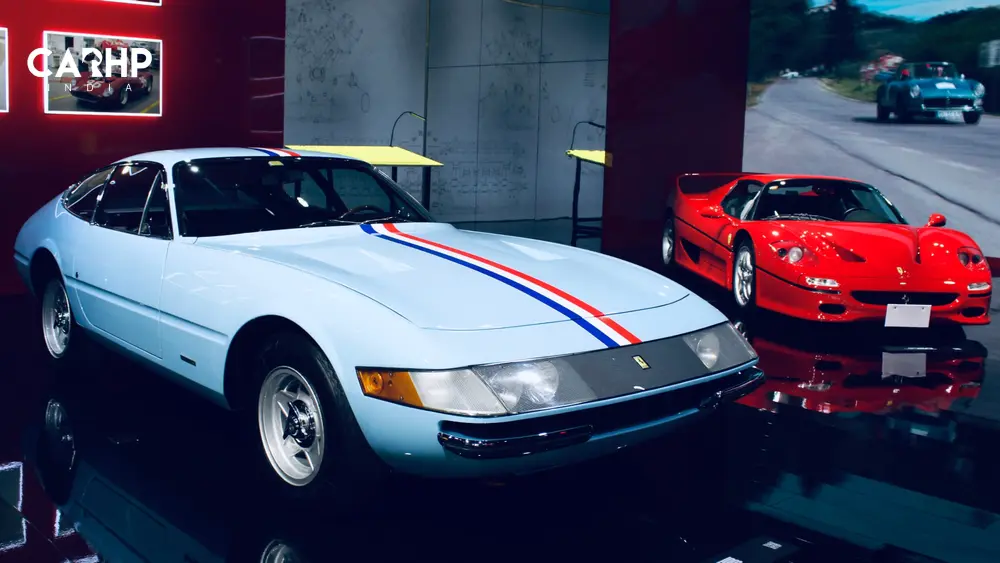
Ferrari has opened the doors to Universo Ferrari in India, and the Prancing Horse has taken over Yashobhoomi in Dwarka, New Delhi.
This is the first time the immersive exhibition is being held in the country and the fifth edition overall, after earlier stops in Italy, Australia, South Korea and Thailand.
I got the opportunity to attend the Media Day on October 17, getting an early walk through the exhibition.
Exotic Cars on Display
Ferrari Luce
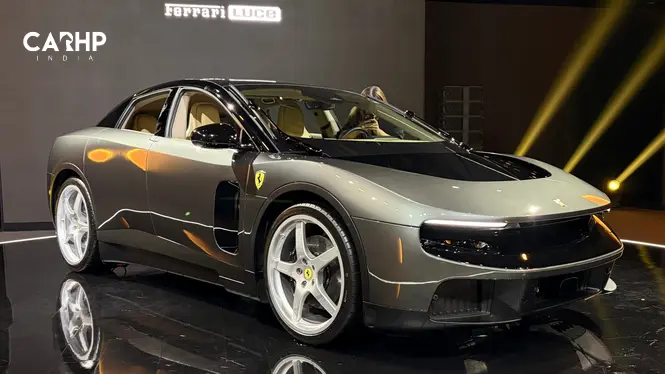
The Luce is Ferrari’s first fully electric car and the major highlight of the show, making its India debut here.
It uses four electric motors, one at each wheel, with a combined output of about 1,035 bhp. The 122 kWh battery gives a claimed range of over 530 km (WLTP).
Ferrari claims 0 to 100 km/h in 2.5 seconds and a top speed above 310 km/h. It is also the first Ferrari with five seats and four doors.
Ferrari has not announced any India launch or price.
Ferrari F80
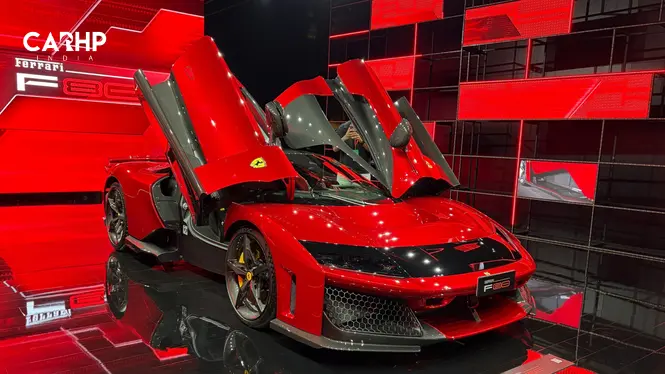
The F80 is Ferrari’s most powerful road car ever and the successor to the LaFerrari. It uses a 3.0-litre twin-turbo V6, derived from the 499P race car, along with three electric motors for a combined 1,184 bhp.
It does 0 to 100 km/h in 2.15 seconds, 0 to 200 km/h in 5.75 seconds, and has a top speed of 350 km/h.
Its cabin has a unique 1+ seating layout. Only 799 units will be built, and all are already sold.
Ferrari 849 Testarossa Spider
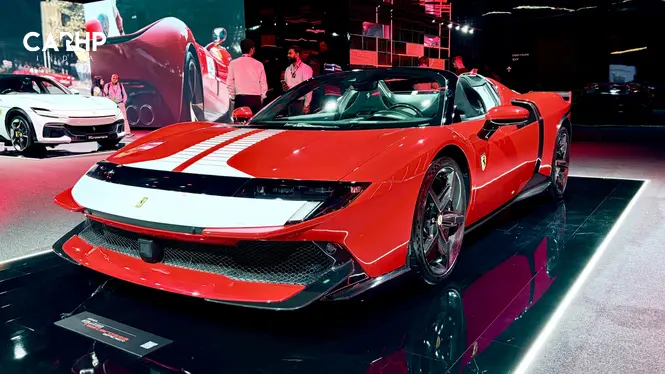
The 849 Testarossa replaces the SF90 Stradale as Ferrari’s plug-in hybrid flagship and revives a legendary name.
A 4.0-litre twin-turbo V8 makes 819 bhp, and three electric motors take the combined output to 1,036 bhp. Power goes to all four wheels through an 8-speed dual-clutch gearbox.
Ferrari claims 0 to 100 km/h in under 2.3 seconds and a top speed of over 330 km/h. The 7.45 kWh battery allows around 25 km of electric-only driving.
The name “849” refers to its eight cylinders and 499 cc per cylinder, and Ferrari offers both a coupe and a Spider.
Ferrari 12Cilindri Manuale
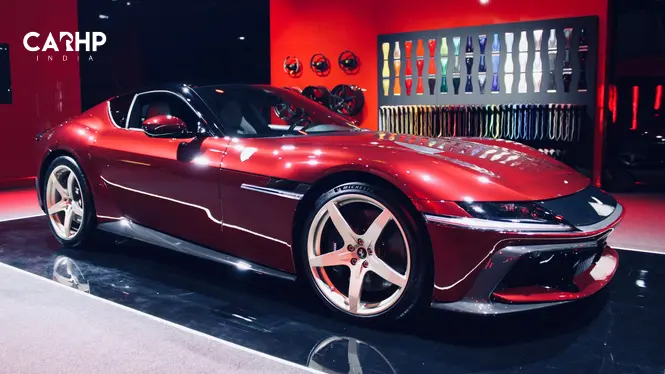
This is a limited-edition version of the 12Cilindri, limited to just 1,499 units worldwide.
The 6.5-litre naturally aspirated V12 makes 819 bhp and revs up to 9,500 rpm.
What makes it special is the new Manuale By-Wire system, offering a real clutch pedal and a metal gated shifter, but it works through the 8-speed dual-clutch gearbox, and drivers can switch to automatic anytime.
Ferrari claims 0 to 100 km/h in around 3 seconds and a top speed above 340 km/h.
The number 1,499 is a nod to the displacement of Ferrari’s first V12 engine.
Ferrari 12Cilindri Spider
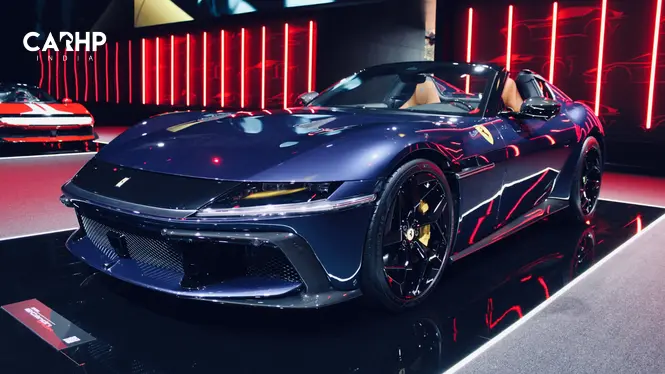
The 12Cilindri Spider is the open-top version of Ferrari’s front-engined V12 grand tourer.
It uses the same 6.5-litre naturally aspirated V12 as the coupe, making about 819 bhp at 9,250 rpm and 678 Nm. The 8-speed dual-clutch gearbox sends power to the rear wheels.
0 to 100 km/h comes in around 3 seconds, with a top speed above 340 km/h.
The retractable hard top opens or closes in about 14 seconds and works at speeds up to 45 km/h.
Ferrari Purosangue
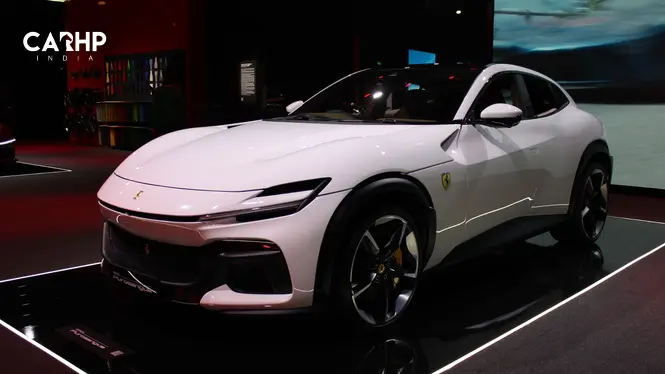
The Purosangue is Ferrari’s first four-door, four-seat car.
Under the long bonnet sits a 6.5-litre naturally aspirated V12 that makes 715 bhp and 716 Nm. Power goes to all four wheels through an 8-speed dual-clutch gearbox.
Rivals like the Lamborghini Urus rely on turbocharged V8 engines, so a V12 gives the Purosangue a very different character. The rear doors are rear-hinged and open in a coach-door style, which makes getting in and out easier.
Ferrari avoids calling it an SUV, as the car sits lower and has a front-mid engine layout.
Ferrari Amalfi Spider
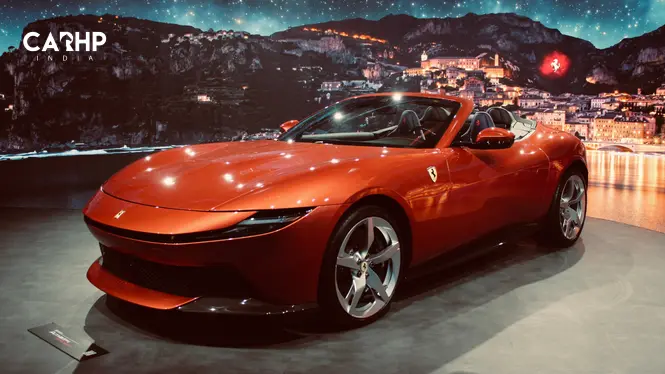
The Amalfi Spider is the open-top version of the Amalfi and replaces the Roma Spider.
A 3.9-litre twin-turbo V8 makes about 631 bhp and 760 Nm, which is enough for 0 to 100 km/h in 3.3 seconds and a top speed of 320 km/h. The fabric roof opens or closes in 13.5 seconds, even at speeds up to 60 km/h.
Boot space is 255 litres with the roof up. A wind deflector built into the rear seat keeps the cabin calm when driving with the roof down.
It is a 2+ layout, so the rear seats are best for short trips or luggage.
Also Read - Ferrari Amalfi Spider Globally Unveiled
Motorsport Displays
As a motorsport, and especially F1 fan, this section of the display stood out for me the most.
Ferrari 499P
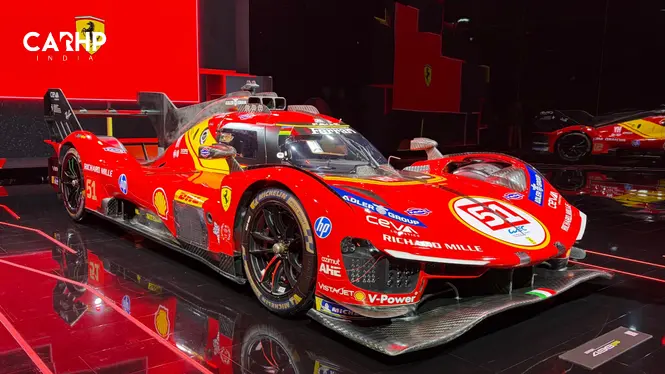
The 499P is the Le Mans Hypercar that returned Ferrari to the top of endurance racing.
It uses a 3.0-litre twin-turbo V6 along with an electric motor on the front axle, and the maximum output is limited to 500 kW (about 671 bhp) by the rules. Minimum weight is 1,030 kg.
It is a three-time consecutive Le Mans winner, taking victories in 2023, 2024, and 2025.
Ferrari SF-26
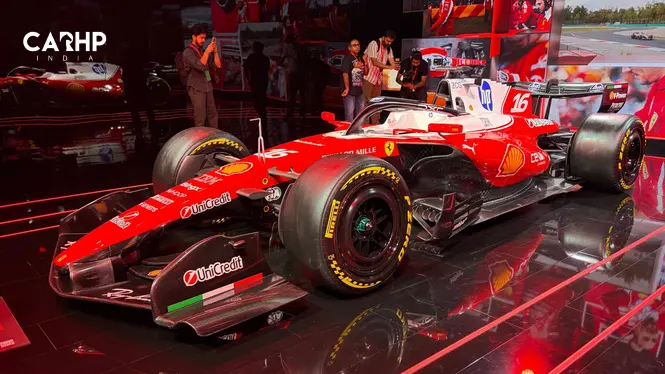
The SF-26 is the car Scuderia Ferrari is racing in the 2026 Formula 1 season, driven by Charles Leclerc and Lewis Hamilton.
It is Ferrari’s first car built for the all-new 2026 regulations, which bring smaller, lighter cars and a much bigger role for electric power, with the MGU-K rated at 350 kW.
It has won the Spanish Grand Prix (with Hamilton) and the British Grand Prix (with Leclerc) this year.
Ferrari 296 GT3 and 296 Challenge
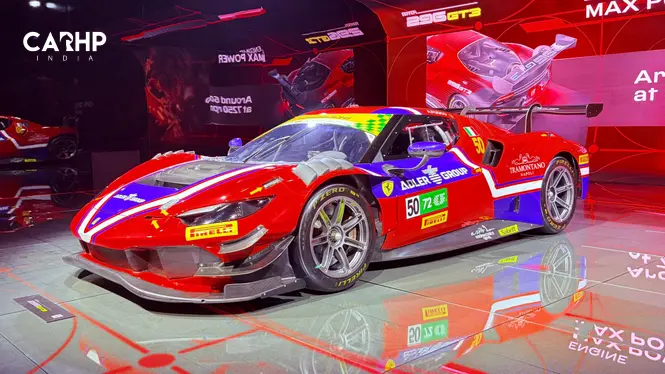
These two track cars are cousins of the road-going 296 GTB.
The 296 GT3 is a customer race car built for GT3 racing, with power capped by regulations at around 592 bhp.
The 296 Challenge is built for Ferrari’s own single-make Challenge series. It drops the hybrid system, which saves around 140 kg, and its 3.0-litre twin-turbo V6 makes about 690 bhp.
Both use the same V6 family as the 296 GTB, and the Challenge car borrows a lot of its aerodynamics from the GT3.
Classiche Cars
Ferrari F50
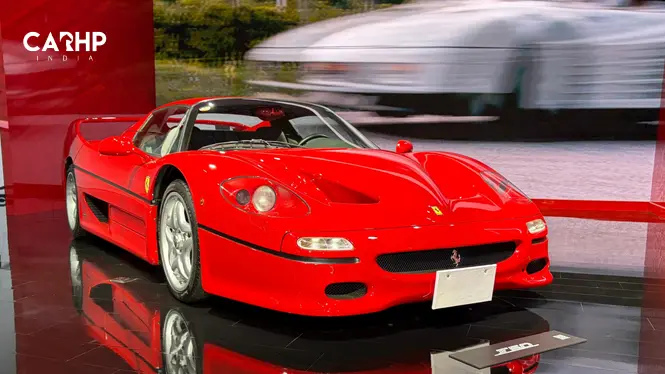
The F50 was built in 1995 to celebrate Ferrari’s 50th anniversary and was designed to feel like a road-legal Formula 1 car.
Its 4.7-litre naturally aspirated V12 is derived from Ferrari’s F1 engine of the time and makes about 513 bhp. The engine is mounted directly to the carbon-fibre monocoque and works as a structural part of the car. It has a 6-speed manual gearbox, a removable hardtop and a top speed of around 325 km/h.
Only 349 units were built, and today it is among the most sought-after modern classics.
Ferrari 365 GTB/4 Daytona
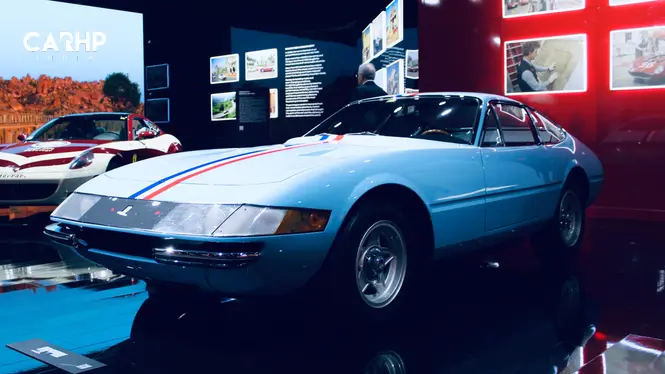
The 365 GTB/4 was unveiled at the Paris Salon in 1968 and became one of Ferrari’s most loved grand tourers.
It has a 4.4-litre front-mounted V12 that makes around 347 bhp, with a 5-speed manual gearbox and a top speed of about 280 km/h. The sharp, wedge-like design was done by Pininfarina’s Leonardo Fioravanti.
The “Daytona” nickname came after Ferrari’s 1-2-3 finish at the 1967 24 Hours of Daytona, though the factory never officially used the name.
It was the last of Ferrari’s classic front-engined V12 sports cars of that era.
Ferrari 612 Scaglietti (Magic India Discovery Tour Car)
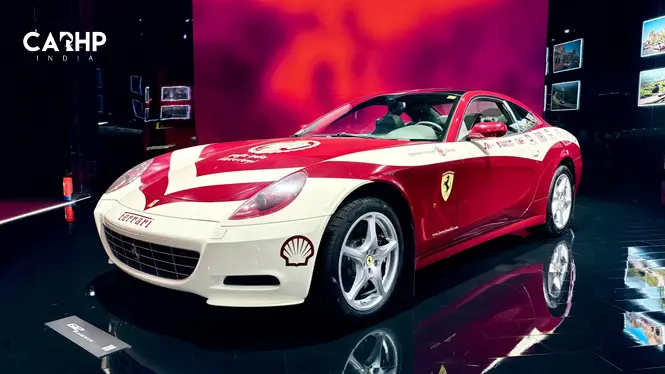
This is the most India-specific car at the event.
The 612 Scaglietti is a 2+2 grand tourer with a 5.7-litre V12 making about 532 bhp and an aluminium spaceframe body. This particular car took part in the 2008 Magic India Discovery Tour, covering around 13,000 km across the country.
More than 50 international journalists drove it during the tour, which introduced India’s roads and landscapes to a global audience.
Icona Series
Ferrari Daytona SP3 and its 840 cv V12 Engine
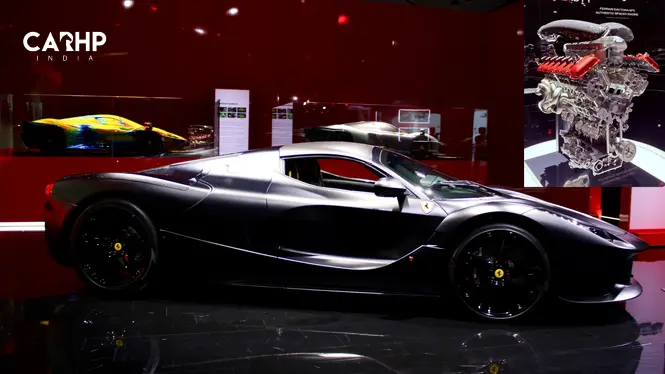
The Daytona SP3 belongs to Ferrari’s limited Icona series and pays tribute to the 1967 Daytona 1-2-3 finish, with design inspired by the 330 P3/4 and 412 P race cars.
Since the displayed model is a test prototype and not a production model, it is donning a LaFerrari disguise.
The engine is the star here, and it sits on a stand-alone display. This 6.5-litre naturally aspirated V12 makes 840 cv (about 829 bhp) and revs to 9,250 rpm, which makes it Ferrari’s most powerful road-car V12 without turbos.
Ferrari claims 0 to 100 km/h in 2.85 seconds and a top speed above 340 km/h.
Why Ferrari Is Doing This
With this exhibition, Ferrari is aiming to deepen its footprint in a fast-growing luxury market, engage a new generation of Indian enthusiasts and collectors, and reinforce long-term brand exclusivity.
The brand has also created an official Instagram handle for the Indian market: @Ferrari.Indiaofficial.
Universo Ferrari is on until November 1, 2026.
Table of Contents
- Exotic Cars on Display
- Motorsport Displays
- Classiche Cars
- Why Ferrari Is Doing This
Join the Conversation
Trending
Every Car With a Sunroof Under ₹15 Lakh
This list includes a variety of models, from premium hatchbacks to compact SUVs.
Arjun Nair
October 27, 2026

2026 Hyundai Bayon Every Variant Explained
The Hyundai Bayon gets seven variants priced from ₹9.99 lakh to ₹18 lakh. The HX5 offers the best balance, while the HX8 adds ventilated seats and the HX10 gets dual 12.3-inch displays and ADAS. Here’s what each variant offers and whether it’s worth the price.
Anmol Kumar
October 27, 2026
Every 4 Cylinder Cars You Can Buy Under 10 lakhs
Four-cylinder engines run smoother, quieter and with less vibration than the three-cylinder motors that dominate today's entry-level cars. Here is every 4-cylinder car you can buy in India for under ten lakhs right now.
Salil Kumar
October 27, 2026
Hyundai Bayon Launched at Rs 9.99 Lakh, With 115 PS and Level 2 ADAS
The Hyundai Bayon has launched in India at an introductory price of Rs 9.99 lakh. It is powered by a 115 PS 1.5-litre petrol engine with manual and iVT options, and gets dual 12.3-inch displays, a panoramic sunroof, ventilated front seats, a Bose sound system and 23-function Level 2 Pro ADAS.
Anmol Kumar
October 27, 2026
Featured
Citroen C3 Review: Who Should Consider This Car?
A few days ago, I took the Citroen C3X out for a spin in the city and on the highways. I travelled long distances and checked its fuel efficiency, features, comfort, and other factors. Today, I’ll briefly share my overall experience with the C3X and will tell you whether you should consider it or not and which is the most value-for-money variant of the lot.
Vatsal Agrawal
May 19, 2026
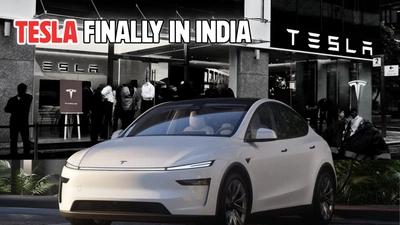
Tesla Finally In India Officially. Why Now And What Does It Mean For EVs?
The much-anticipated 2025 Tesla Model Y has officially arrived in India, marking a pivotal moment for the nation's burgeoning electric vehicle market. Launched on July 15, 2025, the Model Y Juniper facelift offers cutting-edge technology, impressive range, and signature Tesla performance. Positioned as a premium electric SUV, its entry will intensify competition and reshape consumer expectations for EVs across the subcontinent.
Author
July 17, 2025
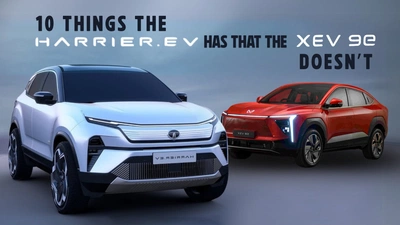
Here Are 10 Things The Harrier.EV Offers That The Mahindra XEV 9E Doesn't
The Harrier.EV is an incredible new offer from Tata. Its most popular competitor would be the Mahindra XEV 9E, priced similarly. With these two incredible offerings from home grown brands available, here is a list of everything the Harrier.EV offers that the XEV 9E doesn't.
Author
June 13, 2025
Write a comment
Comments
No comments yet. Be the first to comment!