
EMI Loading
TVS XL100 Key Specifications
TVS XL100 Variants & Prices
| Variant Details | Ex. Showroom Price | |
|---|---|---|
XL100 Heavy Duty Base Model | ₹ 48250* | |
XL100 Heavy Duty i Touch Start65 kmph | 65 kmpl | 99.7 cc | ₹ 57460* | |
XL100 Heavy Duty i Touch Start Win Edition65 kmph | 65 kmpl | 99.7 cc | ₹ 59,980* |
XL100 Heavy Duty
XL100 Heavy Duty i Touch Start
XL100 Heavy Duty i Touch Start Win Edition
Pros & Cons of TVS XL100
Things We Like
- Exceptional load-carrying capacity with its flat floorboard and removable seat.
- Extremely low purchase price and minimal long-term running costs.
Things We Don't Like
- Engine performance is strictly limited to low speeds; unsuitable for highways.
- Lacks any form of enclosed storage, unlike conventional scooters.
TVS XL100 Overview

Engine, Performance and Mileage
Engine, Performance and Mileage
The heart of the TVS XL100 is its 99.7cc, single-cylinder, 4-stroke engine, now equipped with TVS's EcoThrust Fuel-injection (ET-Fi) system. The specifications are modest: it produces 3.2 kW (4.4 PS) of power at 6,000 RPM and 6.5 Nm of torque at 3,500 RPM. These figures are significantly lower than even 100cc commuter motorcycles, but they reveal the engine's true purpose. The peak torque arrives early in the rev range, which is critical for its primary function: hauling loads from a standstill. The transmission is a single-speed gearbox with a centrifugal clutch, simplifying operation to a 'twist-and-go' affair without the complexity of a scooter's CVT.
In urban traffic, the XL100 is manageable, offering adequate initial acceleration for speeds up to 40 km/h. Beyond this, progress is slow, with a top speed realistically limited to around 60 km/h. Highway use is not its intended environment. The fuel injection system has improved throttle response and eliminated the cold start issues of older carbureted models. Fuel efficiency is a key metric; while ARAI figures are optimistic, a real-world return of 55-65 kmpl under mixed-use with moderate load is a realistic expectation, making its running costs exceptionally low.
posture comfort
posture comfort
Comfort and practicality are the very reasons for the XL100's existence, albeit defined differently from a conventional two-wheeler. The rider's seat is long, wide, and well-padded, designed for long hours of use. The riding posture is completely upright and neutral, with an easy-to-reach handlebar, minimising fatigue. Pillion comfort is also reasonable for short journeys. The moped's standout practical feature is its exceptional load-carrying ability. The large, flat floorboard is famously used to transport everything from gas cylinders to agricultural produce. This is further enhanced by the removable pillion seat, which transforms the rear section into a dedicated luggage platform.
Unlike scooters, the XL100 has no underseat storage or enclosed glovebox; its practicality is external and scalable. The 4-litre fuel tank may seem small, but combined with its high fuel efficiency, it provides a usable range of over 200 km. Heat management is a non-issue due to the low-stress, air-cooled engine and exposed frame. This vehicle is fundamentally a small-scale utility vehicle, and its comfort is derived from its ability to perform its task without straining the rider.
handling ride quality
handling ride quality
The XL100’s chassis and suspension are engineered for durability over comfort. It employs a telescopic fork at the front and twin hydraulic shock absorbers at the rear. This setup is tuned to be stiff to manage its rated payload of 130 kg. When ridden solo without any load, the ride is firm and can feel jarring over sharp bumps. However, with a pillion or some cargo, the suspension settles and absorbs imperfections more competently. Its key handling advantage comes from its 16-inch spoked wheels, which are larger than the 10 or 12-inch wheels on most scooters.
This larger diameter allows it to roll over potholes and navigate broken rural roads with greater stability and less effort. With a kerb weight of just 89 kg, it is incredibly agile in dense traffic, allowing for effortless filtering. Cornering is not its forte; the simple chassis and utilitarian tyres are designed for low-speed manoeuvrability, not spirited riding. Braking duties are handled by 110mm drum brakes on both wheels. While a disc brake option is absent, the system is augmented by TVS’s Synchronized Braking Technology (SBT), which is a combined braking system (CBS). For its performance envelope, the braking is adequate and predictable, providing sufficient stopping power for its operational speeds.
design
design
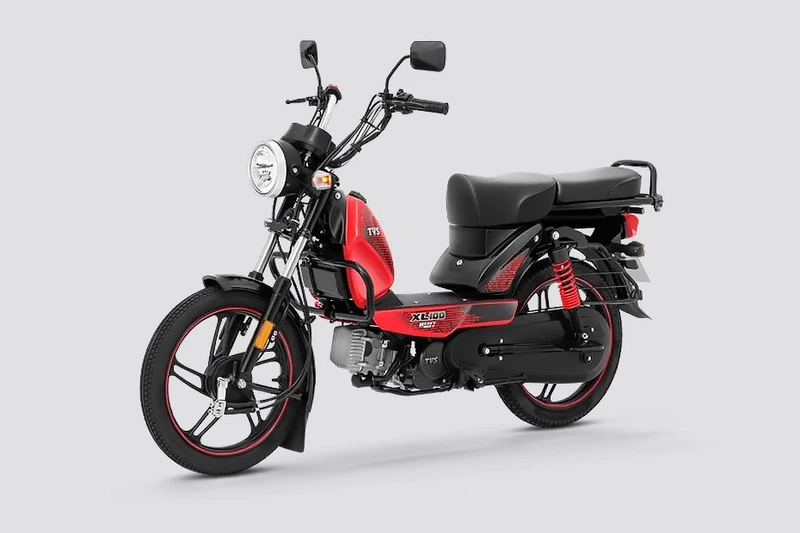
The design of the TVS XL100 is a study in functionalism, remaining largely unchanged for decades. Form strictly follows function, with an exposed tubular frame, minimal body panels, and a focus on durability and ease of repair. It is a tool, not a style statement. The lighting system consists of a basic halogen headlamp and bulb-type indicators and tail lamp, which provide acceptable illumination for low-speed urban and rural environments but are outclassed by the LED units found on competitors. The instrument cluster is fully analogue, featuring a speedometer, an odometer, and a fuel gauge, prioritising readability over information density. Where the XL100 integrates modern technology, it does so with purpose.
The introduction of the i-TOUCHstart system provides a silent, one-touch starter, a significant refinement over older models. Higher variants are equipped with a USB charging port, a crucial feature for users like delivery agents who rely on their smartphones. The most significant feature, however, is its inherent modularity. The split seat design with a removable pillion seat instantly creates a large, flat luggage rack. It lacks modern digital displays, Bluetooth connectivity, or riding modes, focusing its budget entirely on core utility.
safety
safety
The safety equipment on the TVS XL100 is compliant with the mandatory regulations for its category in India but is minimal by modern standards. The primary active safety feature is the Synchronized Braking Technology (SBT). This system automatically applies a portion of the front brake force when the rear brake is engaged, helping to balance the vehicle during braking and reduce stopping distances, especially for novice riders. This is particularly important given the use of drum brakes at both ends, which lack the sharp initial bite of a disc brake. The moped does not offer an Anti-lock Braking System (ABS) or traction control, which are not mandated for this sub-125cc segment.
Passive safety is aided by the large 16-inch wheels that provide better stability on poor road surfaces compared to smaller scooter wheels. The vehicle includes a side-stand engine cut-off switch, a critical feature that prevents the rider from moving with the stand engaged. Visibility to other road users is standard, with the halogen headlamp offering adequate presence but falling short of the conspicuity provided by modern LED DRLs. In essence, the safety package is foundational, relying more on the vehicle's low top speed and predictable handling than on advanced electronic aids.
competition
competition
The TVS XL100 has no direct moped competitors, forcing buyers to consider alternatives from different segments at a similar price point.
Hero HF Deluxe:
This 100cc commuter motorcycle is a primary alternative. It offers a 4-speed manual gearbox, providing better control over power delivery and potentially higher fuel efficiency on open roads.
Differentiator: The HF Deluxe provides a more conventional motorcycling experience with superior high-speed stability and ride quality, making it a better choice for longer commutes than the XL100.
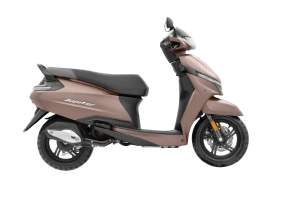
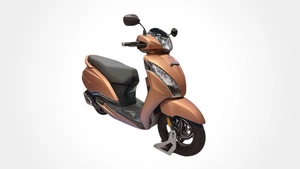
TVS Jupiter 110:
A benchmark 110cc family scooter, often priced slightly higher. It brings a level of convenience and features the XL100 cannot match, including a vast 21-litre underseat storage bay, an external fuel filler cap, and better weather protection.
Differentiator: The Jupiter 110’s primary advantage is its massive, secure storage and superior urban convenience, making it ideal for users who need to carry personal belongings safely rather than oversized cargo.
Bajaj CT 110X:
This is a rugged commuter motorcycle built to tackle poor road conditions. It features a more powerful 115cc engine (8.6 PS), thicker crash guards, and a luggage rack as standard, positioning it as a durable personal commuter.
Differentiator: The CT 110X offers significantly better engine performance and superior suspension comfort, making it a more capable and comfortable vehicle for navigating challenging semi-urban and rural terrains for personal travel.
buying advice
buying advice
Who should buy it?
The TVS XL100 is exclusively for small business owners, rural users, and last-mile delivery services. If your primary need is a low-cost, reliable, and simple vehicle to transport heavy or oversized goods over short distances, nothing else comes close to its utility-per-rupee proposition.
Who should skip it?
Buyers seeking personal comfort, modern features, weather protection, enclosed storage, or highway capability should avoid it. A conventional scooter like the TVS Jupiter or a commuter motorcycle like the Hero Splendor+ would be a far more suitable choice for daily personal transportation and commuting.
TVS XL100 Specifications & Features
Engine & Transmission
| Starting | Kick Start Only |
| Engine Type | 4 Stroke Single Cylinder |
| Displacement | 99.7 cc |
| Max Torque | 6.5 Nm @ 3500 rpm |
| Number of Cylinders | 1 |
| Cooling System | Air Cooled |
| Fuel Supply | Fuel Injection |
| Gear Box | Single Speed Gear Box |
| Bore | 51 mm |
| Stroke | 48.8 mm |
| Emission Type | BS6.2 |
| Clutch | Centrifugal Wet Clutch |
| spark plugs per cylinder | 1 Per Cylinder |
Motor & Battery
| Drive Type | Chain Drive |
| Transmission | Automatic |
| Peak Power | 4.35 PS @ 6000 rpm |
Mileage & Performance
| Overall Mileage | 65 kmpl |
Performance
| Top Speed | 65 kmph |
Chassis & Suspension
| Body Type | Moped Scooters |
Tyres & Brakes
| Front Brake Diameter | 110 mm |
| Rear Brake Diameter | 110 mm |
Dimensions & Capacity
| Width | 670 mm |
| Length | 1895 mm |
| Height | 1077 mm |
| Fuel Capacity | 4 L |
| Ground Clearance | 158 mm |
| Wheelbase | 1228 mm |
| Kerb Weight | 88 Kg |
| Load Carrying Capacity | 150 Kg |
| Fuel Reserve | 1.25 L |
| Seat Height | 787 mm |
| pillion grab rail | |
| pillion seat |
Electricals
| Headlight | Halogen |
| Taillight | Bulb |
| Turn Signal Lamp | Bulb |
| Low Fuel Indicator | |
| Drls |
Features & Safety
| Fuel Gauge | Analog |
| Braking Type | Synchronized Braking System |
Features
| Instrument Console | Analogue |
| Speedometer | Analogue |
| Tripmeter | Analogue |
| Seat Type | Single |
| Passenger Footrest | |
| Odometer | Analogue |
| Body Graphics |
Underpinnings
| Suspension Front | Telescopic Hydraulic spring type |
| Suspension Rear | Swing arm with hydraulic shocks |
| Brakes Front | Drum |
| Brakes Rear | Drum |
| Tyre Size | Front :- 2.5-16 Rear :-2.5-16 |
| Wheel Size | Front :-406.4 mm,Rear :-406.4 mm |
| Wheels Type | Spoke |
| first service | 500-750 Kms/30 Days |
| second service | 2500-3000 Kms/90 Days |
| third service | 5000-6000 Kms/180 Days |
| Tyre Type | Tube |
TVS XL100 Price in Cities
₹ 0.55 Lakh - 0.73 Lakh
₹ 0.48 Lakh - 0.72 Lakh
₹ 0.53 Lakh - 0.72 Lakh
₹ 0.48 Lakh - 0.72 Lakh
₹ 0.53 Lakh - 0.70 Lakh
₹ 0.55 Lakh - 0.74 Lakh
₹ 0.52 Lakh - 0.73 Lakh
₹ 0.52 Lakh - 0.69 Lakh
₹ 0.59 Lakh - 0.75 Lakh
₹ 0.55 Lakh - 0.74 Lakh