Toyota Rumion
Overall Rating

Toyota Rumion
Overall Rating
EMI Loading
Toyota Rumion Key Specifications
Toyota Rumion Highlights

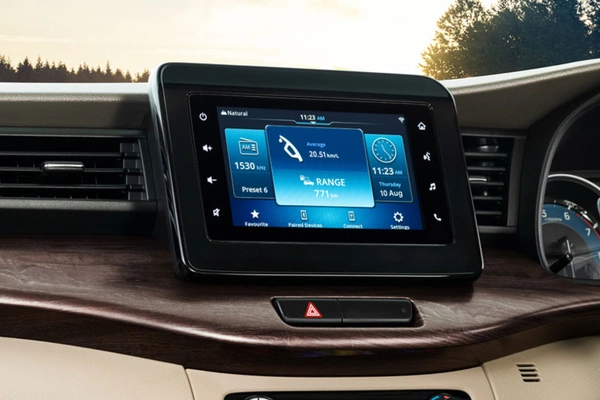
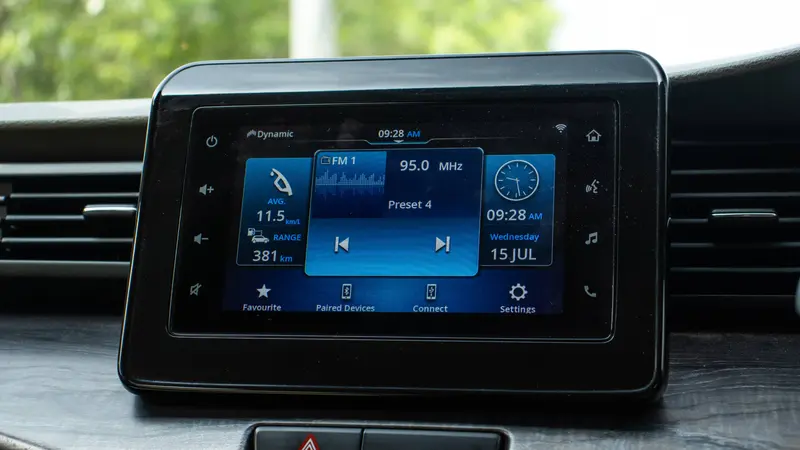
7-inch system with wireless Android Auto & Apple CarPlay.
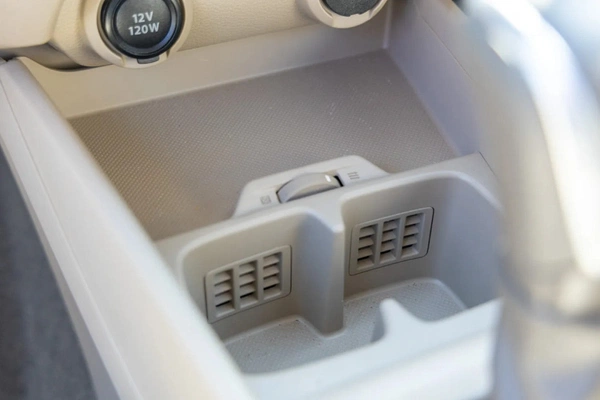
Cooled cup holders.
Toyota Rumion Overview

The Ertiga has been the benchmark compact MPV in India for years, and the badge engineered Rumion is pretty much the same car with a Toyota badge slapped on it.
The question is, whether the Toyota premium over Ertiga variants buys you anything meaningful or whether it is a badge tax dressed up as value.
Current pricing runs from Rs 9.79 lakh for the base E variant to Rs 14.21 lakh for the top-spec V Automatic, ex-showroom. The lineup spans 4 trim levels: E, S, G and V.
In September 2025, Toyota made six airbags standard across the entire range, which meaningfully changed the safety calculus for buyers on the E, S and G variants. This review covers the current, updated lineup and is relevant to anyone making a buying decision today.
Engine and Performance
Engine and Performance
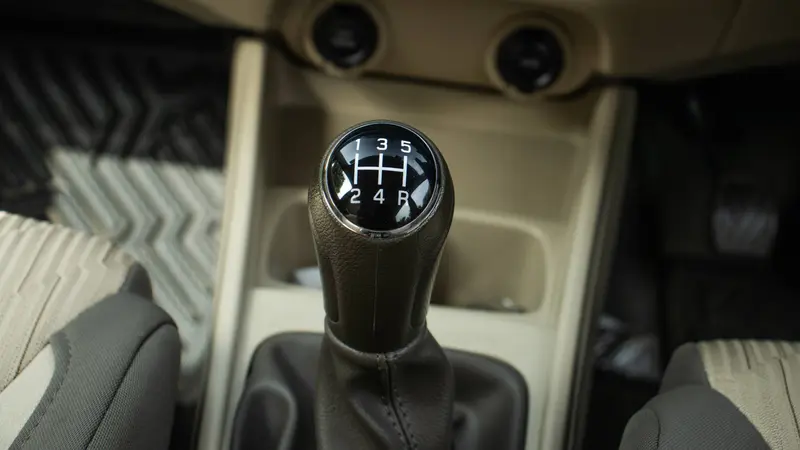
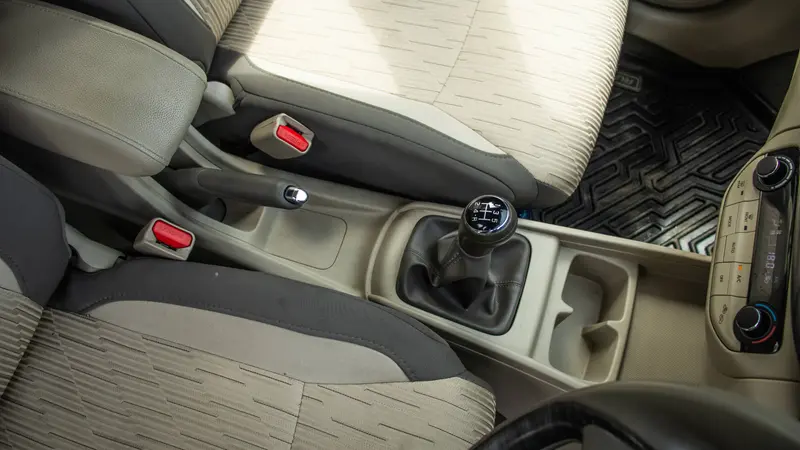
The 1.5-litre K15C petrol with the manual gearbox is the version that suits a driver who wants to extract the most from the engine. The five-speed gearbox has a light, short-throw action, and the clutch is progressive enough that city driving with it is never fatiguing.
The engine pulls cleanly from below 1,500 rpm in the lower gears, making it manageable in traffic without constant downshifting. In the mid-range, the power delivery is linear rather than strong, meaning the city overtakes work without drama. But highway passes of trucks require planning rather than impulse.
Apart from that, 100 km/h in fifth gear, the engine is sitting at around 2,700 rpm, which is relaxed enough for sustained highway travel.
With the six-speed torque converter automatic, the character shifts. The gearbox prioritises efficiency by upshifting early, which keeps revs low but reduces the engine's response to sudden throttle inputs.
At city speeds, the automatic is smooth and effortless, which is its primary selling proposition. On highways, early upshifts create a situation where the car feels flat until the gearbox is either manually overridden via the paddle shifters or forced into a kickdown by a sustained throttle press.
The paddle shifters are a solid help here: holding a lower gear through a highway overtake transforms what would otherwise be a laboured pass into something more deliberate and controlled.
Without them, buyers who frequently overtake on single-lane roads will find the automatic's hesitancy frustrating.
With a full load of seven adults the naturally aspirated engine shows its ceiling. Power is adequate for flat terrain in any configuration but on a full load climbing a gradient, the engine asks for more headroom than it has.
For the typical urban and highway use pattern this car is bought for, this is not a concern in practice.
Ride & Handling
The Rumion's suspension is tuned for comfort, and it delivers comfort. The front MacPherson struts and rear torsion beam setup absorbs Indian urban road surfaces, including potholes, broken tarmac and speed breakers, with composure that larger, heavier SUVs often fail to match.
The suspension is neither harsh nor vague: it filters impacts without communicating every road texture to the occupants, and it settles quickly after an impact rather than bouncing into a secondary oscillation.
However, on bad roads the Rumion feels like a big bulky van, with a noticeable amount of vertical motion.
At highway speeds, the car feels planted for a vehicle in this weight class and price bracket. There is no unsettling lightness from the front end around 100 km/h. The high-speed lane stability is one of the car's genuine strengths, and it makes the Rumion a credible proposition for families who travel significant distances on the highway.
Body roll exists when cornering, as it does in every MPV due to long body and soft suspension.
Electronic Stability Control is standard across the range, which adds a meaningful safety margin when the car is loaded and cornering on a wet road.
Steering is light and direct enough for city manoeuvring, with a turning radius of 5.2 metres that makes U-turns and parking accessible. There is minimal feedback through the wheel about the road surface, which is consistent with a car tuned entirely around passenger comfort.
NVH levels at low speeds are decent, not great. At high speeds with the engine working, wind noise enters through the door screams at a level that becomes intrusive on the highway above 110 km/h.
This is a persistent characteristic of this platform across both the Rumion and the Ertiga, and buyers who spend significant time at highway speeds with the windows up will notice it as a steady background presence rather than an occasional event.
fuel economy
fuel economy
The CNG variant, restricted to the S trim, claims 26.11 km/kg under ARAI test conditions. Owners consistently report real-world figures of 20 to 23 km/kg in city conditions and 23 to 31 km/kg on highways, with efficiency improving after the engine has broken in the past 15,000 km.
The CNG tank is located on the boot floor, which reduces cargo space meaningfully. Buyers for whom running cost efficiency is the primary variable will find the CNG's economics compelling, but the boot compromise is a real sacrifice that family buyers should weigh against their actual usage pattern.
Real-world petrol efficiency from the automatic variant lands at approximately 14 km/l in city conditions and 19 km/l on highways, giving an average around 16.5 km/l in mixed use. The manual petrol returns slightly better, with buyers reporting 16 to 17 km/l city and 21 km/l highway.
ARAI claims are 20.51 km/l for the manual and 20.11 km/l for the automatic. The gap between claim and reality is normal for Indian conditions.
Braking is handled by front disc and rear drum brakes with ABS and EBD across the range. Stopping distances are adequate and the pedal feel is consistent, though the rear drum setup means brake fade tolerance under repeated heavy applications is limited.
interior
interior
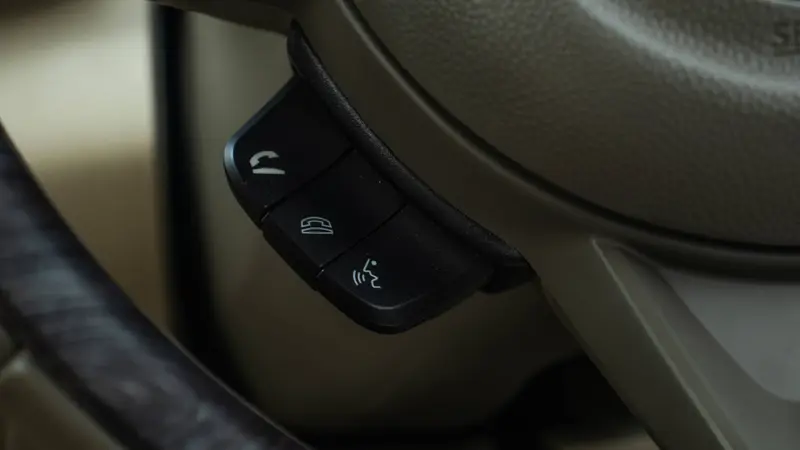
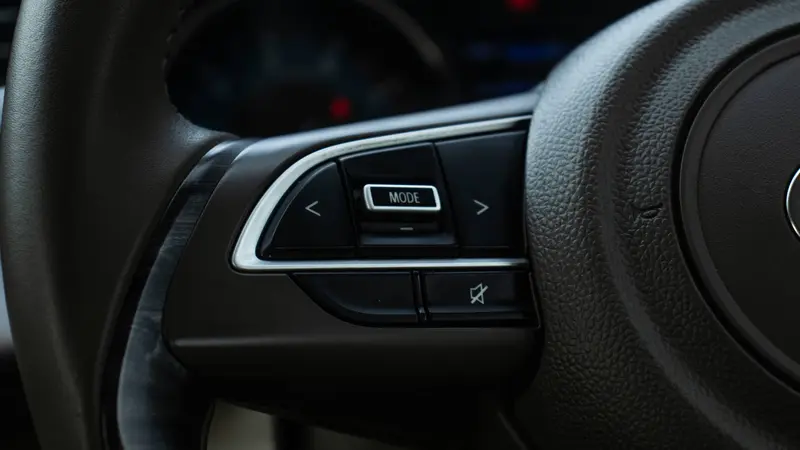
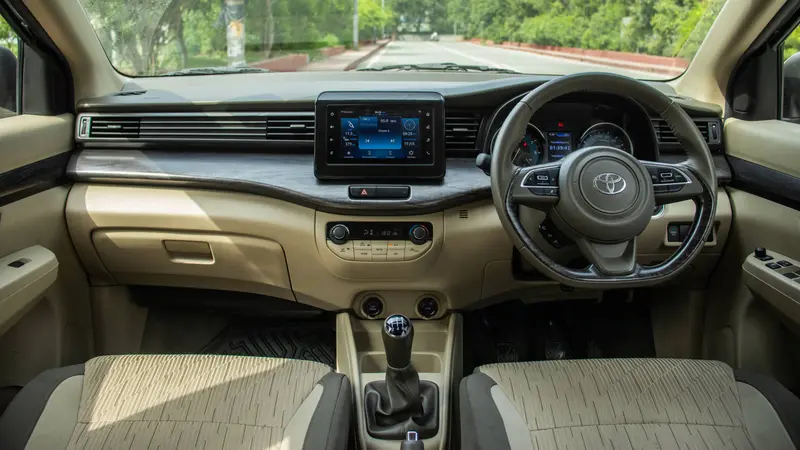
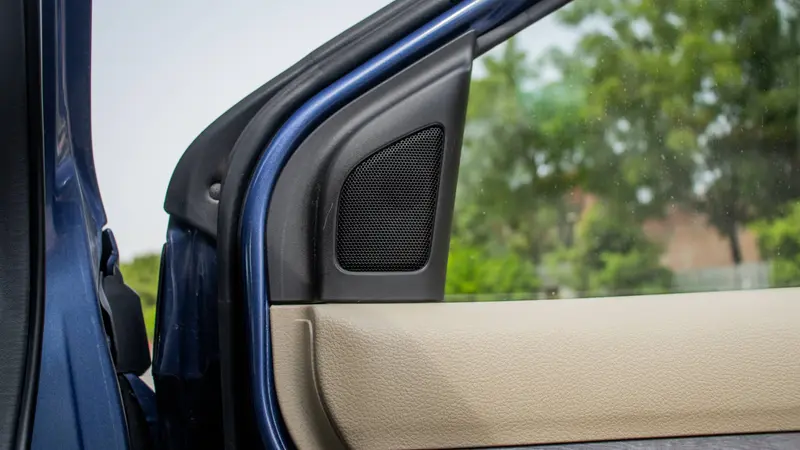
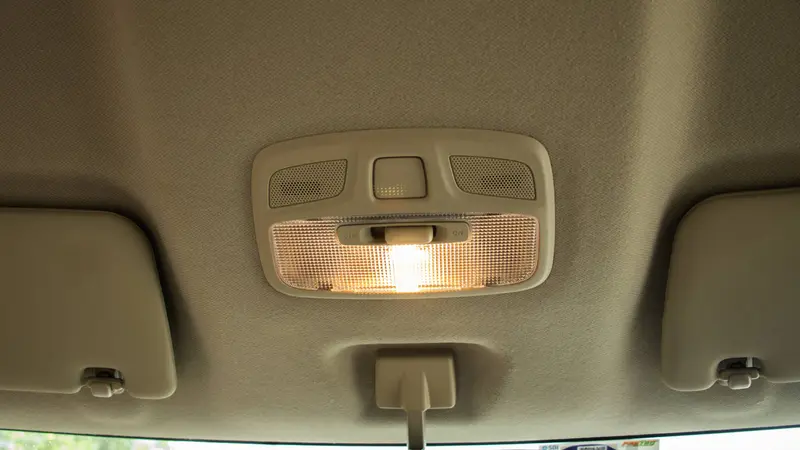
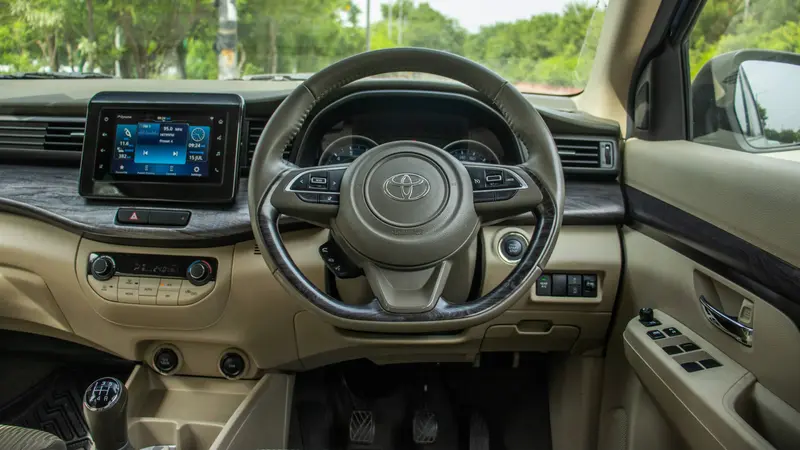
The cabin's visual headline is the dual-tone beige and wood treatment, which Toyota has applied consistently across the range. Beige dominates the seats and upper dashboard surfaces; the wooden texture handles the middle console, and the steering wheel.
The effect is lighter and more open than a full black interior, and in a car that prioritises seven-occupant practicality over driver-focused atmosphere, that is the correct call.
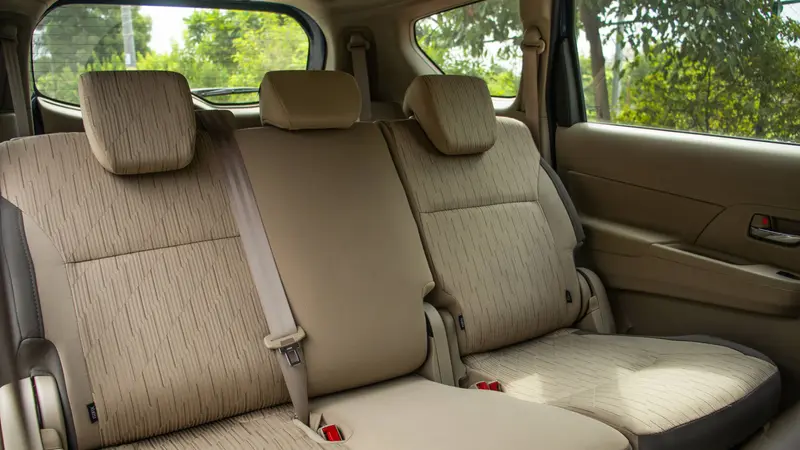
Material quality is honest rather than flattering. The seat fabric is a tight-woven cloth that handles heat and sweat acceptably, and it has enough structure to offer support without collapsing after a year of family use.
The dashboard plastics are hard and unpadded across most contact surfaces. None of this is surprising at this price point, but buyers trading up from a smaller hatchback should understand that the Rumion does not feel significantly more premium than a well-equipped Baleno or an Altroz.
What it does offer is space, and it offers it in a way that makes a difference to daily use.
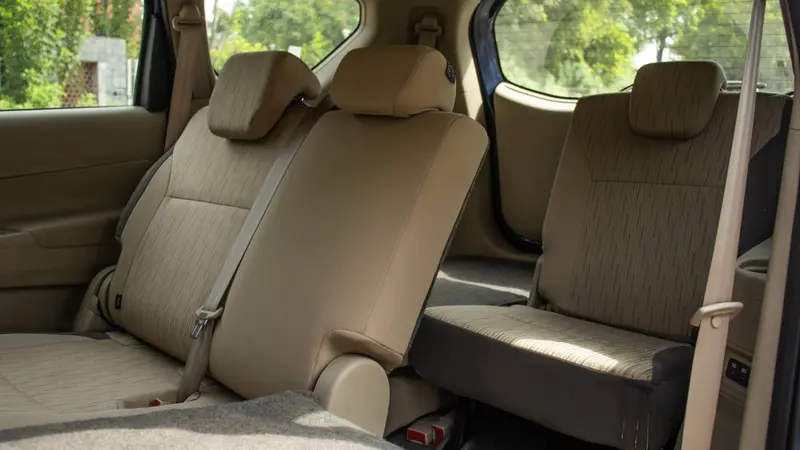
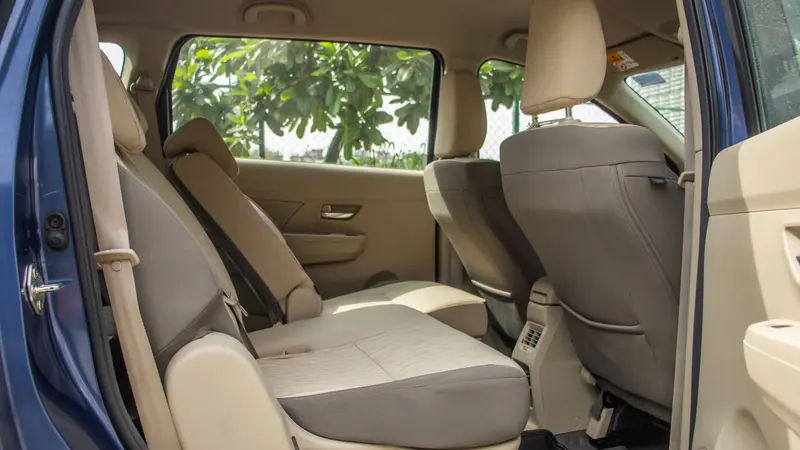
The 2nd row accommodates three adults without the middle passenger being pressed into an uncomfortable perch. Legroom is generous when the first row is set to a normal driving position. Headroom in the second row is excellent for an Indian buyer of average height. The seat cushions in row two have appropriate depth and the flexible backrest angle works for both city commutes and hours-long highway segments.
The third row is honest about what it is: a two-seater suitable for adults up to about 5'8" on journeys of moderate duration, and a genuinely comfortable space for children regardless of journey length.
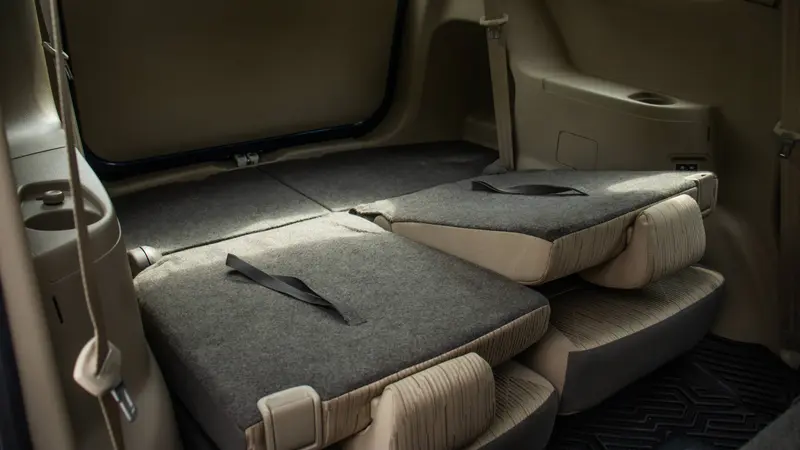
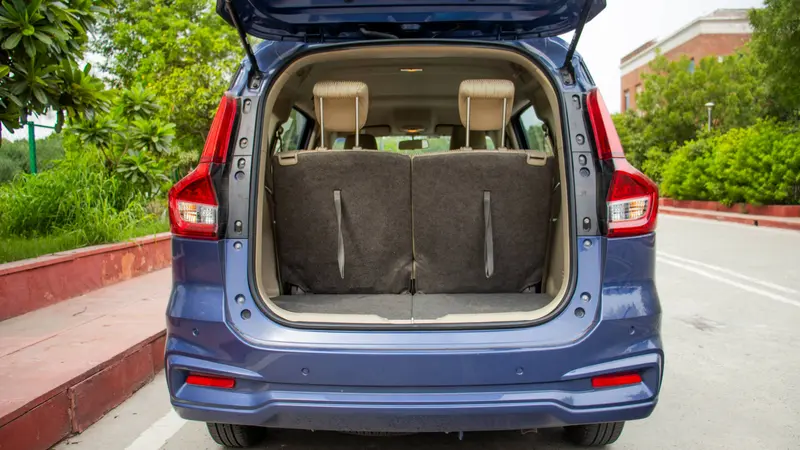
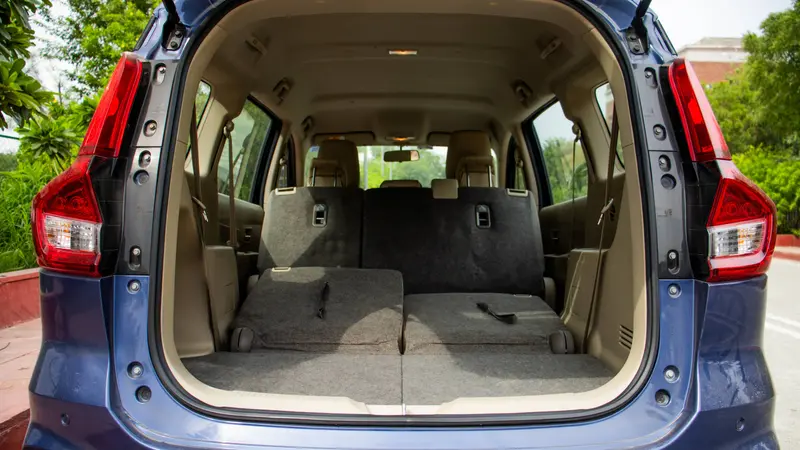
Both second and third rows fold flat in a 60:40 and 50:50 split respectively, collapsing to leave a gigantic boot space enough for 8 full-size carry-ons.
Boot space with all seven seats up is 209 litres, which is tight for a family of seven on anything longer than an overnight trip. With the third row folded, it becomes quite useful.
The infotainment system is a 7-inch Smartplay Cast unit carrying wireless Android Auto and Apple CarPlay on the G and V variants. The screen size is “okay” for the dashboard, the interface is straightforward, and the wireless connectivity eliminates the cable management problem that follows you through the life of a wired car.
The S variant gets a simpler audio unit without the touchscreen. Toyota i-Connect is available on the V variant, bringing remote lock and unlock, climate control via a smartphone, safety alerts and smartwatch compatibility.
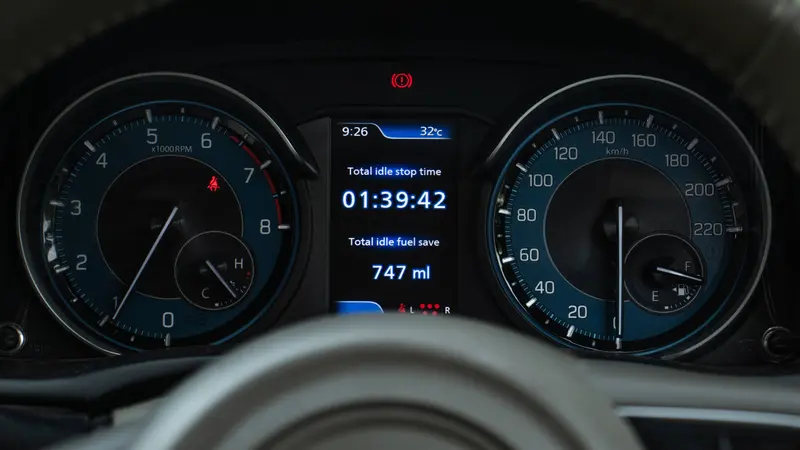
The instrument cluster has been consistently criticised by owners for providing minimal information. The analog dials are functional but the multi-information display between them is small and tells you less than today's tech savvy would expect.
A digital speedometer, a proper trip computer with instantaneous and average efficiency readouts, and a gear indicator for the automatic would all be reasonable expectations at V variant pricing, and their absence is a gap Toyota has not addressed.
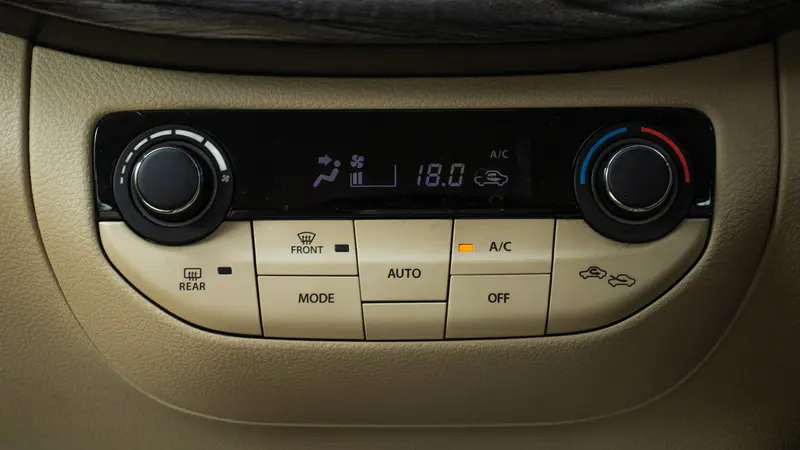
Air conditioning performance, both the manual unit on lower variants and the auto-climate on the G and V, is strong enough for 40 plus degree summer conditions, which is where it matters most.
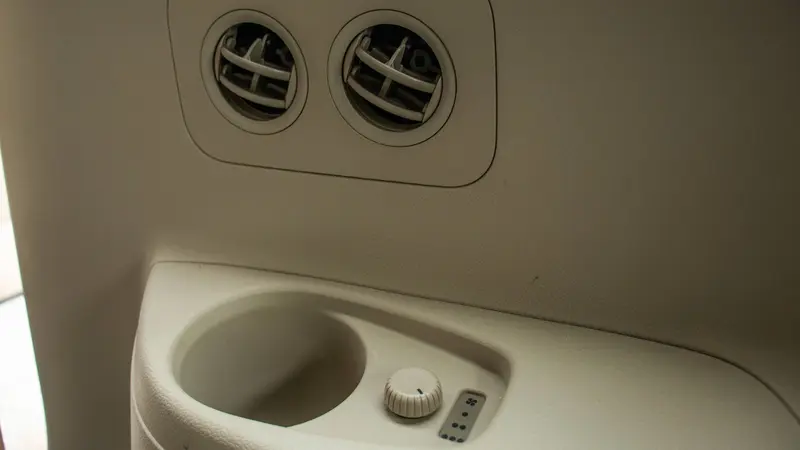
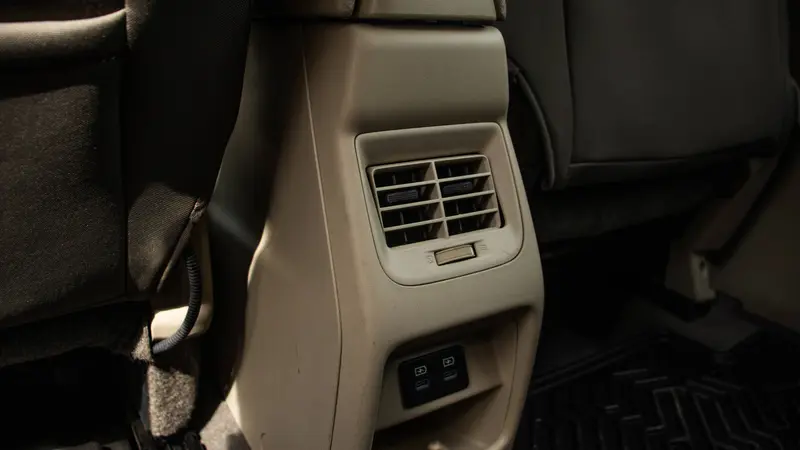
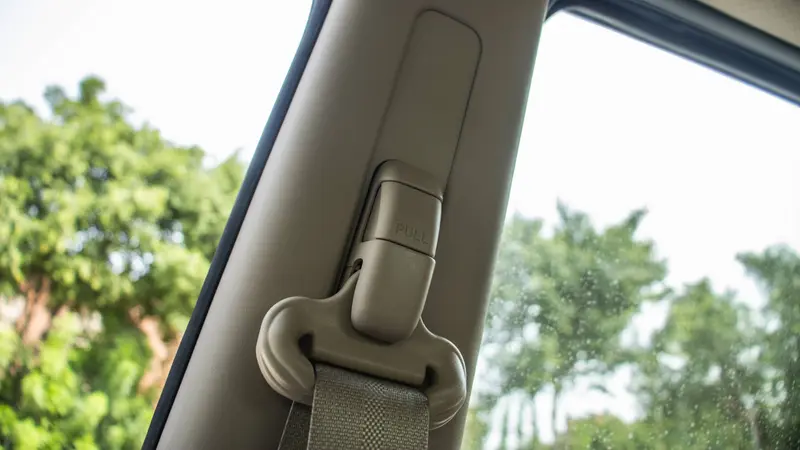
The rear AC vents were updated in last year's revision to include third-row vents, meaning all seven occupants now have airflow directed at them. The middle-row vents were repositioned from the ceiling to the floor console in the same update.
NVH at city speeds is composed. Road noise is low, wind noise is acceptable, and the engine is quiet enough at light throttle to hold a conversation without effort. The picture changes at high throttle openings, which brings on a coarseness that this engine has never shed, and on long highway runs with a full load, the cabin becomes noticeably busier.
exterior
exterior
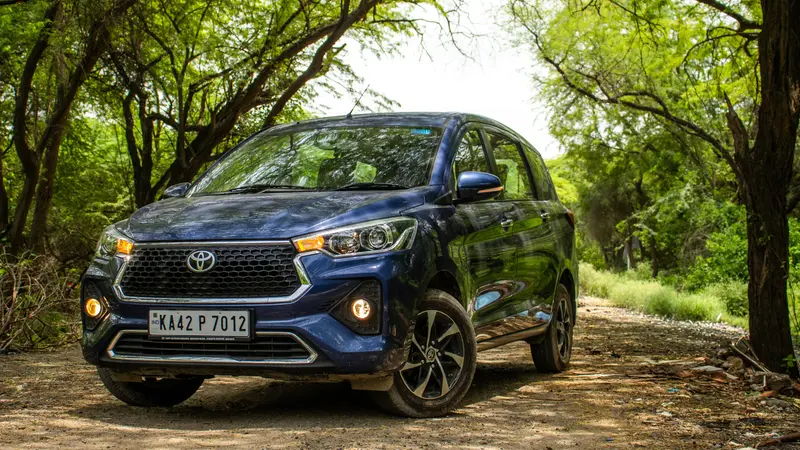
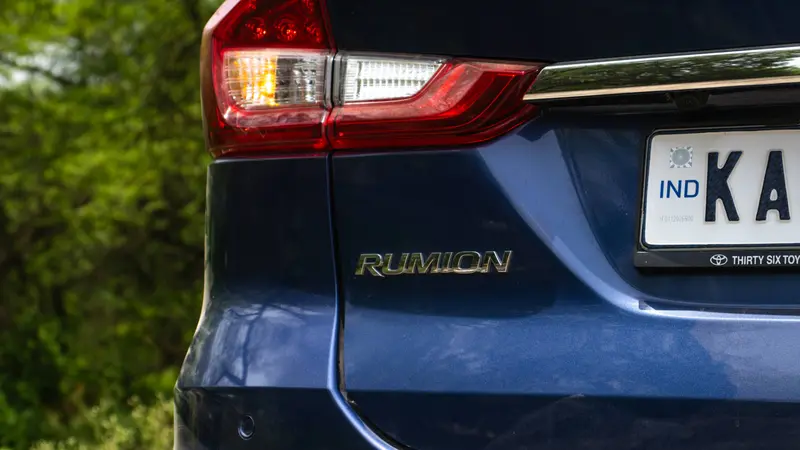
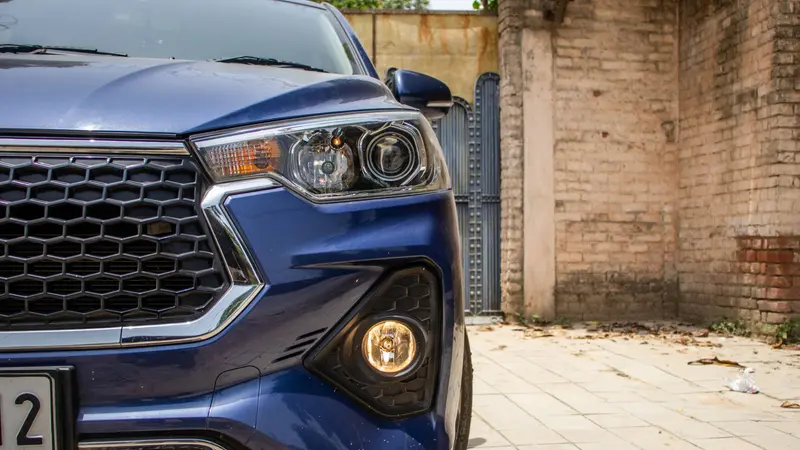
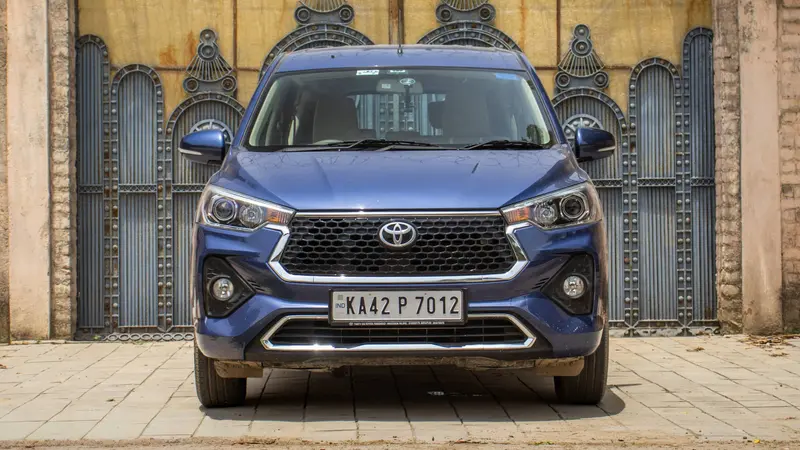
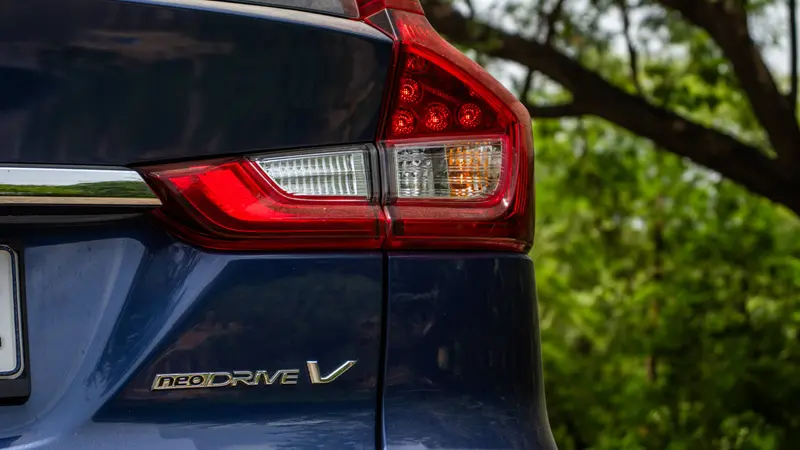
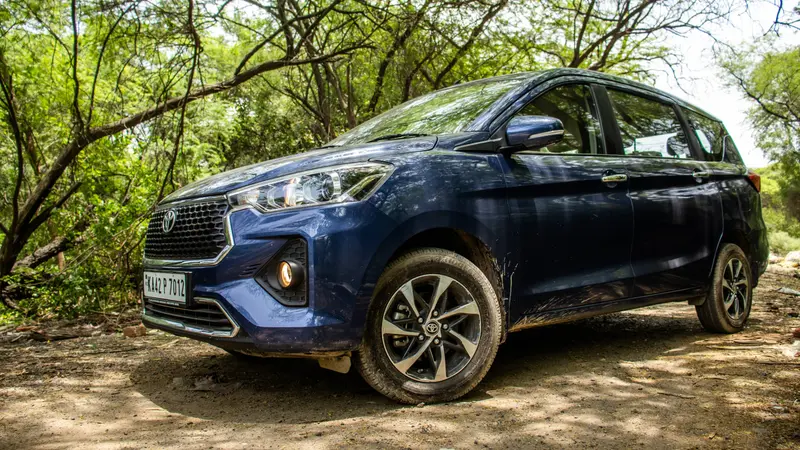
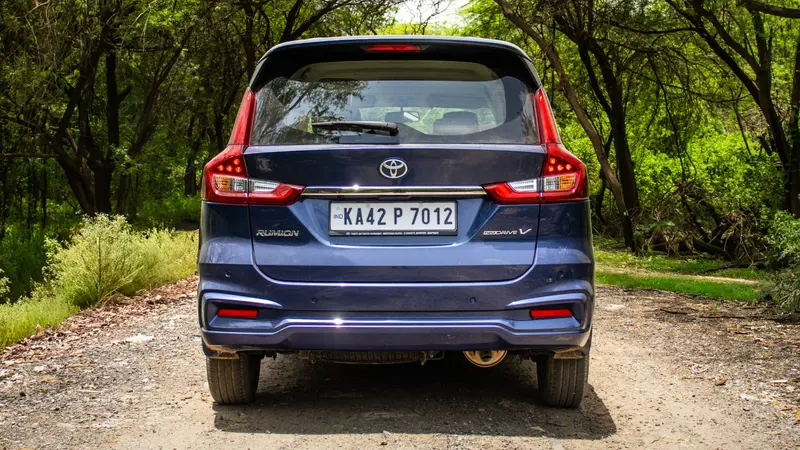
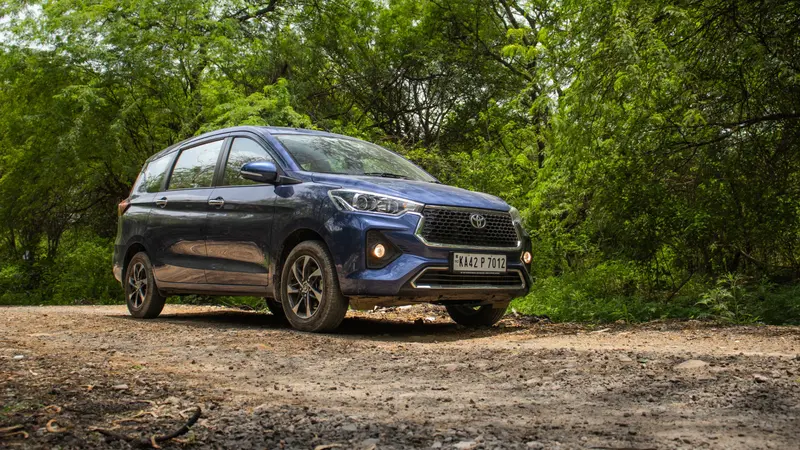
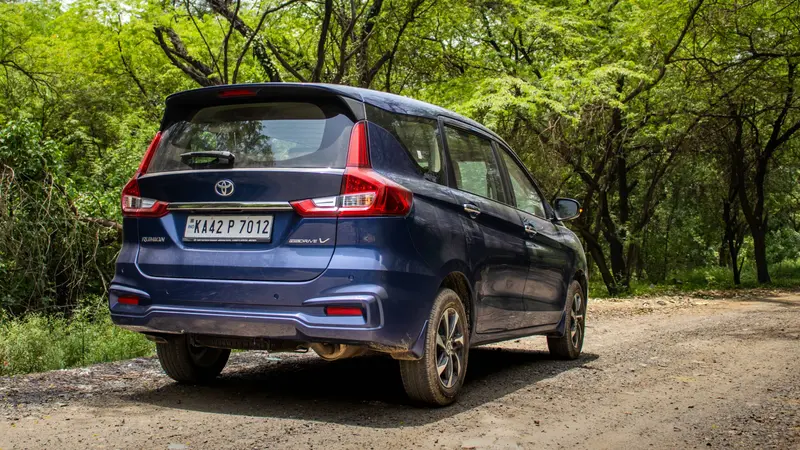
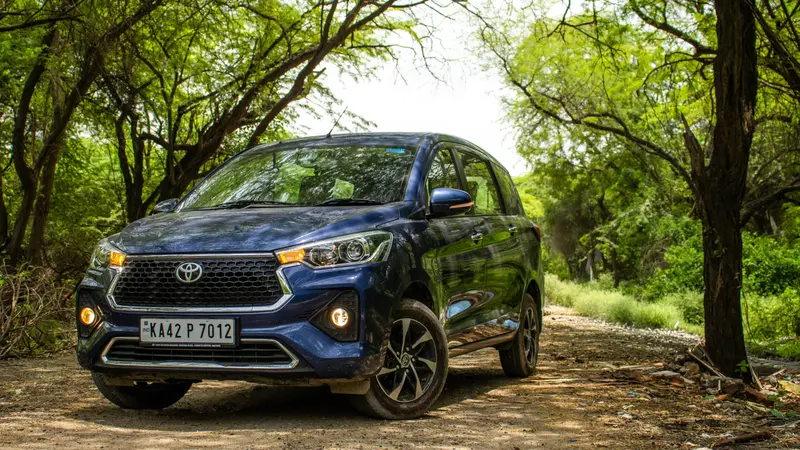
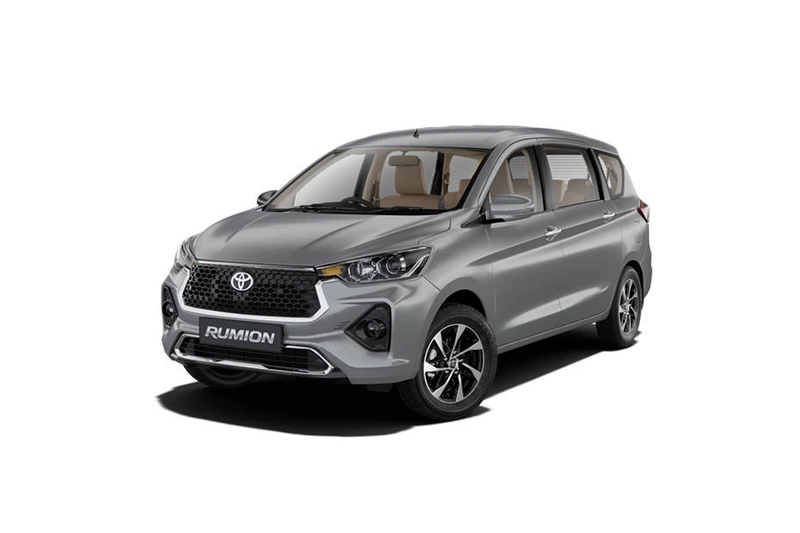
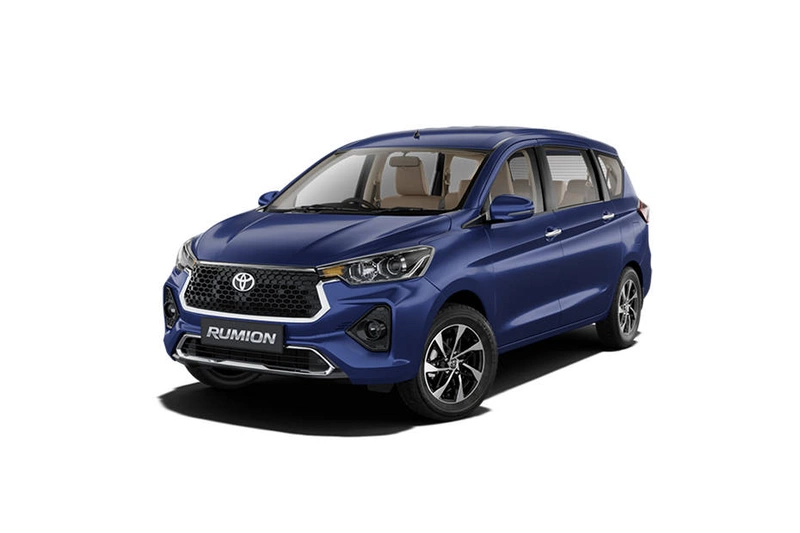
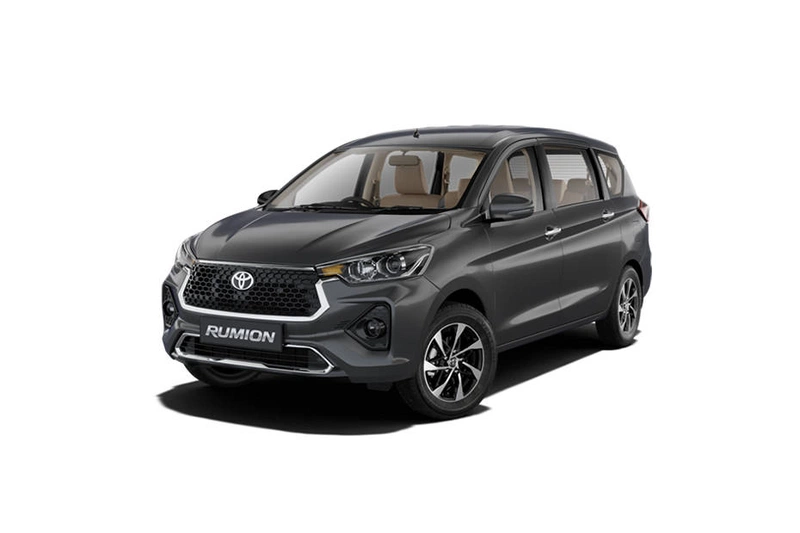
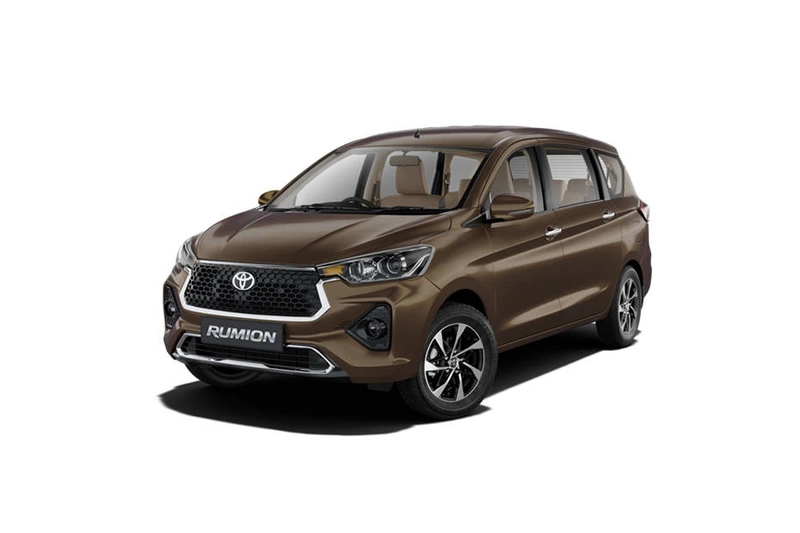
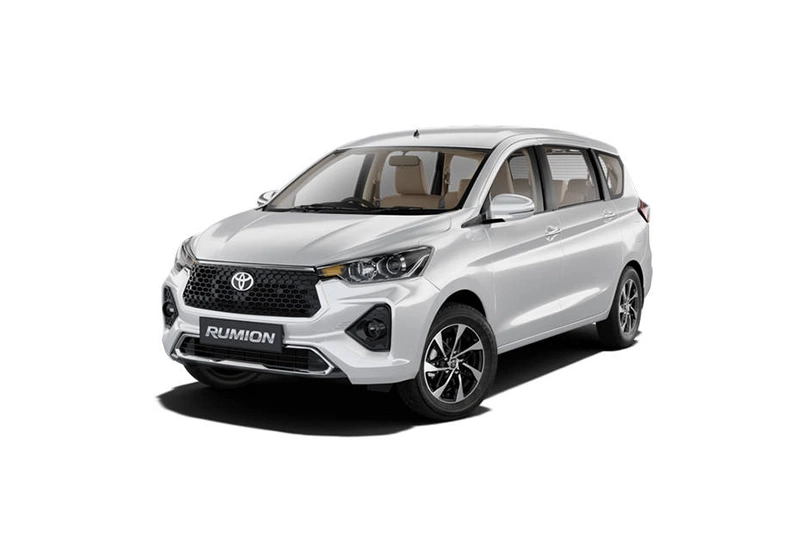
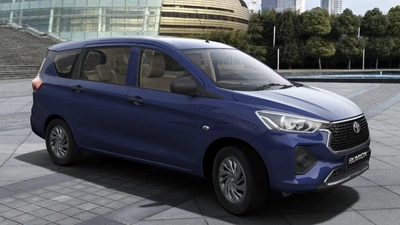
The Rumion's face is thoroughly updated as Toyota's designers applied a wider, more pronounced front grille with chrome detailing, reshaped the bumper, and fitted projector headlamps with a different housing treatment. The LED tail lamps are new as well, carrying a different graphic from the Ertiga's.
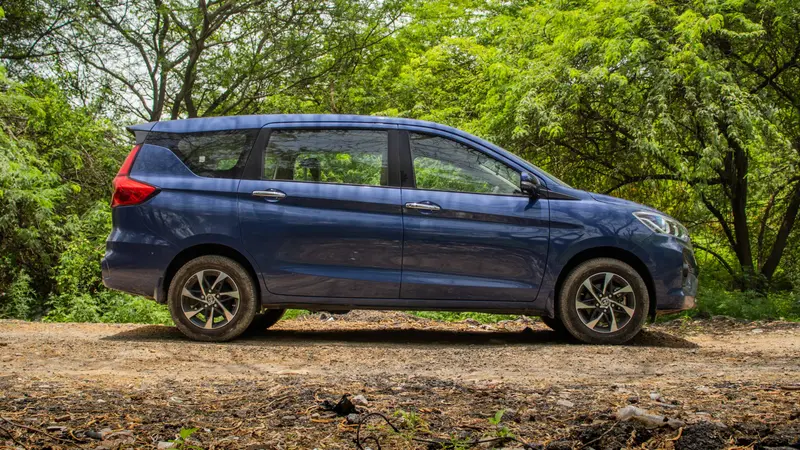
From the front and rear, the Rumion reads as a Toyota. From the sides, it is entirely an Ertiga, because it is: the doors, the greenhouse( whole glass area), the roofline, the body creases and the overall silhouette are shared without modification.
Backing up with the numbers, at 4,420 mm long, 1,735 mm wide and 1,690 mm tall with a 2,740 mm wheelbase, the Rumion has a balanced, upright stance that communicates its purpose without being visually heavy.
The height gives the cabin the airiness it needs, and the length is sufficient for three rows that can seat upto 7 passengers comfortably, 8 if you are carrying children.
The base E & S variants sits on steel wheels while the G and V variants gain alloy wheels with a machined dual-tone finish on the top-end that improves the look considerably.
The wheel size is 185/65 R15, which is appropriate for an MPV prioritising ride quality and tyre replacement costs over road presence.
Panel gaps are consistent with what you find at this segment, which is to say they are acceptable rather than reassuring. The paint quality across the 5 available colours, Cafe White, Enticing Silver, Iconic Grey, Rustic Brown and Spunky Blue, is competent without being memorable.
Rustic Brown is worth mentioning because it is distinct in a segment where white and silver dominate, but this distinction may cause you a poor resale in future.
Ground clearance is 180 mm, which is sufficient for most Indian road conditions including usual speed bumps and village roads, anything serious like the craters you find in Gurgaon and you will have to slow down to prevent any underside damage.
Rear visibility is good by MPV standards, aided by the upright tail and the large rear quarter glass.
safety
safety
The Toyota Rumion has not been independently crash-tested by Global NCAP or Bharat NCAP as of mid-2026. The Maruti Suzuki Ertiga, which shares the Rumion's platform, structure and mechanicals identically, achieved a three-star rating in Global NCAP's Safer Cars for India programme, with an unstable body shell rating.
From September 2025, all Rumion variants carry six airbags as standard: dual front airbags, two side airbags, and two curtain shield airbags.
Previously, the S and G variants were sold with two airbags, which was a meaningful gap at a price point where families with children are the primary buyers.
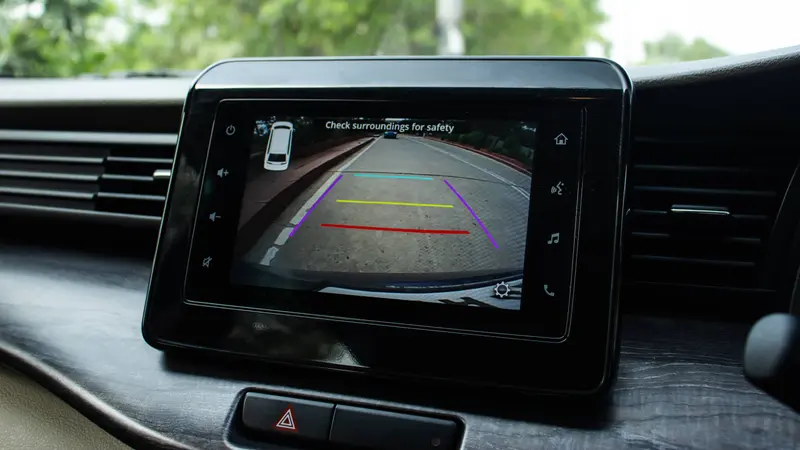
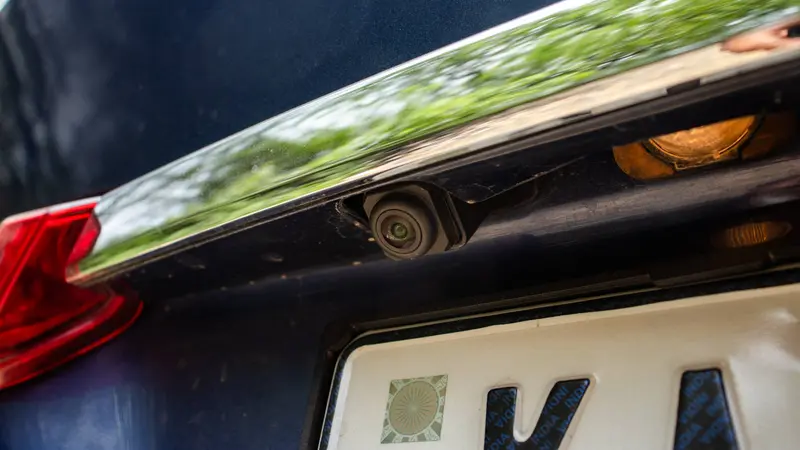
Additional standard safety equipment across all variants includes ABS with EBD, vehicle stability control, hill hold assist, ISOFIX child seat mounts with a top tether on the second row, front and rear seatbelt reminders, rear parking sensors, and a rear-view camera.
The top V variant adds a tyre pressure monitoring system with the September 2025 update. All variants received a 360-degree camera system as part of the same revision.
competition
competition
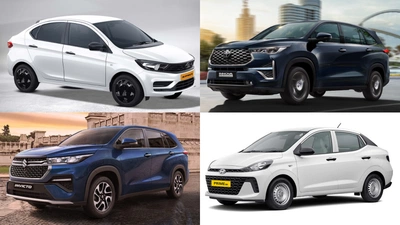
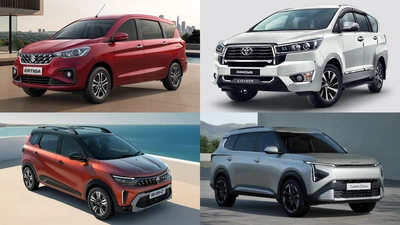
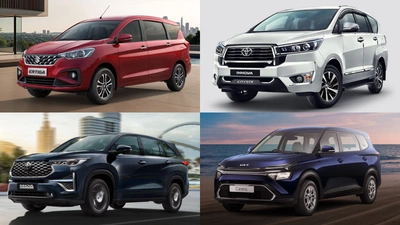
The Rumion closely competes with the Maruti Suzuki Ertiga and Kia Carens / Carens Clavis in its segment.
Rumion Vs Ertiga
The most honest comparison, because the Ertiga is the Rumion stripped of its Toyota dress. It is significantly cheaper per equivalent variant, it carries the same engine, the same gearbox, the same ride quality and the same cabin space. Maruti's service network is denser across India's smaller cities and towns, which matters for buyers whose ownership geography is outside the major metro clusters.
Where the Rumion wins is warranty coverage, which is materially stronger, and resale value, where the Toyota badge carries a premium over Maruti's even when the underlying car is the same.
Rumion Vs XL6
The XL6 uses the same platform and powertrain as the Rumion but configures the second row as captain chairs, reducing seating to six. The trade-off is a meaningfully more comfortable second-row experience for each individual occupant, along with a slightly more premium interior treatment with the NEXA channel's positioning behind it.
It is priced similar to the Rumion across corresponding variants. Buyers who regularly carry five or six people and want the second-row passengers to have individual space should look at the XL6 seriously.
Buyers who need seven seats or who want the Toyota ownership experience at a lower price point should not.
Rumion Vs Carens / Carens Clavis
The Carens / Carens Clavis operates in a different part of the segment. It is longer at 4,540 mm, wider, and offers a significantly more practical third row with better access and more headroom. The powertrain options are broader: a 1.5-litre naturally aspirated petrol, a 1.5-litre turbo-petrol, and a 1.5-litre diesel.
The diesel is the Carens' strongest card for buyers who cover high annual mileage on highways. The turbo-petrol in iMT or DCT guise offers a genuinely different performance character from the Rumion's naturally aspirated engine.
The Carens Clavis also offers ADAS features with certain models that the Rumion does not. Against all of this, the DCT gearbox's reliability in Indian city traffic conditions remains a conversation that potential buyers should research beyond the brochure, because dual-clutch transmissions and Indian stop-start conditions have a documented history of friction. The torque converter in the Rumion does not carry that concern.
Buyers who need diesel, want a stronger third row, or want active safety assist should assess the Carens or Carens Clavis. Buyers who want the simplest, most reliable automatic at a lower price should take the Rumion.
Rumion Vs Triber
The Triber is smaller, cheaper and targets a buyer with fewer seat requirements on a consistent basis. It seats seven in a pinch but is comfortable for five. Against the Rumion, it loses on space, refinement, and powertrain maturity. It wins on extremely low pricing and on compactness in genuinely tight urban parking.
The two cars do not compete directly for the same buyer in practice: the Triber is for a buyer who needs MPV flexibility occasionally; the Rumion is for a buyer who needs seven seats as a primary use case.
buying advice
buying advice
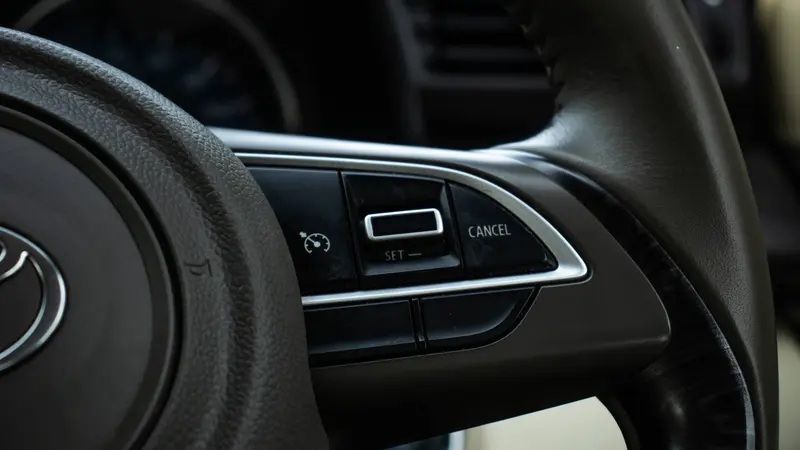
The V AT at Rs 13.62 lakh ex-showroom is the variant that makes the most complete daily use case: the automatic gearbox transforms the city experience, cruise control, auto-folding mirrors, automatic headlamps, TPMS and the 360-degree camera are all included, and the six-airbag standard provision means there is no safety argument for the top variant that was not already made by the E variant below it. The S AT is the entry point for automatic buyers and represents the best pure-value proposition in the range.
The boot space with all seven seats in use is a genuine limitation. If your use case regularly involves a full cabin of adults and luggage, the Rumion will ask you to choose one or the other. If your typical configuration involves three or four people with the rear rows folded, it is a practical, spacious, efficient car that will do the job without complaint for a very long time.
Buy the Rumion V AT if you prioritise long-term ownership confidence over short-term purchase value, keep your car for five years or more, and cover enough city kilometres that an automatic gearbox transforms your daily experience.
Look elsewhere if you need a formally crash-tested five-star result, want ADAS-level safety assist, require diesel efficiency for high-mileage highway driving, or are buying on a tight price discipline where the Ertiga's lower starting point matters more than the Toyota badge.
Toyota Rumion mileage
The Toyota Rumion mileage ranges from 20.11 to 20.51 kmpl and 26.11 km/kg. The Manual Petrol variant has an ARAI mileage of 20.51 kmpl. The Automatic Petrol variant has an ARAI mileage of 20.11 kmpl. The Manual CNG variant has an ARAI mileage of 26.11 km/kg.
| Fuel Type | Transmission | ARAI Mileage | * City Mileage | * Highway Mileage |
|---|---|---|---|---|
| Petrol | Manual | 20.51 kmpl | - | - |
| Petrol | Automatic | 20.11 kmpl | - | - |
| CNG | Manual | 26.11 km/kg | - | - |
Toyota Rumion Expert Reviews
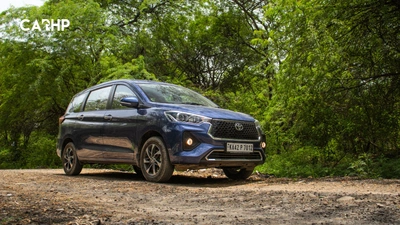
Toyota Rumion 700km Review: Is This the Right Car for a Joint Family?
So, overall, the Toyota Rumion is a great offering in the market, priced under ₹15 lakh, giving you a comfortable and spacious cabin, decent features, and a reliable petrol engine with good fuel efficiency.
Vatsal Agrawal
August 21, 2026
Toyota Rumion News

Toyota Rumion FAQs
What is the seating capacity of the Rumion?
−The Rumion is a 7-seater MPV with three rows, 2 in the front, 3 in the second row, and 2 in the third.
Is the Toyota Rumion available in CNG?
+Yes, the Rumion is available in a factory-fitted CNG variant (MT only), with a 60-litre water-equivalent CNG tank alongside a 45-litre petrol tank.
What is the fuel efficiency of the Rumion?
+The petrol variants deliver 20.51 km/l (MT) and 20.11 km/l (AT). The CNG variant offers 26.11 km/kg.
Does the Rumion have an automatic transmission option?
+Yes, a 6-speed automatic is available on select petrol variants. The CNG variant is manual only.
How many airbags does the Rumion have?
+The Rumion comes with 6 airbags as standard across all variants.
Does the Rumion support wireless Android Auto and Apple CarPlay?
+Yes, but only on select variants, which get a 17.78 cm Smartplay Cast touchscreen with wireless Android Auto and Apple CarPlay.
Is the Toyota Rumion available in petrol, CNG, electric or diesel engines?
+The Rumion is currently available with Petrol and CNG engines.
What are the key safety features in the Rumion ?
+The Rumion comes equipped with several safety features including Anti-lock Braking System (ABS), Central Locking, Electronic Brakeforce Distribution (EBD), Electronic Stability Control (ESC) and Hill Assist.
What are the boot space and dimensions of the Toyota Rumion?
+The Rumion offers 209 Litres of boot space. Its dimensions are 4460 mm in length, 1735 mm in width, and it has a wheelbase of 2740 mm.
What colours does the Toyota Rumion come in?
+The Toyota Rumion is available in the following colours: Enticing Silver, Spunky Blue, Iconic Grey, Rustic Brown and Cafe White.