Maruti Victoris Strong Hybrid Explained: How the Technology Actually Works
By Arjun Nair
Published August 4, 2026
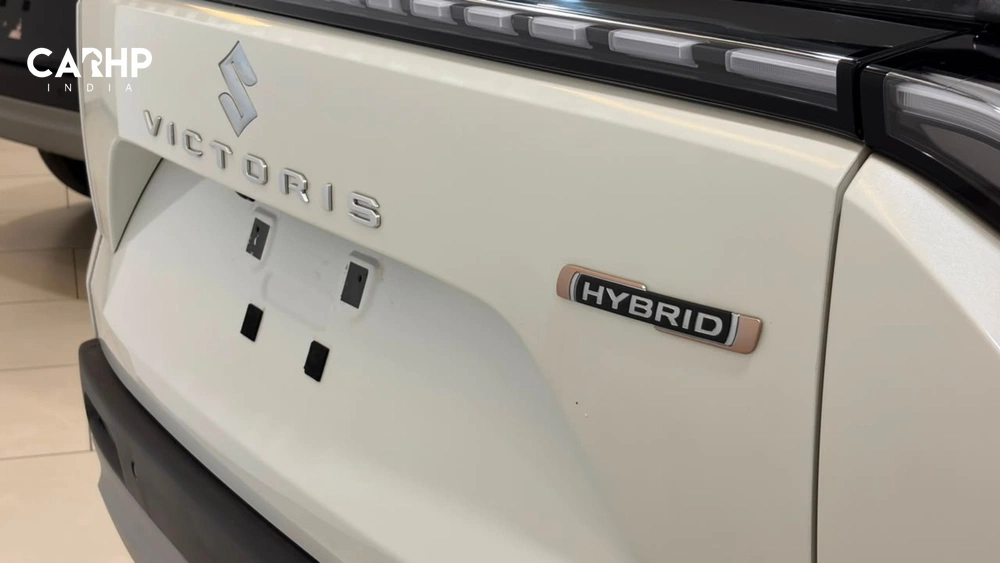
Maruti Suzuki sells the Victoris with three different fuel setups, and the strong hybrid is the one people ask about the most.
It is also the one most misunderstood, because "hybrid" gets used loosely in India and covers everything from a mild starter-motor assist to a full electric drive system. Maruti itself could be partially blamed for this, since all their cars with a mild hybrid have a “Smart Hybrid” badge.
The Victoris strong hybrid sits at the serious end of that scale. Here is what the system does, what it costs, and who it actually suits.
What "Strong Hybrid" Means Here

A strong hybrid (also called a full hybrid) can drive the car on electric power alone, with the petrol engine completely switched off. This is what separates it from a mild hybrid, which only uses a small motor to assist the engine and can never drive the car by itself.
The Victoris strong hybrid can pull away from a standstill, crawl through traffic and hold light throttle at low speeds entirely on its motor. The petrol engine stays off until it is needed. That is where almost all of the fuel saving comes from, because a petrol engine is at its most wasteful exactly when a car is creeping and stopping in city traffic.
It is not a plug-in hybrid, so you do not have to charge it from a wall socket. The battery charges itself from the petrol engine, and when the driver lifts off the accelerator or steps on the brakes. From the driver's side it behaves like an ordinary automatic that happens to use much less fuel.
Also Read - Why India's EV And Hybrid Future Cannot Happen Without China
The Three Ways it Drives

The system moves between three states on its own, and you do not select them. A display in the instrument cluster shows the energy flowing between engine, motor, battery and wheels, so you can watch it happen in real-time.
Electric Only: At low speeds, light loads, gentle acceleration, and while reversing, the motor drives the wheels and the engine stays off. This is the quiet, near-silent mode you get most often in city traffic.
Hybrid: Under harder acceleration or at higher speeds, the engine starts and works alongside the motor. The two combine to give a system output of roughly 116 PS (metric horsepower, a measure of engine power), which is more than either could manage alone.
Engine Only: At steady highway cruising, where a petrol engine is already efficient, the engine takes over and drives the wheels directly. The motor steps back and the battery tops itself up.
The switching is automatic and, by most road-test accounts, hard to notice unless you are watching the display. There are also three driver-selectable modes, Eco, Normal and Power, which change throttle response rather than the hybrid logic itself.
The Petrol Engine, and Why it is Unusual
The strong hybrid uses a different engine from the rest of the Victoris range. It is a 1.5-litre three-cylinder unit (the M15D) producing about 92 PS and 122 Nm.
On paper that looks weak next to the 103 PS four-cylinder engine in the regular petrol Victoris, and taken alone it would be.
The reason it works is that it runs on the Atkinson cycle (intake valve opens longer during compression, extra fuel air charge gets back into the prechamber), which trades fuel efficiency for power.
On its own that would make for a sluggish car. In a hybrid it is the right choice, because the electric motor covers exactly the low-speed pull the Atkinson engine gives up.
The two are designed around each other.
The Motor, the Battery and the Gearbox
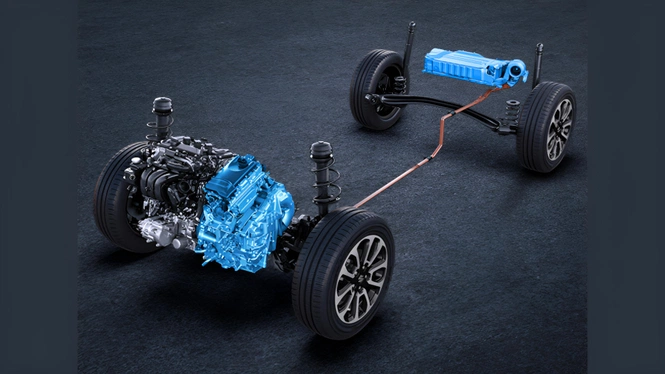
The electric motor is an AC synchronous unit making around 80 PS and 141 Nm. Note that its torque figure is higher than the petrol engine's, and it delivers it from a standstill, which is why the car feels responsive off the line despite the modest engine.
It draws from a 0.6kwh lithium-ion battery. This is a small pack by electric-car standards, because it is never asked to provide long range, only to hold enough charge for short electric stints and to soak up braking energy.
Maruti mounts it under the rear seat rather than in the boot floor, which is a sensible packaging decision and one reason the hybrid keeps a usable 373 litres of luggage space, expanding to 766 litres with the rear seats folded.
The gearbox is an e-CVT (electronic continuously variable transmission). Despite the name it is not a standard belt-driven CVT. It is a set of planetary gears connecting engine, motor and generator, with no fixed ratios and nothing to shift. Power flows to the wheels continuously, so acceleration builds smoothly with no gear change step at all.
Also Read - Different Types of Automatic Gearboxes Available in India Explained
The trade-off is that under hard acceleration the engine holds high revs and drones, because there are no gears for it to move through.
Many buyers and often owners, get confused regarding the maximum power the hybrid system produces.
The Victoris Strong Hybrid pairs a 92.45 PS, 122 Nm 1.5-litre petrol engine with an 80 PS, 141 Nm electric motor, yet the system produces a combined 116 PS. That's because the engine and motor reach their peak power and torque at different speeds, so their maximum outputs are never available simultaneously.
The e-CVT and hybrid control system blend both power sources within the limits of the drivetrain, resulting in a lower combined output than the simple sum of their individual figures
Regenerative Braking

Every time you lift off or brake, the motor runs backwards as a generator and turns the car's momentum back into electricity instead of wasting it as heat in the brake pads. This is called regenerative braking, and it is why the battery never needs plugging in.
It also has a side benefit worth knowing: because the motor does much of the slowing, the actual brake pads wear more slowly than in a conventional car, which usually shows up as lower maintenance costs over the years.
That certified figure of 28.65 kmpl makes it one of the most efficient SUVs sold in India. Treat it as a laboratory number, since certification testing is done under controlled conditions.
Road tests put the real figure closer to 20 to 25 kmpl, which is still well ahead of anything non-hybrid in this class.
Also Read - How Regeneration Works in EV Cars
Should You Consider it?

The Maruti Suzuki Victoris Strong Hybrid is best suited to high-mileage city drivers who want excellent fuel economy, low running costs, and a smooth, quiet automatic without switching to a full EV. Its higher upfront price can be recovered over time if you drive enough, especially in stop-and-go traffic.
However, buyers should note that it misses out on the refinement of a four cylinder, ADAS, AllGrip AWD, and even a spare wheel, while the fuel-saving advantage reduces significantly on highway-focused usage.
If your monthly driving is low or mostly on highways, the petrol automatic offers better overall value.
Image Source: Maruti Suzuki
Table of Contents
- What "Strong Hybrid" Means Here
- The Three Ways it Drives
- The Petrol Engine, and Why it is Unusual
- The Motor, the Battery and the Gearbox
- Regenerative Braking
- Should You Consider it?
Join the Conversation
Trending
2026 Maruti Suzuki Baleno Facelift Every Variant Explained
Every Baleno facelift variant explained, from the stripped Sigma to the ADAS-equipped Alpha (O). Find out exactly which trim suits your needs, what each one gives up, and where the real value sits in the lineup.
Anmol Kumar
September 19, 2026
5 Hatchbacks Under Rs 8 Lakh You Can Consider as Your Next Car
All these hatchbacks are good picks, suiting different requirements.
Arjun Nair
September 19, 2026
Top 10 Best Mileage CNG Cars You Can Buy In 2026
CNG offers an unbeatable value for money proposition for car buyers. Here are the most efficient CNG cars currently on sale.
Salil Kumar
September 19, 2026
Featured
Citroen C3 Review: Who Should Consider This Car?
A few days ago, I took the Citroen C3X out for a spin in the city and on the highways. I travelled long distances and checked its fuel efficiency, features, comfort, and other factors. Today, I’ll briefly share my overall experience with the C3X and will tell you whether you should consider it or not and which is the most value-for-money variant of the lot.
Vatsal Agrawal
May 19, 2026
Tesla Finally In India Officially. Why Now And What Does It Mean For EVs?
The much-anticipated 2025 Tesla Model Y has officially arrived in India, marking a pivotal moment for the nation's burgeoning electric vehicle market. Launched on July 15, 2025, the Model Y Juniper facelift offers cutting-edge technology, impressive range, and signature Tesla performance. Positioned as a premium electric SUV, its entry will intensify competition and reshape consumer expectations for EVs across the subcontinent.
Charan Narain
July 17, 2025
Here Are 10 Things The Harrier.EV Offers That The Mahindra XEV 9E Doesn't
The Harrier.EV is an incredible new offer from Tata. Its most popular competitor would be the Mahindra XEV 9E, priced similarly. With these two incredible offerings from home grown brands available, here is a list of everything the Harrier.EV offers that the XEV 9E doesn't.
Charan Narain
June 13, 2025
Write a comment
Comments
No comments yet. Be the first to comment!