
Honda Forza 350 Variants & Prices
| Variant Details | Expected Price | |
|---|---|---|
Forza 350 STD Base Model | ₹ 3.70 Lakh* |
Forza 350 STD
Pros & Cons of Honda Forza 350
Things We Like
- Exceptionally refined and smooth 330cc liquid-cooled engine performance.
- Excellent highway stability and touring comfort for long rides.
- Massive under-seat storage can accommodate two full-face helmets.
- Comprehensive safety suite including dual-channel ABS and traction control.
- Practical features like an electronically adjustable windscreen enhance usability.
Things We Don't Like
- Premium pricing due to CBU import route limits accessibility.
- Suspension feels firm over sharp bumps on Indian roads.
- Instrument cluster feels dated compared to TFT displays on rivals.
- Conservative styling may not appeal to all buyers in segment.
- Limited service network through Honda's premium BigWing dealerships.
Honda Forza 350 Overview

Engine, Performance and Mileage
The core of the Forza 350 is its 330cc, single-cylinder, 4-valve, liquid-cooled eSP+ engine. Complying with BS6 Phase 2 norms, this unit produces a substantial 29.2 PS of power at 7,500 rpm and 31.5 Nm of torque at 5,250 rpm. Mated to a seamless V-Matic automatic transmission, the powertrain is engineered for refinement and linear power delivery rather than aggressive, off-the-line acceleration. In urban environments, the throttle response is smooth and predictable, allowing for effortless gap-finding in traffic without any jerky behaviour. However, its true capabilities are realised on the highway.
The engine comfortably holds speeds of 100-120 km/h with minimal strain, making it an accomplished touring machine. Overtakes are executed with confidence, thanks to the accessible torque in the mid-range. Fuel efficiency is a respectable point; real-world figures hover around 28-32 km/l, which, for a scooter of this displacement and performance, is adequate. The engine's refinement is its most significant attribute, with vibrations being exceptionally well-contained across the rev range, a clear differentiator from some of its more aggressively-tuned rivals.
posture comfort
As a maxi-scooter, the Forza 350 prioritises rider and pillion comfort for long-distance travel. The riding posture is upright and relaxed, with ample room on the floorboard for the rider to position their feet forward or flat. The stepped, single-piece seat is wide and well-cushioned, providing excellent support. At 780mm, the seat height is accessible, though its width might require shorter riders to be on their tiptoes. Pillion comfort is commendable, with a spacious seating area and well-positioned, robust grab rails.
The most significant practical feature is its cavernous under-seat storage compartment, which Honda claims can accommodate two full-face helmets—a segment-leading attribute that negates the immediate need for a top box. Additionally, a deep, lockable glovebox on the left side of the front apron offers sufficient space for a smartphone, wallet, and other small items. Heat management is excellent; the liquid-cooling system and bodywork effectively channel hot air away from the rider’s legs, ensuring comfort even in dense, slow-moving traffic. These practical elements make it a viable option for both daily commuting and weekend touring.
handling ride quality
The Forza 350 is built on a robust underbone chassis, supported by 33mm telescopic forks at the front and twin shock absorbers at the rear with 7-step preload adjustability. This suspension setup is calibrated for a balance between comfort and stability. On well-paved city roads and highways, the ride quality is plush, effectively absorbing minor undulations and providing excellent high-speed composure. However, on broken Indian tarmac with sharp-edged potholes, the firm setup can transmit jolts to the rider. Its handling characteristics are neutral and confidence-inspiring. Despite its 186 kg kerb weight, the Forza feels manageable at low speeds due to a well-optimised centre of gravity.
In corners, it remains stable and predictable, though it isn't as agile as lighter, sport-focused scooters like the Yamaha Aerox 155. Braking duties are managed by a single 256mm disc at the front and a 240mm disc at the rear, governed by a dual-channel ABS system. The braking offers progressive feel and strong stopping power, providing the necessary assurance for a vehicle capable of significant highway speeds. The system performs reliably without being overly sharp, preventing unexpected lock-ups.
Design
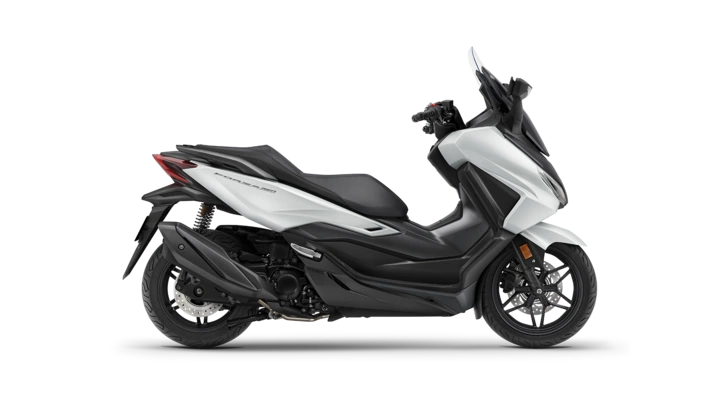
The Forza 350’s design language is distinctly European—sharp, aerodynamic, and substantial. It avoids bulbous proportions, opting for angular lines and a sophisticated presence, accentuated by its full-LED lighting system, including dual headlamps and a distinctive X-shaped tail lamp. The standout feature is the electronically adjustable windscreen, which can be raised by up to 180mm via a switch on the left handlebar, offering superior wind protection for riders of varying heights during highway cruises. The instrument cluster is a semi-digital unit, with two classic analogue dials for the speedometer and tachometer flanking a central LCD screen.
This screen displays vital information such as a trip meter, fuel consumption data, and ambient temperature. Functionality is further enhanced by the Honda Smartphone Voice Control System (HSVCS), enabling Bluetooth connectivity for turn-by-turn navigation, calls, and music control. A USB Type-C socket in the front glovebox provides convenient charging, and the scooter is equipped with a smart key for keyless ignition and seat/fuel lid access, adding a layer of modern convenience expected at this price point.
safety
Honda has equipped the Forza 350 with a comprehensive safety package that aligns with its premium positioning. The primary safety net is the dual-channel Anti-lock Braking System (ABS), which independently monitors both wheels to prevent lock-ups during hard or emergency braking on varying surfaces. This system is crucial for a vehicle with its performance potential, providing confidence in both dry and wet conditions. Augmenting the ABS is the Honda Selectable Torque Control (HSTC), essentially a traction control system. HSTC monitors wheel speed and intervenes by modulating engine torque to prevent rear-wheel slip during aggressive acceleration or on low-traction surfaces like gravel or wet roads.
The system can be switched off if desired. Another critical feature is the Emergency Stop Signal (ESS), which automatically flashes the hazard lights during sudden, hard braking to alert vehicles behind. The scooter’s excellent all-LED lighting setup ensures superior visibility for the rider at night and makes the scooter highly visible to other road users, further enhancing its safety credentials. These features place it on par with, or even above, the safety standards of its immediate competitors.
competition
The premium maxi-scooter segment in India, while niche, offers distinct alternatives. Each competitor presents a different value proposition against the Forza 350's refined, premium-priced package.
Keeway Vieste 300:
Priced significantly lower, the Vieste 300 offers a more accessible entry into the maxi-scooter category. Its 278.2cc engine produces less power than the Forza, but it provides adequate performance for city and light highway use. Its key differentiator is its value-for-money proposition, offering maxi-scooter styling at a more budget-friendly price point.
Zontes 350E:
The Zontes 350E competes directly on displacement and features. It boasts a slightly more powerful 349cc engine (36.7 PS) and an even larger feature list, including a full-colour TFT display and tire pressure monitoring system. Its primary differentiator is its aggressive focus on technology and higher on-paper performance specifications, appealing to spec-sheet-driven buyers.
BMW C 400 GT:
Positioned a segment above in price, the BMW C 400 GT is an aspirational rival. It offers a more powerful 350cc engine (34 PS), superior build quality, and the prestige of the BMW badge. Its key differentiator is the premium brand experience and more robust touring-focused engineering, targeting buyers for whom budget is a secondary concern.
buying advice
Who should buy it?
The ideal buyer is a mature rider seeking a premium, reliable, and comfortable two-wheeler for a mix of executive commuting and long-distance highway touring. They prioritize Honda's refinement, build quality, and practicality (like storage) over raw power or aggressive styling and are willing to pay the premium for it.
Who should skip it?
Budget-conscious buyers or those purely seeking the highest performance-to-price ratio should look elsewhere. Riders who prefer a feature-loaded tech interface or a more aggressive design might find the Zontes 350E or other alternatives more appealing than the Forza's understated competence.