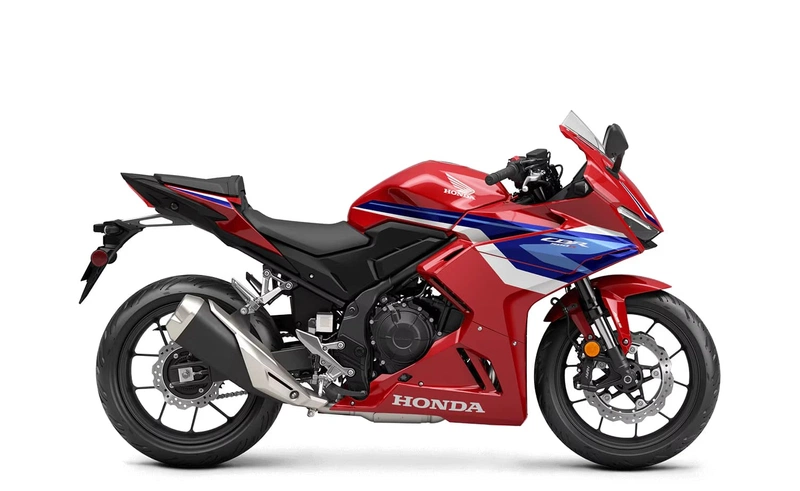

Honda CBR500R Variants & Prices
| Variant Details | Expected Price | |
|---|---|---|
CBR500R STD Base Model | ₹ 5.50 Lakh* |
CBR500R STD
Pros & Cons of Honda CBR500R
Things We Like
- Exceptionally refined and tractable parallel-twin engine performance.
- Premium Showa SFF-BP front suspension offers excellent stability.
- Superior braking with dual front discs and Nissin calipers.
- Comfortable sport-touring ergonomics suitable for long distances.
- Impeccable Honda build quality, fit, and finish ensure longevity.
Things We Don't Like
- Prohibitive pricing due to its CBU (Completely Built-up Unit) route.
- Lower power-to-price ratio compared to its main rivals.
- Lacks advanced electronic aids like cornering ABS or ride modes.
- Kerb weight of 192 kg makes it heavier than competitors.
- After-sales and service costs may be higher than locally made rivals.
Honda CBR500R Overview

Engine, Performance and Mileage
The heart of the CBR500R is its 471cc, liquid-cooled, DOHC parallel-twin engine, a powerplant engineered for tractability over outright aggression. It produces a compliant 47.5 PS at 8,600 rpm and 43 Nm of torque at 6,500 rpm. These figures are not designed to win spec-sheet battles but to deliver a linear and predictable powerband. In urban environments, the engine is remarkably docile. The torque is accessible from low revs, minimising the need for frequent gear changes, a significant advantage in stop-and-go traffic. This is complemented by a light-action slip-and-assist clutch integrated with the 6-speed transmission.
On the highway, the CBR500R finds its true calling. It can comfortably sustain speeds of 120-140 km/h with minimal strain, exhibiting the hallmark refinement expected of a Honda twin—vibrations are well-damped throughout the rev range. Throttle response is crisp without being snatchy. From a fuel efficiency standpoint, real-world figures are expected to hover around 26-28 km/l, which, combined with a 17.1-litre fuel tank, translates to a practical touring range of over 400 kilometres, a compelling figure in this segment.
posture comfort
Unlike purebred supersport machines, the CBR500R is engineered with long-distance comfort in mind. The rider’s triangle strikes an intelligent balance between sporty intent and relaxed touring. The clip-on handlebars are positioned above the top yoke, and the footpegs are not excessively rear-set, resulting in a posture that is engaging without placing undue strain on the rider's wrists and back. The 785mm seat height is accessible for a wide range of Indian riders, and the seat itself is well-padded for extended stints in the saddle. Pillion comfort is acceptable for a sportbike, with a reasonably sized seat and integrated grab rails, making it more practical for two-up riding than many of its rivals.
Heat management from the parallel-twin engine is commendable, directing hot air away from the rider’s legs, a crucial attribute for navigating dense city traffic. For touring purposes, the robust subframe and pillion seat provide a stable platform for mounting tail bags or saddlebags, further cementing its credentials as a capable sport-tourer. The large fuel tank is another practical advantage for those who wish to cover long distances with fewer stops.
handling ride quality
Honda has equipped the CBR500R with a chassis and suspension setup that prioritises stability and rider confidence over razor-sharp track performance. The front end features a non-adjustable 41mm Showa Separate Function Fork-Big Piston (SFF-BP) USD setup, a significant upgrade that offers superior damping control and front-end feel compared to conventional telescopic forks found on some rivals. The rear is managed by a Pro-Link monoshock with 5-step preload adjustability. This combination provides a ride quality that is firm yet compliant, effectively absorbing undulations on Indian roads without unsettling the motorcycle.
In city traffic, its 192 kg kerb weight is noticeable but well-distributed, making it manageable. High-speed stability is excellent, courtesy of the steel diamond-tube frame. While not as flickable as a KTM RC 390, its handling is neutral and predictable, allowing for smooth, flowing lines through corners. The braking system is a standout feature: twin 296mm front discs with Nissin radial-mount four-piston calipers, paired with a 240mm rear disc and dual-channel ABS. This setup provides formidable stopping power and precise feedback, a clear advantage over the single-disc configurations of its primary competitors.
Design
Drawing clear design inspiration from its litre-class sibling, the CBR1000RR-R Fireblade, the CBR500R boasts an aggressive and aerodynamically-focused design. The sharp fairing with integrated winglets, dual LED headlamps, and sleek tail section give it the presence of a larger-capacity machine. The latest model addresses a key previous shortcoming with the inclusion of a new 5-inch full-colour TFT instrument cluster. This modern display offers excellent clarity and includes Honda RoadSync connectivity via Bluetooth, enabling turn-by-turn navigation, call alerts, and music controls directly on the screen—a highly practical feature for touring. The entire lighting system is full-LED, ensuring superior visibility.
A critical functional upgrade is the introduction of Honda Selectable Torque Control (HSTC), or traction control, which can be deactivated if desired. Other practical equipment includes an Emergency Stop Signal (ESS) system that flashes the hazard lights during sudden braking and a slip-and-assist clutch that reduces both lever effort and rear-wheel hop during aggressive downshifts. While it lacks the multiple riding modes of some rivals, its core equipment list is now comprehensive and modern.
safety
Honda has fortified the CBR500R’s safety credentials, aligning it with modern segment expectations. The primary safety net is its superior braking hardware, featuring dual 296mm discs with radially mounted Nissin calipers at the front. This setup offers not just immense stopping power but also superior feel and heat dissipation compared to single-disc systems, providing a significant confidence boost during spirited riding or emergency braking situations. This is governed by a standard dual-channel ABS system that prevents wheel lock-up on varying surfaces.
The most significant addition to the electronic safety suite is the Honda Selectable Torque Control (HSTC). This system monitors front and rear wheel speeds and modulates engine torque to prevent rear-wheel spin during aggressive acceleration or on low-traction surfaces like wet roads or gravel patches. Furthermore, the Emergency Stop Signal (ESS) enhances visibility to trailing vehicles by automatically activating the hazard lights under hard braking. The powerful, full-LED lighting package ensures the rider can see and be seen effectively in all conditions, rounding out a comprehensive safety package that focuses on real-world accident prevention.
competition
The Honda CBR500R enters a fiercely contested space in the Indian market, where its CBU-induced price point pits it against formidable rivals.
Aprilia RS 457:
Engineered with a singular focus on performance, the RS 457’s twin-cylinder engine produces similar power but in a more aggressive manner. Its key differentiator is its advanced, track-derived electronics suite, including multiple ride modes, multi-level traction control, and a ride-by-wire throttle, all offered at a highly competitive, locally manufactured price point.
Kawasaki Ninja 500:
As a direct parallel-twin competitor, the Ninja 500 offers a similar user-friendly experience but with a characteristically more rev-happy engine. Its main differentiator is likely to be its more accessible pricing strategy in India, appealing to buyers who want a Japanese twin-cylinder sportbike but are constrained by the CBR500R’s premium cost.
KTM RC 390:
The RC 390 remains a unique proposition with its high-strung, single-cylinder engine and an uncompromisingly aggressive, track-focused chassis. Its clear differentiator is its unparalleled value-for-money technology package, which includes a quickshifter+, cornering ABS, and cornering MTC (traction control), features typically found on much larger motorcycles.
buying advice
Who should buy it?
The ideal CBR500R owner is a mature rider graduating to their first multi-cylinder motorcycle. They value brand reliability, superior build quality, and a comfortable, refined sport-touring experience over outright track performance and aggressive electronics. This is a "buy-it-for-life" motorcycle for the discerning enthusiast.
Who should skip it?
Budget-conscious buyers and track-day regulars should look elsewhere. The Aprilia RS 457 and KTM RC 390 offer more performance and features for significantly less money. Riders seeking the sharpest handling and most aggressive character will find the CBR500R too composed for their tastes.