
Honda CB500F Variants & Prices
| Variant Details | Expected Price | |
|---|---|---|
CB500F STD Base Model | ₹ 5.00 Lakh* |
CB500F STD
Pros & Cons of Honda CB500F
Things We Like
- Supremely refined and tractable parallel-twin engine.
- High-quality Showa suspension offers an excellent ride-handling balance.
- Powerful twin-disc front brake setup inspires great confidence.
- Exceptional fuel efficiency and a large tank for touring.
- Accessible seat height and comfortable, neutral riding ergonomics.
Things We Don't Like
- Premium pricing does not align with its performance figures.
- Outdated negative LCD instrument cluster lacks modern connectivity.
- Absence of a traction control system is a major omission.
- Feature list is sparse compared to newer, cheaper rivals.
- Conservative performance may feel underwhelming for experienced riders.
Honda CB500F Overview

Engine, Performance and Mileage
The heart of the Honda CB500F is its 471cc, liquid-cooled, parallel-twin engine, now compliant with BS6 Phase 2 norms. It produces 47.5 PS of power at 8,600 rpm and 43 Nm of torque at 6,500 rpm, paired with a 6-speed gearbox featuring a slip-and-assist clutch. These figures, while not segment-leading, are engineered for accessibility and real-world usability. The power delivery is exceptionally linear, devoid of any intimidating surges, making it an ideal platform for riders transitioning from smaller displacement motorcycles. In dense urban traffic, the engine’s tractability shines; it can comfortably pull from as low as 3,000 rpm in higher gears, reducing the need for constant shifting.
The throttle response is precise, and Honda’s renowned refinement ensures vibrations are almost non-existent below 6,000 rpm. On the highway, the CB500F cruises effortlessly between 100-120 km/h, with enough reserve for overtakes, though executing them swiftly often requires a downshift. Fuel efficiency is a significant advantage, with real-world figures consistently hovering between 25-28 kmpl. Combined with its 17.1-litre fuel tank, this translates to a practical touring range of over 450 kilometres, a figure that many of its more powerful competitors struggle to match.
posture comfort
Ergonomics on the CB500F are thoughtfully designed for a wide range of riders and use cases. The riding posture is neutral with a slight forward lean, a comfortable compromise between an upright commuter and an aggressive sportbike. The single-piece handlebar is positioned for relaxed control, and the footpegs are placed without being overly rear-set, making it suitable for both daily commutes and moderately long highway journeys. The seat height of 789mm is quite accessible, allowing riders of average Indian height to comfortably plant both feet on the ground. The seat itself is well-cushioned for the rider, though the pillion section is less generous and best suited for shorter trips. Pillion comfort is aided by practical grab rails.
One of the most critical aspects for Indian conditions is heat management, and the CB500F’s parallel-twin engine excels here, directing hot air away from the rider’s legs effectively, even in stop-and-go traffic. For touring, the large 17.1-litre fuel tank is a standout practical feature, minimizing fuel stops. While there are no dedicated pannier mounts as standard, the simple tail section and grab rails make it easy to mount universal tail bags or saddlebags for luggage.
handling ride quality
The CB500F’s dynamic capabilities are underpinned by a high-quality chassis and suspension setup. It is built on a steel diamond-tube frame, paired with a 41mm Showa SFF-BP (Separate Function Fork - Big Piston) upside-down front fork and a Pro-Link rear monoshock with 5-stage preload adjustability. This combination strikes a masterful balance between comfort and sportiness. The ride is compliant, effectively absorbing most urban road imperfections like potholes and uneven patches without unsettling the rider. At higher speeds, the motorcycle feels remarkably stable and planted. Its 189 kg kerb weight is managed well, and the mass centralization contributes to a feeling of lightness and agility that inspires confidence when filtering through traffic or navigating tight city lanes. In corners, the chassis communicates ample feedback, allowing the rider to carry good speed with precision.
The braking hardware is a notable strong point, featuring twin 296mm front discs with Nissin radial-mount four-piston calipers and a single 240mm rear disc. This setup provides strong, progressive stopping power with excellent feel at the lever, out-specifying several single-disc competitors. The dual-channel ABS intervenes predictably, providing a robust safety net without being overly intrusive during aggressive braking.
Design
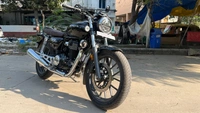
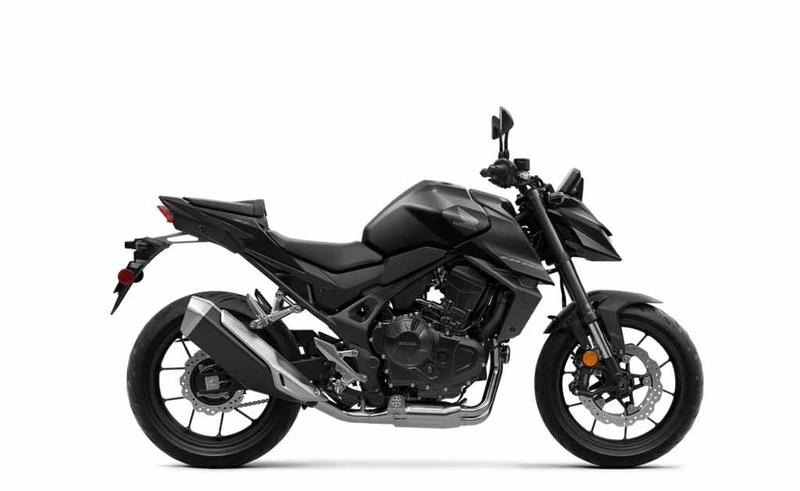
The CB500F follows a sharp, minimalist streetfighter design language. Its aesthetic is aggressive yet mature, characterized by a mass-forward stance, a sculpted fuel tank, and a compact tail section. The all-LED lighting system, including the headlight, tail light, and indicators, not only lends it a modern look but also significantly enhances visibility during night rides. However, when it comes to electronic features, the CB500F’s spec sheet appears dated for a 2024/2025 model. The instrument cluster is a negative LCD unit that, while legible, lacks the functionality and visual appeal of the full-colour TFT displays found on many competitors, including those at a lower price point. It displays essential information like a speedometer, tachometer, dual trip meters, fuel gauge, and gear position indicator, but there is no Bluetooth connectivity, turn-by-turn navigation, or smartphone integration.
Practical features are limited to the essentials: a Honda Ignition Security System (HISS) immobilizer for theft protection and an Emergency Stop Signal (ESS) function that automatically flashes the hazard lights during sudden, hard braking. The absence of riding modes, ride-by-wire throttle, and a USB charging port feels like a significant omission in this competitive segment.
safety
Honda has equipped the CB500F with a robust, albeit basic, safety package. The primary safety feature is the dual-channel Anti-lock Braking System (ABS), which is now a standard expectation in this category. The system works independently on the front and rear wheels, preventing wheel lock-up during emergency braking on various surfaces. The confidence inspired by the braking system is high, thanks to the twin 296mm front discs—a superior setup compared to the single-disc systems on some rivals, offering better heat dissipation and resistance to brake fade during sustained aggressive use. An additional active safety feature is the Emergency Stop Signal (ESS), which enhances visibility to trailing traffic by flashing the indicators during sudden deceleration.
However, a glaring omission for a motorcycle in this price bracket in 2024 is the lack of a Traction Control System (TCS). Competing models, even at significantly lower price points like the Triumph Speed 400, offer TCS as standard. This puts the CB500F at a disadvantage, as traction control is a crucial safety net on unpredictable Indian road surfaces, especially during monsoon conditions or on gravel-strewn tarmac. While the fundamental braking is excellent, the absence of this electronic rider aid is a definite compromise.
competition
The middleweight landscape in India is fiercely contested, and the CB500F faces strong rivals from multiple fronts. Each competitor offers a distinct proposition for a potential buyer, making the choice heavily dependent on individual priorities.
Kawasaki Z650:
Priced higher than the Honda, the Z650 is for the performance-oriented buyer. Its 649cc parallel-twin engine produces a much healthier 68 PS, offering a significant straight-line speed advantage. It also features a TFT display with smartphone connectivity, making it a more modern package.
Differentiator: Superior Engine Performance.
Triumph Speed 400:
This motorcycle has completely disrupted the market. Despite its smaller 398cc single-cylinder engine, it offers comparable power, a lighter chassis, and a far superior features list, including ride-by-wire, traction control, and a more informative display, all at a substantially lower price point.
Differentiator: Unbeatable Value and Modern Features.
Benelli Leoncino 500:
The Leoncino 500 competes directly on displacement and offers a unique Italian scrambler design that stands out visually. Its parallel-twin engine is known for its characterful exhaust note, appealing to riders who prioritize aesthetics and aural drama over clinical refinement.
Differentiator: Distinctive Styling and Sound.
buying advice
Who should buy it?
The rider upgrading from a 150-300cc bike who prioritizes Honda’s legendary refinement, reliability, and predictable handling over raw power and modern electronics. It’s an excellent, fuss-free tool for honing multi-cylinder riding skills, especially for those who value engineering quality above all.
Who should skip it?
The tech-savvy buyer seeking features like a TFT display and traction control, or the performance enthusiast who will find the Kawasaki Z650 more thrilling. Budget-conscious riders will find the Triumph Speed 400 offers a more compelling value-for-money proposition with more safety features.