1 Images
Exterior

Honda Elevate EV

4.3

Overall Rating

Rate & Earn ₹1000/-
The Honda Elevate EV is the upcoming all-electric version of Honda's mid-size SUV, expected to launch in India by mid-2026. It will likely feature a battery capacity between 40kWh and 50kWh, offering a driving range of approximately 400km to 500km on a single charge. Positioned to compete with the Hyundai Creta EV and Tata Curvv EV, this model will play a critical role in Honda’s plan to launch five electric vehicles in India by 2030.
18 Lakh*
Honda Elevate EV Key Specs
Fuel Type
Electric

Honda Elevate EV Variants & Prices

Filter By Fuel type & Transmission type

Elevate EV Elevate EV

18 Lakh*
Automatic, Electric

Honda Elevate EV Overview

user avatar
Salil Kumar
Updated on February 18, 2026

The Honda Elevate EV marks a significant transition for Honda Cars India as it moves toward a carbon-neutral future. While the internal combustion engine (ICE) version of the Elevate has established a presence in the mid-SUV segment, the electric version is part of Honda’s "ACE" (Advanced Compact External) project. This project focuses on adapting existing platforms to accommodate heavy battery packs and electric drivetrains specifically for emerging markets like India. The Elevate EV will measure approximately 4,312mm in length, maintaining its footprint in the competitive 4.3-meter SUV category. This segment is currently seeing high demand from urban buyers who require a family vehicle with high ground clearance and zero tailpipe emissions. The vehicle is expected to bridge the gap between Honda’s current hybrid offerings and its future dedicated EV line-up. Industry reports suggest that the Elevate EV will not just be a regional product but may also be exported to international markets, including parts of Asia and Europe, showcasing Honda’s manufacturing capabilities in India. By focusing on a familiar SUV silhouette, Honda aims to attract traditional car buyers who are looking to switch to electric mobility without compromising on the rugged road presence of a traditional SUV.

Battery and Motor

The Honda Elevate EV is expected to be powered by a front-mounted permanent magnet synchronous motor, delivering power figures in the range of 140 PS to 150 PS and torque exceeding 250 Nm. Reports suggest that Honda will offer at least two battery pack options to cater to different buyer needs. A smaller 40kWh battery pack could provide a city-focused range of 350km, while a larger 50kWh unit is likely to offer a claimed ARAI range of nearly 500km. The vehicle will support multiple charging standards, including AC home charging and DC fast charging. Using a 50kW DC fast charger, the Elevate EV could potentially charge from 10% to 80% in approximately 45 to 60 minutes. To enhance efficiency, the SUV will feature multi-mode regenerative braking, allowing drivers to toggle between different levels of energy recovery using steering-mounted paddle shifters. This setup ensures that the vehicle can handle both city commutes and occasional highway trips with minimal range anxiety. The electric powertrain will be tuned to provide linear acceleration, consistent with Honda’s focus on refined driving dynamics rather than aggressive performance bursts.

interior

Inside the cabin, the Honda Elevate EV is expected to offer a more premium and tech-heavy environment compared to the standard model. The primary focus will be on the updated infotainment system, likely featuring a 10.25-inch or larger touchscreen with wireless Android Auto and Apple CarPlay. Drivers can expect a fully digital 7-inch or 10-inch instrument cluster that displays EV-specific data such as battery percentage, real-time energy consumption, and regenerative braking levels. To improve the premium feel, Honda might introduce a new color theme for the upholstery, possibly using lighter shades or sustainable materials to reflect the eco-friendly nature of the vehicle. The interior space will remain a strong point, utilizing the 2,650mm wheelbase to provide ample legroom for rear passengers. However, the floor might be slightly raised due to the battery placement, which could marginally alter the seating posture. Features like a single-pane or panoramic sunroof, ventilated front seats, a wireless phone charger, and an air purifier are likely to be standard on higher trims. While the petrol Elevate offers 458 liters of boot space, the EV version may see a minor reduction in storage volume to make room for rear-axle components and charging hardware.

exterior

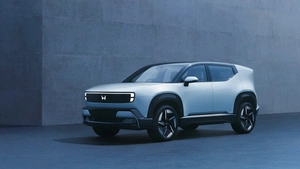
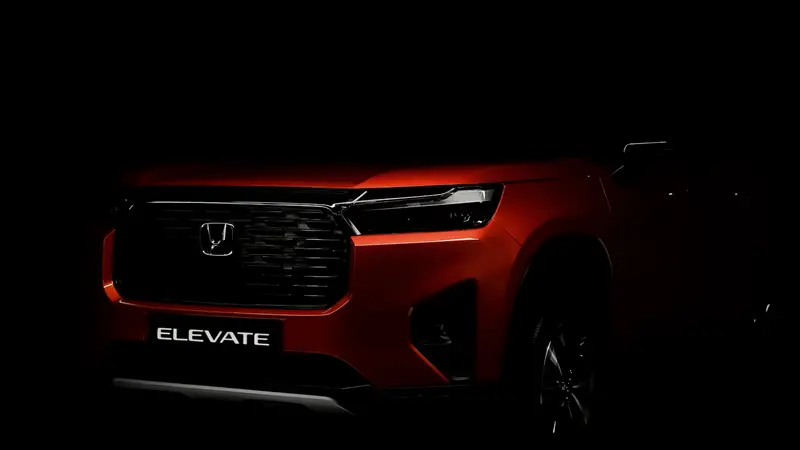
The exterior design of the Honda Elevate EV will likely retain the upright and boxy silhouette of the current ICE model while introducing several EV-specific styling elements to reduce aerodynamic drag. A signature change will be the front fascia, where the large radiator grille is expected to be replaced by a closed-off panel to improve airflow. This panel could feature a new "H" emblem with blue accents, signifying its electric nature. The LED headlamp setup with integrated DRLs is likely to remain, though Honda might introduce a full-width LED light bar across the nose for a more modern appearance. The side profile will continue to highlight the SUV’s 1,790mm width and 1,650mm height, but the 17-inch alloy wheels will likely feature a new aero-efficient disc design to maximize range. While the ICE Elevate boasts a class-leading ground clearance of 220mm, the EV version might see a slight reduction to approximately 190mm to 200mm to accommodate the under-floor battery casing. At the rear, the connected LED taillamp design will likely be carried over, potentially with clear lens housing and revised bumper inserts that eliminate exhaust cutouts. These subtle yet functional changes will ensure the Elevate EV looks distinct from its petrol-powered sibling while maintaining its tough SUV stance.

competition

The mid-size electric SUV segment in India is becoming highly competitive, and the Honda Elevate EV will face stiff competition upon its launch. Its primary rival will be the Hyundai Creta EV, which is also expected to launch in a similar timeframe with comparable range and features. Another major competitor is the Tata Curvv EV, which offers a unique coupe-SUV body style and a high-capacity 55kWh battery pack. The MG ZS EV, a well-established player in this segment, will also be a direct alternative for buyers looking for a proven electric platform. Additionally, the upcoming Maruti Suzuki eVX and its Toyota derivative will enter the market around 2025-2026, offering 4WD options that might challenge the Elevate EV’s front-wheel-drive configuration. Honda will need to rely on its reputation for reliability, cabin space, and suspension tuning to differentiate the Elevate EV from these established and upcoming rivals.

Honda Elevate EV Car FAQs

The Honda Elevate EV is expected to launch in the first half of 2026, possibly around August. It may be showcased at the Bharat Mobility Global Expo and will become Honda’s flagship electric SUV in India.
Upcoming Cars Content Upcoming Cars Content 100% 10 J4 The Honda Elevate EV is expected to be priced between ₹18–22 lakh (ex-showroom). A lower-spec variant may start around ₹15–16 lakh, while higher trims with ADAS and premium features could exceed ₹20 lakh. The Honda Elevate EV is expected to be priced between ₹18–22 lakh (ex-showroom). A lower-spec variant may start around ₹15–16 lakh, while higher trims with ADAS and premium features could exceed ₹20 lakh. Turn on screen reader support To enable screen reader support, press ⌘+Option+Z To learn about keyboard shortcuts, press ⌘slash
The Elevate EV will use a re-engineered ACE platform with a floor-mounted lithium-ion battery pack. It is expected to feature high-density, liquid-cooled cells, possibly LFP or NMC chemistry, marking Honda’s full transition to a dedicated BEV setup.
Honda Elevate EV