Ather Konarc
This EV charge calculator helps you accurately estimate your monthly charging expenses for any electric vehicle in India. By entering simple details like battery capacity, daily distance, and electricity rate (home or public), you get an instant and clear cost breakdown per km, full charge cost, and monthly expenses with no waiting time. It supports popular EVs like Tata, MG, Ola, Ather and more, with home tariffs around ₹6-10/unit. We have also added options to compare with petrol/diesel running costs. It will further help you plan budgets better, see huge savings (often 70-80% lower than fuel cars), compare charging at home vs public stations, track ownership costs, and make smarter decisions about switching to electric for daily commutes or long-term use.
Vehicle Type
Select Your Electric Bike
Monthly Charging Cost
₹0Ather Konarc News
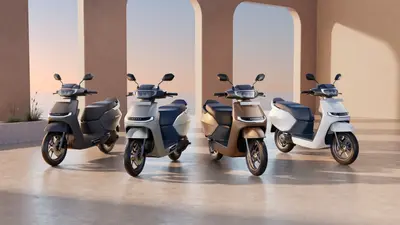
Ather Konarc Launched at Rs 99,999, New Platform and Up To 161 Km Range
Ather Energy has launched the Konarc, its first scooter on the new EL platform, starting at ₹99,999. It is a practical family scooter offering multiple battery options with claimed ranges from 100 to 200 km.
Arjun Nair
August 31, 2026
FAQs
What is the Ather Konarc, and how does it fit into Ather's lineup?
−The Konarc is Ather's entry-level electric scooter and the most affordable product in its current range. It sits below the 450 and Rizta families and is built on an entirely new EL platform designed for mass-market buyers rather than performance enthusiasts.
How many variants does the Ather Konarc come in, and what are they called?
+Six variants are available across two trim lines: the S line and the Z line. The S line is offered with 100 km, 125 km, and 161 km IDC range options. The Z line adds more features including AEBS and MagicKey. A 200 km variant is also confirmed but not yet available at launch.
What is the ARAI IDC certified range of the Ather Konarc?
+The S 100 km delivers 100 km, the S 125 km delivers 125 km, and the S 161 km delivers 161 km as per ARAI IDC certification. Ather's own TrueRange figures in SmartEco mode are 80 km, 100 km, and 130 km respectively.
What are the battery and motor specs of the Ather Konarc?
+Battery capacities are 2.1 kWh, 2.7 kWh, and 3.5 kWh across the three S variants. The S 100 km produces 4 kW and 16 Nm, while the S 125 km and S 161 km produce 4.7 kW and 16 Nm. All use a swingarm-mounted PMSM motor with IP67 protection.
How fast does the Ather Konarc charge?
+With the default 450 W on-board charger, the S 161 km takes approximately 5 hours 40 minutes to reach 80 percent. A combined 900 W charger is included standard on the S 161 km and cuts this to around 3 hours 10 minutes. Ather Grid fast charging is included from the S 125 km upward, adding approximately 15 km of range in 10 minutes.
What is the top speed of the Ather Konarc?
+All S variants share a top speed of 70 km/h.
Does the Ather Konarc have ABS or any advanced braking system?
+The S variants do not have ABS. The top Z variants get Ather's Advanced Electronic Braking System, which uses electronic control to reduce stopping distances and minimise rear-wheel lock-up. The S 100 km uses drum brakes at both ends, while the S 125 km and S 161 km get a 220 mm front disc with a rear drum.
What display does the Ather Konarc get?
+The S 100 km gets a 4.2-inch DeepView display. The S 125 km and S 161 km step up to a 7-inch DeepView unit. The Z variants additionally get Google Maps and WhatsApp on the dashboard.
What connectivity features does the Ather Konarc offer?
+Ather Connect with theft and tow alerts, Find My Scooter, remote charging status, ride stories, and OTA updates are included from the S 125 km upward, complimentary for three years. The S 100 km gets only basic Ather App access without the connected features. AtherStack Pro is available as an optional upgrade across all variants.
What is AirWalk and AutoHold on the Ather Konarc?
+AutoHold prevents the scooter from rolling on inclines and is standard across all variants. AirWalk allows the rider to walk the scooter slowly without using the throttle, useful in parking lots, and is available from the S 125 km upward.
What is MagicKey on the Ather Konarc Z?
+MagicKey is a Z-exclusive feature that allows the rider to unlock the scooter's boot through the Ather app instead of using a physical key. On the Konarc Z 161, MagicKey works with the AutoPop function, which automatically pops the boot open without needing a physical interaction.
How much underseat storage does the Ather Konarc have?
+All variants offer a 31-litre boot, which is competitive in the segment and can accommodate most full-face helmets.
When do Ather Konarc deliveries begin, and which variants come first?
+The S 125 km and S 161 km begin deliveries in mid-September in select cities, expanding across India in phases. The S 100 km is scheduled for Q1 2027, Z variants for Q2 2027, and the 200 km variant for Q3 2027.