1 Images
Exterior

MG 4 EV

4.3

Overall Rating

Rate & Earn ₹1000/-
The MG 4 EV is a premium electric hatchback expected to launch in India by mid-2026 with a price tag of approximately ₹30 lakh. It features a modern design, a range of up to 450 km, and a rear-wheel-drive setup. Positioned between the MG ZS EV and more expensive luxury EVs, it will compete with the BYD Atto 3 and the upcoming Hyundai Creta EV.
30 Lakh*
(Rumoured Price in India)
MG 4 EV Key Specs
Fuel Type
Electric

MG 4 EV Variants & Prices

Filter By Fuel type & Transmission type

4 EV 4 EV

30 Lakh*
Automatic, Electric

MG 4 EV Overview

user avatar
Salil Kumar
Updated on February 20, 2026

The MG 4 EV represents a significant step for JSW MG Motor India as it looks to expand its electric vehicle portfolio beyond the Comet, Windsor, and ZS EV. This global electric hatchback is built on the dedicated MSP (Modular Scalable Platform), which is designed specifically for battery-powered vehicles. Unlike converted internal combustion engine cars, the MG 4 EV utilizes a thin battery setup that allows for more cabin space and a lower center of gravity. In the Indian market, this car is expected to occupy the premium executive segment, catering to buyers who want a high-tech, performance-oriented electric car that is easier to maneuver in city traffic than a full-sized SUV. The car has already seen success in European markets, and its arrival in India in 2026 will likely coincide with the brand's push for increased local assembly at its Halol plant. By bringing this model, MG aims to bridge the gap between the ₹20 lakh and ₹40 lakh price brackets, offering a product that feels more premium than mid-range electric crossovers. The vehicle measures approximately 4,287 mm in length and has a wheelbase of 2,705 mm, making it comparable to mid-size SUVs in terms of interior legroom while maintaining a compact footprint for urban driving.

Battery and Motor

The MG 4 EV is expected to offer multiple battery and motor configurations to suit different price points in India. Globally, the car comes with two main battery options: a 51kWh LFP (Lithium Iron Phosphate) pack and a larger 64kWh NMC (Nickel Manganese Cobalt) pack. For the Indian market, the 51kWh battery is the most likely candidate for the entry-level variants, offering a driving range of approximately 350 km to 400 km on a single charge. The higher variants might get the 64kWh pack, which could provide a range of up to 450 km under Indian testing conditions. The motor is mounted on the rear axle, making it a rear-wheel-drive (RWD) vehicle, which helps in better weight distribution and handling. The power output is expected to range between 170 PS and 204 PS, with a peak torque of 250 Nm. This allows the car to accelerate from 0 to 100 km/h in less than 8 seconds. Charging performance is also a highlight; using a 150kW DC fast charger, the battery can go from 10% to 80% in about 35 to 40 minutes. For home charging, a 7kW AC charger will likely take around 7 to 9 hours for a full charge.

interior

The interior of the MG 4 EV follows a minimalist and modern approach, focusing on digital controls and physical space optimization. The dashboard is clean and horizontal, featuring a 10.25-inch floating touchscreen infotainment system that supports wireless Android Auto and Apple CarPlay. Directly in front of the driver is a 7-inch digital instrument cluster that displays speed, range, and ADAS alerts. One of the most unique elements is the floating center console, which houses a rotary gear selector and a wireless charging pad, leaving the floor area open for extra storage. The use of soft-touch materials on the dashboard and door panels is expected to give the cabin a premium feel compared to the MG ZS EV. Because the battery is placed low and flat under the floor, the car offers a completely flat floor for rear passengers, significantly improving middle-seat comfort. The boot space is likely to be around 350 to 363 liters, which can be expanded to over 1,100 liters by folding the 60:40 split rear seats. Other expected features include a 360-degree camera system, automatic climate control, and an air purifier, which have become standard expectations for Indian buyers in this price range.

exterior

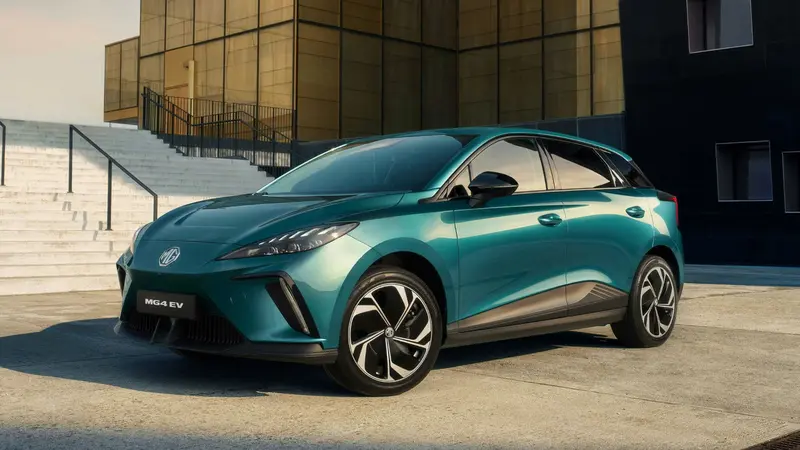
The exterior design of the MG 4 EV is sharp and aggressive, following an aerodynamic philosophy meant to maximize battery efficiency. The front profile is dominated by a sharp, nose-like design with sleek LED headlamps that feature a 6-bar vertical light signature. There is no traditional grille; instead, the car uses an active grille shutter system in the lower bumper that opens or closes based on cooling requirements to reduce drag. The side profile shows a sporty hatchback silhouette with a sloping roofline and a sharp character line running across the doors. It is expected to come with 17-inch or 18-inch alloy wheels with aero-covers to further improve wind resistance. The rear of the car is perhaps its most distinct feature, sporting a complex LED tail lamp assembly that runs across the width of the tailgate and features a unique 'Cygnus' pattern. A prominent dual-wing rear spoiler is likely to be included on the higher variants to provide better stability at high speeds. With a ground clearance of around 150 mm to 160 mm, the car sits lower than typical SUVs, but its short overhangs are designed to help it navigate standard Indian speed breakers without difficulty.

competition

Upon its launch in 2026, the MG 4 EV will enter a segment that is becoming increasingly competitive. Its primary rival will be the BYD Atto 3, which offers a similar premium experience but in an SUV body style. It will also face competition from the upcoming Hyundai Creta EV and the Maruti Suzuki eVX, both of which are expected to be priced in the ₹20 lakh to ₹30 lakh range. While the Creta EV and eVX are traditional SUVs, the MG 4 EV will position itself as a more sophisticated and better-handling alternative for those who prefer the driving dynamics of a hatchback. Another potential rival is the Tata Curvv EV, especially in its long-range variants. The MG 4 EV's rear-wheel-drive setup and dedicated EV platform may give it an advantage over rivals that are based on modified petrol-car platforms. In the higher price brackets, it might also see some cross-shopping with the base versions of the Hyundai IONIQ 5, although the IONIQ 5 remains a more expensive, luxury-oriented offering.

MG 4 EV Car FAQs

The MG 4 EV is expected to debut in India by February 2026, possibly at the Bharat Mobility Expo, with launch likely by mid-2026. Initial units may arrive via CKD for assembly at Halol.
The MG 4 EV is expected to be priced between ₹28–35 lakh (ex-showroom). The 51kWh base variant may start near ₹28 lakh, while the 64kWh top variant with ADAS could reach ₹35 lakh.
The MG 4 EV may use a localized LFP battery for India to improve thermal stability and reduce costs. Standard 51kWh and 64kWh packs are expected, targeting at least 350km real-world range.
MG 4 EV