
EMI Loading
Hero Electric Atria Key Specifications
Hero Electric Atria Variants & Prices
| Variant Details | Ex. Showroom Price | |
|---|---|---|
Atria LX25 km/Hr | 85 km/charge | 4-5 Hr | ₹ 77,690* |
Atria LX
Hero Electric Atria Comparison with similar Bikes
Pros & Cons of Hero Electric Atria
Things We Like
- No driving license or RTO registration required for use.
- Extremely low running and maintenance costs compared to petrol.
Things We Don't Like
- Top speed of 25 km/h is dangerously slow for main roads.
- Limited real-world range of 60-70 km per charge.
Hero Electric Atria Overview

Engine, Performance and Mileage
Engine, Performance and Mileage
The powertrain of the Hero Electric Atria is what defines its entire character and intended purpose. It is equipped with a 250W Brushless DC (BLDC) hub motor, powered by a 51.2V, 30Ah Lithium-ion battery pack, which translates to a total capacity of 1.536 kWh. This configuration places it squarely in the low-speed electric vehicle category, legally exempting it from registration and licensing requirements. Consequently, its top speed is electronically limited to a mere 25 km/h. Throttle response is calibrated to be gentle and linear, prioritizing safety for novice riders over brisk acceleration.
Performance is adequate only for flat, uncongested internal roads. On inclines or with a pillion rider, the 250W motor visibly strains, and momentum drops significantly. The claimed range is 85 km on a full charge, but a more realistic real-world figure would be between 60-70 km, depending heavily on rider weight and terrain. A full charge from empty takes approximately 4-5 hours using a standard home socket. This scooter is not designed for keeping pace with city traffic; it is a purpose-built mobility tool for short, predetermined errands within a residential or commercial complex.
posture comfort
posture comfort
Comfort and practicality are central to the Atria's proposition as a short-distance commuter. The single-piece seat is long, wide, and well-cushioned, providing ample support for the rider on brief journeys. The riding posture is upright and neutral, with an easily accessible handlebar and sufficient space on the flat floorboard for an average-sized adult. However, while the seat is long enough for a pillion, the scooter's 250W motor is not practically suited for carrying two adults; performance and range will be severely compromised. It is best considered a single-rider vehicle.
The seat height is low, making it accessible to riders of all statures and allowing for easy flat-footing at stops. Underseat storage is modest, largely occupied by the battery pack, and will likely accommodate a charger and small personal items but not a full-face helmet. There is a small glovebox at the front for added utility. The scooter's extremely low kerb weight is its most significant practical advantage, making it easy for anyone to handle, park, and move around without the engine on. This accessibility is a key selling point for its target demographic, which may include elderly riders or those new to two-wheelers.
handling ride quality
handling ride quality
The Atria’s chassis and suspension are engineered to complement its low-speed mandate. It employs a standard telescopic fork at the front and twin shock absorbers at the rear. Given the 25 km/h speed ceiling, this setup provides a reasonably compliant ride over minor road imperfections and speed bumps. However, the small 10-inch alloy wheels mean that sharp-edged potholes or broken tarmac will transmit noticeable jolts to the rider. The scooter’s primary dynamic advantage is its exceptionally low kerb weight of just 69 kg. This makes it incredibly agile and effortless to maneuver in tight parking spots or dense, slow-moving market traffic.
U-turns can be executed with minimal effort. Stability is not a concern at its limited top speed. The braking system consists of drum brakes on both the front and rear wheels, which is standard for this segment. While lacking the initial bite of disc brakes, they offer sufficient stopping power for the speeds the Atria is capable of. The inclusion of a Combined Braking System (CBS) is a crucial safety net, linking the front and rear brakes to provide more balanced and stable deceleration, particularly for riders who may not be adept at modulating brake pressure.
design
design
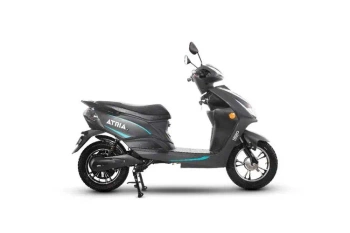
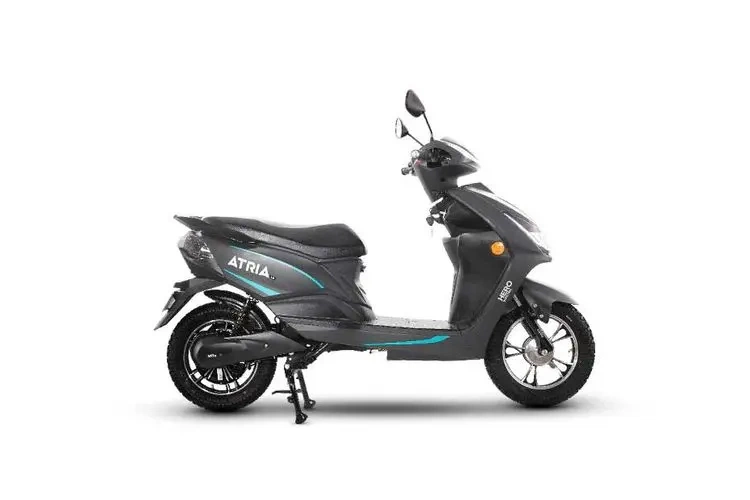
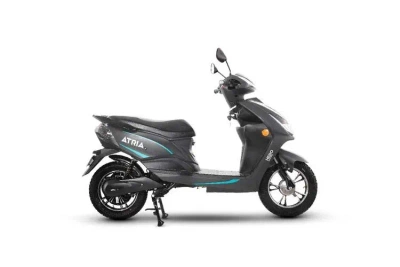
Visually, the Hero Electric Atria adopts a conservative and functional design language, reminiscent of traditional petrol scooters. The styling is unlikely to appeal to those seeking a modern or aggressive aesthetic; its focus is clearly on utility. The body panels are straightforward, with a large, comfortable-looking seat and a practical, flat floorboard. The lighting system is a notable highlight, featuring a bright LED headlamp and DRLs, which significantly enhance its visibility to other road users—a critical feature for a slow-moving vehicle. The instrument cluster is a simple digital unit that displays essential information such as speed, battery level, and an odometer.
In terms of features, the Atria is surprisingly well-equipped for its class. It includes a cruise control system, which allows the rider to maintain the 25 km/h speed without holding the throttle—a useful feature for short, clear stretches. A USB charging port adds modern convenience for charging mobile devices. Other practical additions include alloy wheels, which are more durable and visually appealing than steel rims, and a find-my-bike function to locate the scooter in a crowded parking area. These features add a layer of practical value to an otherwise basic package.
safety
safety
In the context of a low-speed electric scooter, safety is approached differently than in higher-performance vehicles. The Atria's primary safety feature is its inherent performance limitation—the 25 km/h top speed drastically reduces the potential severity of any collision. Beyond this passive measure, the most significant active safety technology is the Combined Braking System (CBS). When the rear brake lever is applied, CBS automatically engages a portion of the front brake, ensuring a more balanced distribution of braking forces.
This mitigates the risk of a front or rear wheel lock-up during sudden stops, a common issue for inexperienced riders using independent drum brakes. The scooter lacks Anti-lock Braking System (ABS), which is not legally mandated for this vehicle class. Visibility is another key safety pillar. The integration of a bright LED headlamp and LED Daytime Running Lights (DRLs) ensures that the Atria is easily seen by other motorists, which is crucial for a vehicle that will always be one of the slowest on the road. A side-stand engine cut-off switch is also included, preventing the scooter from moving if the stand is engaged. Overall, the safety equipment is appropriate and adequate for its legally defined operational envelope.
competition
competition
Okinawa R30:
The R30 is a direct, like-for-like competitor, also featuring a 250W motor and a 25 km/h top speed. It targets the exact same user base. Its primary differentiator is often its slightly lower price point and a more contemporary, sharper design language that may appeal to younger, license-exempt riders.
Ampere Magnus EX:
Priced slightly higher, the Magnus EX represents the next logical step up. Its key differentiator is performance. With a top speed of 50-55 km/h and a more powerful motor, it is a proper city commuter but requires a license and registration. It highlights the Atria's primary trade-off: convenience for capability.
TVS Scooty Pep+:
This is the quintessential petrol-powered rival. Its main differentiator is convenience and range. It offers a higher top speed (around 60 km/h) and can be refueled in minutes, eliminating range anxiety and long charging times. However, this comes with the burden of higher running costs, regular maintenance, and registration.
buying advice
buying advice
Who should buy it?
This scooter is purpose-built for individuals needing last-mile connectivity, such as students, senior citizens, or for errands within a large campus or gated community. Its no-license, no-registration requirement is its single biggest selling point for this specific demographic.
Who should skip it?
Anyone whose commute involves main roads, flyovers, or distances exceeding 15 km one way should avoid the Atria. If you need to keep pace with city traffic, carry a pillion regularly, or cannot wait 4-5 hours for a recharge, this is not the right vehicle.
Hero Electric Atria Specifications & Features
Engine & Transmission
| Motor Power | 0.25 kW |
| Starting | Push Button Start |
| Valve Per Cylinder | |
| Paddle |
Motor & Battery
| Drive Type | Hub Motor |
| Battery Type | Li-ion |
| Reverse Assist | |
| Transmission | Automatic |
| Battery Warranty | 3 Years |
| Swappable Battery |
Performance
| Top Speed | 25 kmph |
| average speed |
Chassis & Suspension
| Body Type | Electric Scooters |
Electricals
| Headlight | LED |
| Taillight | LED |
| Turn Signal Lamp | LED |
| Low Battery Indicator | |
| Projector Headlights | |
| Low Oil Indicator | |
| Low Fuel Indicator | |
| Pilot Lamps | |
| Drls |
Features & Safety
| Additional Features | Walk Assist |
| Display | |
| Traction Control | |
| Power Modes | |
| Launch Control | |
| Quick Shifter | |
| Adjustable Windscreen | |
| Engine Kill Switch | |
| Central Locking | |
| Real Time Mileage Indicator | |
| Service Due Indicator | |
| Switchable ABS | |
| Engine Immobilizer | |
| EBS | |
| Braking Type | Combi Brake System |
| Shutter Lock | |
| Internet Connectivity | |
| Airbag | |
| Fast Charging | |
| External Fuel Filling | |
| Seat Opening Switch | |
| I3S Technology | |
| Telematics | |
| Artificial Intelligence | |
| exhaust heat shield | |
| hazard warning indicator | |
| hazard warning lights | |
| high beam indicator | |
| malfunction indicator | |
| no of tripmeters | - |
| saree guard | |
| shift light | |
| stand alarm | |
| vehicle location tracking |
Underpinnings
| Suspension Front | Telescopic |
| Brakes Front | Drum |
| Brakes Rear | Drum |
| Wheel Size | Front :-304.8 mm,Rear :-304.8 mm |
| Tubeless Tyre | Tubeless |
| Tyre Type | Tubeless |
Warranty
| Mobile Application | |
| Vehicle Warranty | 3 Years |
| Roadside Assistance |
Hero Electric Atria Price in Cities
₹ 0.81 Lakh - 0.81 Lakh
₹ 0.81 Lakh - 0.81 Lakh
₹ 0.81 Lakh - 0.81 Lakh
₹ 0.81 Lakh - 0.81 Lakh
₹ 0.82 Lakh - 0.82 Lakh
₹ 0.81 Lakh - 0.81 Lakh
₹ 0.81 Lakh - 0.81 Lakh
₹ 0.86 Lakh - 0.86 Lakh
₹ 0.81 Lakh - 0.81 Lakh
₹ 0.81 Lakh - 0.81 Lakh